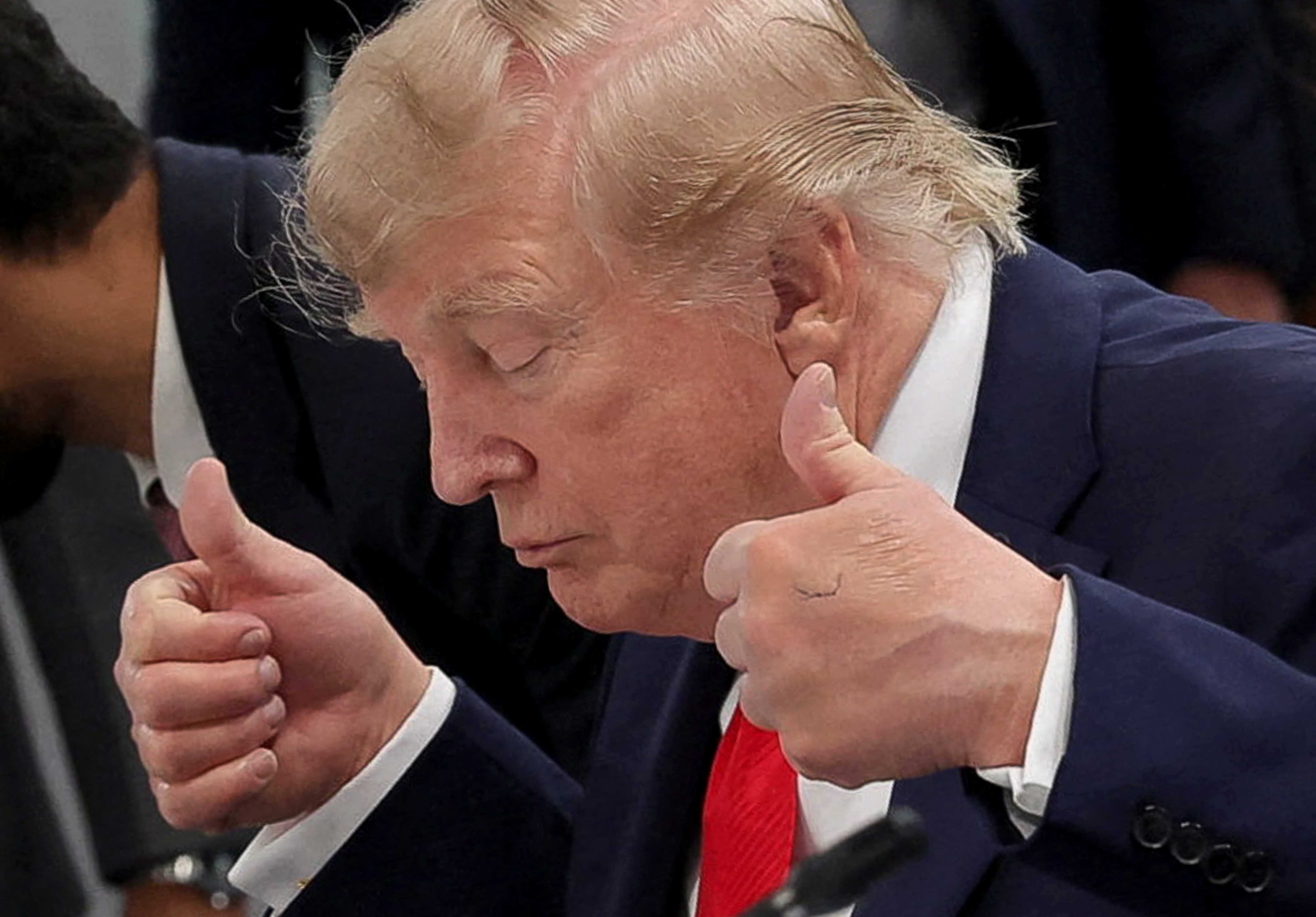
U.S. President Donald Trump gestures during a working session with G7 leaders and outreach partners on international investment partnerships at the G7 summit in Evian-les-Bains, France, June 16, 2026. REUTERS/Christian Hartmann
Dr. Germaine Odenheimer, M.D., a geriatric neurologist and professor emeritus at the University of Oklahoma College of Medicine, thinks something about President Donald Trump could be going on that falls outside the typical understanding of cognitive decline.
Odenheimer spoke to cult expert Dr. Steven Hassan on his podcast on Monday about Trump's timeline.
"Lying and behaving has been the same for a really long time," Hassan explained.
"The difference now is he doesn't have healthy, healthier people around him going, 'you can't say that' or 'you can't do that,'" said Hassan. He cited one example of Trump saying he pays his "people" a lot of money, and that they told him he "shouldn't say this, but I'm going to say it anyway." It was the comment Trump made during the GOP mini-convention in Dallas last month before Trump began dunking on Republican Senate Candidate Ken Paxton.
"I've always been concerned about his cognitive abilities long before this," said Odenheimer. "But they do seem to be much worse or much more obvious. People say, 'Well, then he's got dementia.' Well, that doesn't mean that he has dementia. He might. But they've also — the Supreme Court has taken all the guardrails away. So, he doesn't have anybody telling him what to do. So, we don't know how much of this increase in his, sort of, irrational, unhinged behavior is related to a change in his brain, which is possible. Or it's related to the fact that there are no guardrails anymore."
She noted it could also be a mixture of both.
What is certain, Hassan said, is that the guardrails have been "systematically disassembled over decades."
If Democrats take back the House and Senate, Odenheimer said that it's entirely possible that Trump could "interfere."
"You can count on it," Hassan cut in.
Hassan noted Trump's comments from the midterm convention saying that he's been elected three times, and Odenheimer explained that it's part of his understanding that if you repeat a lie often enough you believe it.
Hasan said that he recently spoke to a neurologist from UCLA who explained that neurons that "fire together, wire together."
"And it helped me understand the neurological basis for why repeating a lie over and over and over again starts getting believed," he said.
Odenheimer also noted that doctors exist in silos just as voters do, and it's one of her biggest concerns about medicine. One example she used was that a person would present with dementia, but had another disorder like diabetes or thyroid problems. Doctors would refer them to the dementia clinic, and she would argue that they're being impaired because they're likely not following the directions outlined in their health plan or medication.
"I think first of all people will point out gaffes that Trump has made, misspeaking, etc," she said. "But he doesn't always do that. Which makes me think there's something that's making him worse, and that's usually a medication, or, you know, kidney failure or whatever. He's probably not in kidney failure. It's probably medication is most likely but he might be taking something that doesn't allow him to think as clearly and so he misspeaks."
She said she'd watched his GOP speech, which was incredibly long and rambling, but nothing stood out to her as a specific language-skill problem. As people age, they become more "susceptible to the cognitive changes of medications than we were when we were younger."
She said his unsteady gait could also be due to medication. But because the White House doesn't release all of his medical information, there's really no way of knowing.
"So, there are a lot of unknowns. We don't know what meds he's on. We don't know his laboratory study results. We don't know the results of his cognitive testing, but it is suggestive that if they keep repeating cognitive testing on him, somebody's worried about him," said Odenheimer.