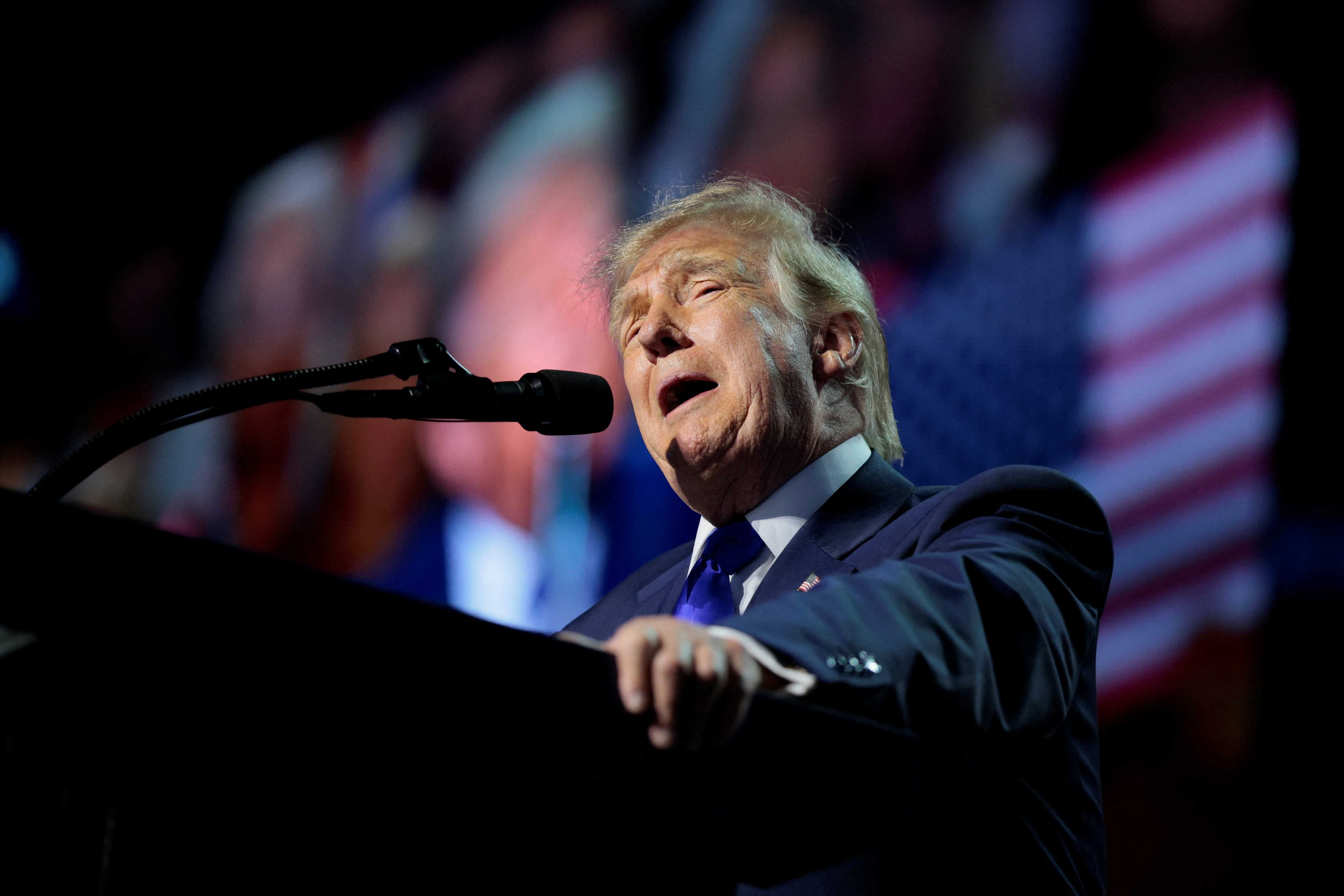
U.S. President Donald Trump speaks at the Republican National Midterm Convention in Dallas, Texas, U.S., September 9, 2026. REUTERS/Evan Vucci
President Donald Trump's latest tactic to build some of his decoration projects has been to claim that they're actually for the military. One report thinks that the strategy will backfire.
Writing for The Atlantic on Saturday, Janay Kingsberry noted that since announcing the project last year, the administration has been trying to bypass all of the regulations in place to get it built quickly before it can be stopped either by the judiciary, the legislature or a new president.
This week, on Thursday, the vice chair of the Advisory Council on Historic Preservation terminated the Section 106 review process for the proposed "Triumphal Arch" at Memorial Circle. Section 106 is supposed to make federal agencies listen to the public before moving ahead. That didn't happen for Trump's arch. Officials ended the review before talks were even finished and gave the public only three and a half business days to respond. Americans have until before 11:59 p.m. ET on Tuesday, Sept. 29 to email jloichinger@achp.gov about their thoughts for or against the arch.
A veterans group has been fighting against the arch, noting the numerous problems with it, such as the massive height with an "observation deck" would allow tourists to watch funerals at Arlington National Cemetery. Others can't stand the way it turns the view away from Arlington, which is meant to honor American soldiers who sacrificed their lives for their country, and instead makes it about Trump.
"In arguing against the veterans’ lawsuit," Kingsberry said, "the project’s lead agency, the National Park Service, said the arch did not need congressional approval because a 1925 law had already authorized a pair of columns on that end of Memorial Bridge, to symbolize the post–Civil War reconciliation of North and South."
Near Abraham Lincoln's Washington cottage are the first fallen U.S. soldiers, their headstones marking a sacred vow to keep America whole. Seeking more room for the dead, Northern troops occupied the estate of Mary Anna Custis Lee, wife of Confederate Gen. Robert E. Lee. The Lincoln administration seized the land through a forced tax sale, a move the Supreme Court later ruled illegal. Yet, the landowner ultimately bowed to the grave; with thousands of American defenders already resting eternally, the grounds were fully sold to the government.
A single sightline of stone spans the Potomac River, weaving American history from Lincoln’s temple of freedom across the Memorial Bridge toward Arlington’s hills. It is there that the marble headstones dot green hills, forever binding a broken republic back together from Washington, D.C., from the United States, to Virginia in the Confederacy.
Kingsberry wonders if a 25-story Trump monument is even truly plausible, given Trump is now painting it as a "military facility" where snipers will be stationed, drones propped and ammunition stored. First, it makes little sense because there's no populated area around it. There are no federal buildings to defend. It's already less than a mile from the Pentagon, Fort Myer and less than two miles, as the crow flies, from the White House, where Trump claims he's building another "military center" he can also use as a ballroom.
What is in the area, however, is the heavily restricted flight path of many planes that land at Washington's closest airport, DCA. Already in the Trump administration, military missions near the airport led to the deaths of 67 people on a commercial flight when an Army helicopter ran directly into it. Kingsberry thinks adding drones could make things even more dangerous.
Storing so much ammunition near publicly accessible monuments also creates its own problems, requiring strict military safety mandates.
Experts, such as Patrick Suermann, a Texas A&M construction-science professor and retired Air Force officer, told Kingsberry that ammunition storage normally requires protected “quantity-distance” zones, which are safety buffers intended to protect people and nearby structures in the event of an explosion.
If those rules apply, the public might not be able to safely approach the arch at all, despite being designed for tourists and including a "cafe" and "gift shop." The other problem is that Memorial Circle is a heavily traveled area. There are six bridges people take in and out of Washington to Virginia via road or rail. Following the requirements of a protected distance zone could mean cutting off Memorial Bridge entirely.
Recently, Trump has battled with his ballroom architect, who was talking about building codes. The Washington Post reported that Trump bellowed, "I am the code." There appear to be many codes Trump would be forced to adhere to for his arch.
In short, the military pivot may give critics more grounds to sue, force the administration into new reviews, increase costs beyond the already estimated $100 million and build an even greater opposition. Instead of speeding construction, combining a gift shop with an arsenal could turn Trump’s arch into a legal, logistical and public-relations disaster.