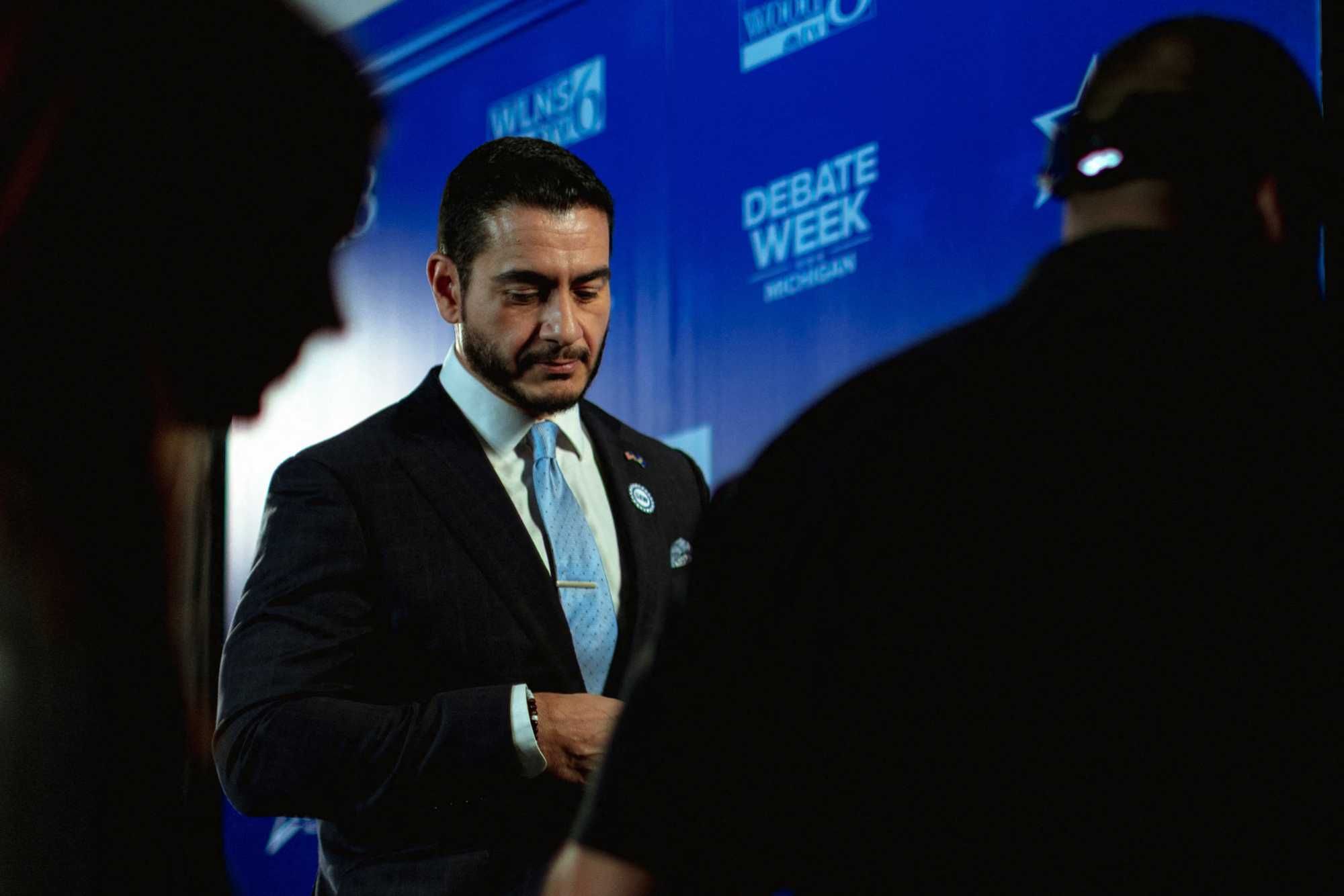
Democratic US Senate candidate Abdul El-Sayed leaves the spin room stage after speaking to the press following a debate with Republican rival candidate Mike Rogers, in Grand Rapids, Michigan, US, October 8, 2026.
The Michigan U.S. Senate race was always going to be a toss-up after primary voters elected Abdul El-Sayed. Longtime moderate Republican, former Rep. Mike Rogers (R) sought the seat with little opposition from other Republicans.
In the early hours of Wednesday, NBC News changed its prediction to say it's leaning toward an El-Sayed win, with 75 percent confidence. Much of the outstanding vote appears to be in heavily Democratic Wayne County, home to Detroit and Dearborn. The Decision Desk HQ called it for El-Sayed a little after 1 a.m. El-Sayed declared victory before 2 a.m. and Rogers sent his supporters home. At 2:27 a.m. NBC News called it for El-Sayed.
The New York Times polling aggregator has shown El-Sayed with a slight lead throughout the past several months, but it has always been within the margin of error. Rogers was leading for a time during the late Summer and directly after the GOP primary, but even his polling was never outside of the margin of error. The race came down to turnout and which party could get their side to the polls by Nov. 3.
Rogers was heavily pressed by President Donald Trump, who eagerly campaigned in the state, denying the affordability crisis and warning that the state of communism in America today was a greater threat than terrorism from 9/11 and both world wars.
NBC’s live coverage reported that Trump used the word “communist” or “communism” more than 10 times during roughly the first 45 minutes of the speech, while broadly attacking Democrats.
Trump's tariffs dealt a heavy blow to Michigan's auto industry, making car production significantly more expensive at a time when many Americans can't afford the increase. Taxes on imports for equipment, components, parts and especially aluminum and steel have raised prices. That gave automakers the choice of either absorbing the increase and cutting costs elsewhere or passing the costs on to customers.
Still, Trump told his July 27 audience of auto workers that he had “done more for you than your parents.” He did not explain how. According to Trump, Michigan auto workers had been "sold out and betrayed by globalist politicians and corrupt special interests." He then alleged that had he not been elected in 2024, there’d be "no auto industry." He never explained why.
Rogers began heavily recruiting Jewish Democrats, terrified by the reports they were hearing about El-Sayed. They feared that his rhetoric about Israel extended beyond a general dissatisfaction with the political leadership in Israel and associated all Jews everywhere with the country and its far-right leaders. The issues dogged El-Sayed throughout the race as he desperately tried to pivot to talk about the economy and affordability.
So, Rogers had an uphill climb to overcome the mountain of half-baked policy garbage that Trump left for the GOP to overcome. But he was able to bring over some select Democrats too afraid of their own possible persecution.
El-Sayed had to overcome more than mere allegations about anti-Semitism. Rogers began outright claiming that he was a member of the Muslim Brotherhood, an Islamist religious and political movement that the U.S. formally worked with over the past 100 years, particularly after the revolution in Egypt.
It was under Trump that in Jan. 2026, extreme sects of the Muslim Brotherhood were declared a terrorist organization by the U.S. The entire movement has not been labeled a terrorist group, however. Still, Rogers used it in a way that critics felt was a racist and Islamophobic dog whistle.
A conspiracy theory developed about El-Sayed's mother, who divorced his father when El-Sayed was just three years old. While she didn't raise him, he's maintained a positive relationship with her. El-Sayed's half-sister reportedly wrote in 2012 about their mother's activism with the Muslim Brotherhood in the 1970s, before El-Sayed was born. Critics then translated that into his mother being a member of a terrorist group. She then worked for a non-profit, the Islamic American Relief Agency, which the Treasury Department designated an association with terrorism in 2004. However, El-Sayed's mother left the job two years before that.
Rogers has said from the debate stage that her work with the group prior to the designation proves that it was not his mother a terrorist but that he was a secret terrorist.