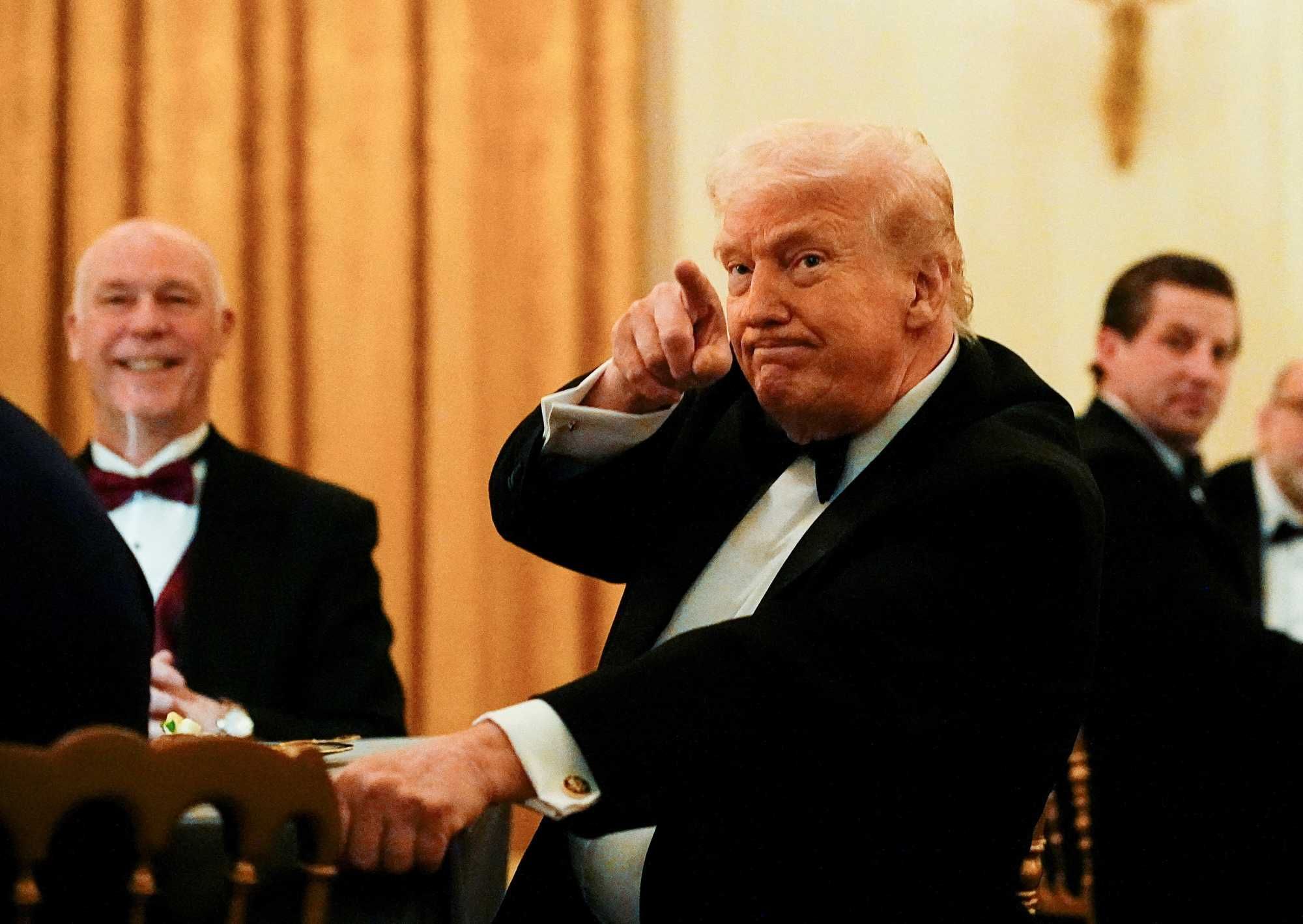
President Donald Trump attends a Governors Dinner at the White House in Washington, D.C., U.S., February 21, 2026.
Since starting his second term, President Donald Trump has earned between $1 billion and $2 billion off being in power, by far the worst profiteering ever committed by an American president. He also created a $1.8 billion slush fund for his supporters, and his children have used his foreign policy connections to make money on everything from Kazakhstan tungsten mines to an environmentally-protected island in Albania.
This is just the start. Trump and his supporters also reportedly have designs on Social Security, which recently ran a $2.5 trillion surplus, to allowing his cronies to take over the oil fields of Venezuela months after invading that nation without provocation. His tariffs also create what President Grover Cleveland described in 1894 as a "communism of pelf," a situation where he and his buddies profit from levying increased rates on imported goods while everyone else is left with higher prices.
None of this is normal. It is, according to one expert, a "kleptocracy," or a government in which those in charge blatantly steal from the people. It needs to be opposed whether you are a democratic socialist like Sen. Bernie Sanders (I-VT), a mainstream liberal like President Barack Obama, a mainstream conservative like President Ronald Reagan or a far rightist like commentator Tucker Carlson.
To better understand our kleptocratic status quo, AlterNet spoke with Dr. Karl Widerquist, a Georgetown University in Qatar professor who specializes in distributive justice and has written fantastic books like The Problem of Property: Taking the Freedom of Nonowners Seriously, A Critical Analysis of Basic Income Experiments and Economics for Social Workers.
This transcript has been lightly edited for length, context and clarity.
MATTHEW ROZSA: I've spoken to experts who are concerned that, for lack of a better word, looting is what they have in mind, namely that Trump and his cronies plan on privatizing Social Security into cryptocurrency and other vehicles from which they can personally profit while the American taxpayer gets screwed. Do you share that concern?
DR. KARL WIDERQUIST: Yes. From the level of corruption I've seen in the Trump administration, I certainly think they would want to do that.
ROZSA: How can the ordinary American citizen understand this? Because I find that when discussing this as a journalist, it is frequently difficult to translate these complicated issues into layperson's terms.
WIDERQUIST: Okay. Social Security has basically been a promise that the generations made to each other for 90 years now, that each generation, the workers will produce goods and we're gonna just give elderly people money to buy them. And they don't have — the elderly people don't have to do anything back for those people who are producing them. Then when they retire, they're gonna get some money and they'll buy that from the next generation. That's been a promise. There is no savings in Social Security. There's very, very little. What we're saving really is a promise. We're just saving the promise to spend this money for elderly people. If they start taking the money out of the trust fund — it's just in bonds, which all bonds are as a government promise.
If they start taking the money out and putting it into private investments, even good ones, not necessarily corrupt ones, what that is doing is putting the risk — it's lowering the promise that we give to elderly people, putting a risk on them. Hey, if the markets go up, maybe you'll do pretty well in retirement, but if the markets go down, the loss is on you. We're not promising to take care of you when you're elderly. A lot of private pensions have gone that route. And a lot of elderly people are not as well off as they were when we had defined benefits pensions, when private companies promised, "We will take care of you in retirement until you die." And now they're saying, "Well, we'll give you a little bit of money now.
You put that in some savings, maybe it goes up, maybe it goes down, then you're on your own. We forget about it." That's what privatization, Social Security — it means not only that, but it also means a chance for government cronies to make money off, which is corrupt enough. We've got donors, so-called donor class, giving these bribes we call campaign contributions to Congress. And then Congress makes laws, "Okay, we're gonna put the Social Security Trust Fund in your investment." That's corrupt enough. But now when you just have people, "Well, I'm the president and we're gonna put it — we're gonna have people invest in the stuff that I'm selling, even though it's stuff like Trump coin, it's likely to go to zero when he leaves office." That's just another level.
ROZSA: I now want to talk about a different subject in terms of economics, the tariffs that Trump has levied against Canada and a number of American longtime trade partners. Before I discuss the economic impact, I have a much simpler question. How can you contextualize Trump's protectionism within the broader paradigm of American economic history?
WIDERQUIST: Well, the United States used to be the leading industrial producer in the world, and it switched to being a leading financial economy and lost a lot of its production leading at around the same time. Part of that was inevitable. I mean, part of the reason we were such a leading economy was, in 1945, there were maybe four major industrial areas in the world, and three of them were in trouble because of bombings in World War II. We had the only one that was intact yet. The US is gonna lead the world. For the rest of the world to come back, the United States could never again have the dominance that it had in the 40s and the 50s. But the United States has fallen off in industrial capacity.
It's made enough with, with financial, when it's leading in financial stuff. A lot of things are owned here, a lot of management is done here, and a lot of banking and things like that is done here. Whether that's ultimately sustainable or not, to boost an economy that's doing less and less production, I don't know. But we are becoming just one of many powerful economic nations, not the only one, not the biggest one on the block. And it's sort of the pushback of a fading power is what we're seeing. He's trying to move around. And he's pushing back in really the wrong way. If you really wanna maintain US as an industrial leader, you invest in industry.
And instead, he's trying to bully people around and say, "Maybe we can squeeze a little more money out of people." That's not gonna work. He's already, in the first Trump administration, got Canada to revise the NAFTA treaty and let him put his name on it. Now he wants him to do it again. There's just so far you can push people, until they start to say, "Well, this is a matter of national pride, maybe national security, you're threatening to invade us and make us the 51st state. This is national security. We've gotta fight this with everything we have," which makes me think that Canada's bound to win because they're fighting for their lives. If what he means by the 51st state is true, we should take it seriously. There might be. Whereas what the US is looking for is money.
Well, we're losing money doing it. The method of doing this is, we're both gonna lose a lot of money in the short term. Well, we're likely to give up a lot more than a country that has good reason to believe it's gonna be internationally humiliated and maybe invaded if it is.
ROZSA: My next question is about the impact of these tariffs on ordinary consumers, particularly people who are likely to have voted for Trump, such as farmers. What is the impact?
WIDERQUIST: Well, the supply chains go back and forth across the border — you've gotta know what's going back and forth across the border. You've gotta really be an expert in very specific industries. Some goods might pass the border three and four times. You'd take oil from Canada and put it in a combine in the United States to make wheat, and you send it up to Canada for processing, send it back to the United States to sell it as food, not to mention adding a bunch of packaging who knows where. You have a really complex supply chain. So tariffs aren't as simple as these. Used to be it was our industries and their industries, put a tariff on their industries, that's gonna help our industries, at least in that sector.
But now that there's not really this identical — there's not so many identifiable sectors. Like the automobile industry that's moving stuff back and forth from Canada all the time, you might be helping industries that are wholly contained in the United States, such as mining or something like that. They're probably gonna make a lot of profits, but there's only so much they can mine. So other industries that rely on mining — they're all paying more. So you're gonna help a few US industries a lot, and you're gonna hurt a lot of other US industries and consumers even more than you help those. So no, I don't see this as a good prospect for a lot of people who voted for Trump.
ROZSA: I appreciate, again, your thoroughness. Now I want to talk about how Trump has cut taxes for the rich. Republicans since the days of President Reagan have insisted that trickle-down economics is the way to create prosperity. Are you seeing any evidence of that or are you seeing evidence of the opposite?
WIDERQUIST: No, I mean, we've been trying trickle-down economics for going on 50 years now. And it's not trickle-down. The people in the middle and the bottom of our economic distribution are not much better off than they were 50 years ago, whereas our economy has doubled just since the '80s, 40 years. So we've got an economy that's more than doubled in 50 years, and almost all of that increase has gone to the top 1%. It hasn't trickled down. There's no reason to believe it's gonna start trickling down now. We need — if we want the middle-class person, the low-class worker, we want all Americans to share in this — we've gotta have redistributed taxation of the top 1%, tax them so they can't be using as many helicopters and buying as many houses that they do, to free up that land and those resources so the rest of us can buy them and share in this growth that every American has contributed to over the last half century.
ROZSA: Now my question is about what seems to be the kleptocracy that's in place. Trump has profited more than $2 billion since taking office. People who are close to the president have similarly made a killing. Would you argue that we are in a state of literal kleptocracy in this country?
WIDERQUIST: This is a kleptocratic administration. And it is surprising how many of his supporters are sticking with him on this. Usually when somebody goes this far, eventually they lose support. Since Trump appeared on the political scene, it was always about when he was going to go too far, and he went farther than anybody else into narcissism or just idiotic policies and never seemed to go too far. This level of blatant corruption that obviously hurts, largely in ways that are at the expense of his constituents. Sooner or later, this is gonna come home. I don't think he's gonna live to see it, at this point, the way so many people are sticking with him. It's things like Trump coin.
And that's just one of the most blatant examples. If you're super rich and you're buying Trump coin, you're getting access to Trump — you're actually buying something like that. But if you're just a Trump supporter and you're buying Trump coin, you're buying that because somebody you trust has told you that this is a good investment, and it's a terrible investment. But yet there are people holding onto their big losses on Trump coin, believing that somehow it's the Democrats that have made Trump coin go down the valley. Sooner or later, people are gonna figure this out. If you're doing stuff that isn't so obviously selfish, you can get away with this stuff for longer. Hitler did things that were more and more immoral and still kept his supporters, even grew his supporter base.
And people didn't really turn against him till he lost the war. And very often then a lot of the people that turned against him, lost him, turned against him, not for all those in world policies, but for losing war. And for this to really get discredited, he's gonna have to do something that really obviously hurts his own supporters. Getting a little bit of corruption here and there. Compared to the size of the US government, I suppose this is still too small. But sooner or later, people are gonna realize they didn't get what they wanted out of it. They might have gotten brown people kicked out of the country.
They might like that. But they're not getting the prosperity that they were promised that all these policies were written. As a matter of fact, a lot has been taken from it.
ROZSA: My next question is about how Canada plans on retaliating with targeted tariffs. The early reports indicate that they are going to go after people in states that are more likely to have voted for Trump. Do you believe that could be the tipping point that turns many of his supporters against him per what you discussed a moment ago?
WIDERQUIST: It's hard to tell because they could — well, they could blame Canada. They might blame Canada instead of blaming Trump for that. So it might not be. But I do believe that Trump will have to blink first because Canada can go to its people and say, "We're doing this to protect our nation from foreign bullying." And that people are getting united across the political perspective behind that. If Trump is going to people and saying, "We're doing this because we're gonna make more money," and we're making less money as long as this war goes on, both sides will make less money. Both sides will suffer economically. Canada has got a good reason to tell its people, "We gotta stick this out, this economic suffering, we gotta stick it out to win." The United States has, "Oh, we're gonna — you're losing money now, you're gonna make more money later." Well, if they don't start seeing that pretty soon, they're gonna have to abandon this policy.
Whether that'll lead to abandoning Trump is another question, but I do think they'll abandon this policy.
ROZSA: My next question is, you are an expert on universal basic income. Do you believe that the conditions created in America through Trump could make Americans more amenable to universal basic income? I'm thinking specifically of how Trump keeps promoting AI.
WIDERQUIST: I'm not someone who thinks that it's AI that's gonna be the tipping point for basic income. I think we're long overdue for a basic income because the wealth of the world have just been taking and taking and taking from the less privileged of the world, the middle class and the lower class put together. The prospect that AI is gonna come and take all our jobs and then that's gonna make everybody say, "Aha, now we need basic income." I, sure, I'd like everybody to do that, but I'm not confident it will. There's a lot of other ways people could respond to it. I think more what's coming out of this is he's destroying so much of the existing liberal order — the neoliberal order — that people are gonna be open to new ideas.
They're not just gonna want to rebuild Lyndon Johnson's welfare thing. They're gonna be looking for new ideas, and basic income is one of those new ideas.