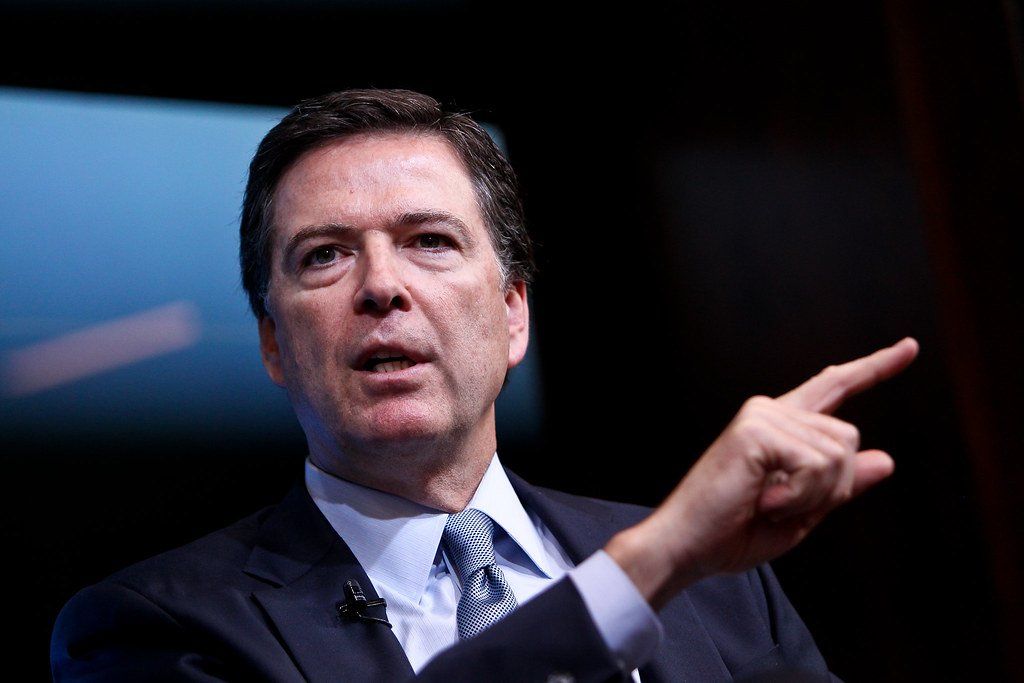
James Comey Director Federal Bureau of Investigation discusses the impact of technology on the work of law enforcement. Image via Brookings Institution/Flickr.
The Justice Department had ten years to indict former FBI Director James Comey for what it claims was his "disclosing classified information." So, why didn't they?
Former federal prosecutors Barbara McQuade and Joyce Vance both detailed in columns Wednesday that "the charges are fatally flawed — which the Department of Justice is either too incompetent to realize or too dishonest to care," as McQuade wrote.
As Vance pointed out, the crime they've claimed Comey violated "is 18 U.S.C. § 793, which covers crimes involving receipt, possession, transmission, etc., of National Defense Information." She said it should sound familiar because it mirrors the charges President Donald Trump faced for stealing classified documents when he left the White House in 2021. Trump then refused to return the documents.
The case became known on Monday when the court unsealed a document formally charging Comey. As with other recent indictments out of the Washington D.C. District Attorney's office, this one didn't go to a grand jury for a criminal indictment. A grand jury is required in most felony cases under the Fifth Amendment to the U.S. Constitution.
"Instead, it is what is referred to as an 'information,' a piece of paper signed by only the prosecutor. An information may be used for misdemeanor offenses, which do not have Fifth Amendment protections, or when defendants have waived their right to be indicted, usually when they are planning to plead guilty," said McQuade, noting she doesn't see it applying in either case.
Vance explained, "It used to be unusual for a grand jury to refuse to indict. Now it’s becoming increasingly common, and the government’s new move to bypass grand jury scrutiny altogether speaks volumes about the quality of the revenge docket cases DOJ is willing to bring to please the president."
The same happened in the recent case against former FBI agents who worked to protect the 2020 election from foreign interference.
Both legal eagles also wrote that there are statute-of-limitations issues. According to the Justice Department, they submitted the "information" filing because the statute of limitations was about to run out. If it's too late, they can't charge. It's a ten-year limit; however, there's a caveat.
“Except as otherwise expressly provided by law, no person shall be prosecuted, tried, or punished for any offense, not capital, unless the indictment is found or the information is instituted within five years next after such offense shall have been committed," Vance quoted, with her own emphasis.
However, it appears the DOJ wants to charge Comey with the 10-year espionage. Vance pointed out that the language there is very specific: “An indictment for any violation of title 18, United States Code, section 792, 793, or 794, other than a violation constituting a capital offense, may be found at any time within ten years next after such violation shall have been committed.”
The DOJ didn't secure a grand jury indictment for either the five-year or 10-year limitations. The DOJ filed only "information" in the case. That's why Comey's lawyers argue it should be thrown out.
But the DOJ claims other statutes allow limitations deadlines to be paused, so it should do the same here.
"It’s certainly a creative argument," wrote McQuade. "Neither party cites a case that directly addresses the issue, probably because no competent prosecutor investigating a prosecutable case has ever waited more than 10 years to seek an indictment." She expects the judge to throw it out based on the law's text.
But it prompted McQuade to ask how the DOJ messed up if it wanted to indict Comey so desperately. The Trump administration already knew about the situation, The New York Times reported. Comey corrected misinformation that appeared in reports, but "the subject was legally prevented from addressing itself."
McQuade said that if that's true, it seems to lack the sinister "willfulness necessary to be a violation of the Espionage Act." She said that most prosecutors wouldn't bring such a case. But this is the Trump Justice Department, which appears to be working through a list of foes, from former FBI agents to former Justice Department lawyers to former Trump White House staffers who testified at the Jan. 6 committee hearings. Even the Washington D.C. Bar Association hasn't been safe.
McQuade wondered if perhaps the reason they didn't go to the grand jury before their Oct. 5 deadline was "maybe they’re just inept. Maybe they were too busy carrying out the president’s other vendettas. Maybe they just lost track of the time."
Another possibility, however, is less able to be mocked. The DOJ may have known it couldn't persuade a grand jury because its evidence didn't establish enough facts to believe a crime was committed. "And if they are unable to establish probable cause to obtain an indictment, then they most certainly would be unable to prove guilt beyond a reasonable doubt at trial," McQuade said.
So, it's possible the DOJ pressed forward with the case it knew it couldn't prove. Then the prosecution itself becomes the punishment. This has been the allegation of the Trump administration's use of the Justice Department by legal scholars. Cases are being brought against Trump's enemies list not for the purpose of justice, or even to win a case, but to cost the individual money and to publicly attack them personally while using taxpayer funds to do it, as Just Security's Adam Klasfeld and Ryan Goodman wrote in late 2024 before Trump was even elected.