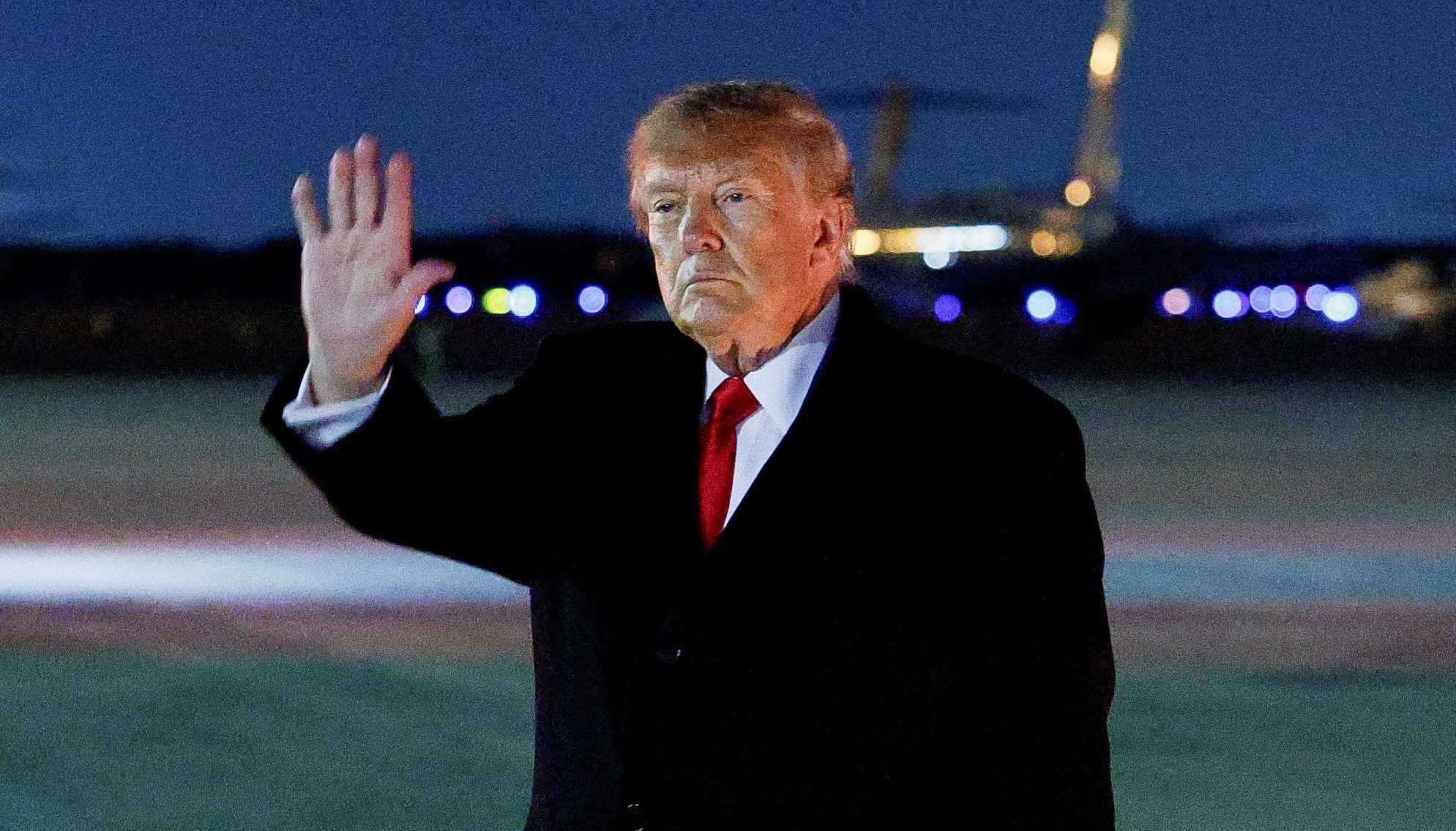
US President Donald Trump waves as he arrives at Joint Base Andrews following a campaign rall; REUTERS
Because Democrats captured key governorships and state legislative majorities across the country, they now have a realistic path to address the system that enabled President Donald Trump's first election: the Electoral College.
Instead of America electing its presidents through a straightforward majority, we use an indirect system. The Constitution created the Electoral College — which includes electors chosen by the voters in each state (and Washington, D.C) in accordance with their populations — to choose our president and vice president.
Yet there is a possible workaround to this issue, the National Popular Vote Interstate Compact, a complicated plan created two decades ago that if implemented at the time would have prevented Trump's rise in the first place. The downside is that it is a plan which requires the good faith of the participants and could be struck down by the courts. Its upshot is that if it overcame those obstacles, it would mathematically guarantee that America's president would always be the candidate with the most votes. It holds states that sign it to give their electoral votes to the presidential ticket with the most votes nationally. Because there are 538 electoral votes in total, the plan would work once states with 270 or more votes agreed to it.
To understand more about the National Popular Vote Interstate Compact and why it may soon become a reality, AlterNet spoke with the former US governor who officially kicked off the movement by ratifying it in his own state, Martin O'Malleyof Maryland.
The following interview has been lightly edited for clarity, context and length.
Why aren't presidents chosen by the popular vote?
ROZSA: In April 2007, you became the first governor to sign the National Popular Vote Interstate Compact, and Maryland became the first state to join. What made you want to go first, and what was the debate in Annapolis like?
O'MALLEY: Well, honestly, I give credit for that one to Birch Bayh, the former United States senator from Indiana, who was now a Maryland resident on the Eastern Shore. He came to me and made the pitch. This was something that he was pushing. Very accomplished guy; passed Title IX, among other things, as a United States senator. So we were just coming off of a tough election loss where the Democrats had won the popular vote but lost the Electoral College. And Birch Bayh pretty much said to me, "Look, we don't have to just curse the darkness. We can light a candle here, and hopefully other states will follow." And so that's what we did. We did a number of things in that first session, including raising the minimum wage and StateStat, and I forget the others. I think I sent you the [inaudible] from it. So in any event, I give Birch Bayh credit for that one. So, next question?
And I have followed it ever since. It's been encouraging to see how every year we get a little closer to the 270 electoral votes needed among the states to retire this institution, which no longer serves.
Why haven't we fixed this yet?
ROZSA: And can you explain in plain English how this would work, the way you'd put it to someone at a kitchen table?
O'MALLEY: Yeah. What I would say is, when a majority of states agree to abandon the Electoral College process and to pledge their votes to the popular vote winner, then the Electoral College will be no more. So that's what we're proposing: that instead of having this bizarre winner-take-all game board, we do it like other democracies do it, and the person that gets the most votes wins. [Laughs] People tend to understand that. It's only four times that the presidency's gone to a person that did not win the popular vote, but two of them have happened in these times.
ROZSA: I hate to correct you, but I think there were actually five. It was 1824, John Quincy Adams; 1876, Rutherford B. Hayes; 1888, Benjamin Harrison; 2000, George W. Bush; and 2016, Donald Trump.
O'MALLEY: So two of those five times have happened in our own time.
ROZSA: Yes. And the other three, by the way, were before the 20th century.
O'MALLEY: Tell me who those other three were again.
ROZSA: Adams Jr., Hayes, and Harrison.
O'MALLEY: Adams Jr., Hayes, and Harrison. Interesting.
ROZSA: When you signed it, did you think it would take nearly 20 years to get close to the 270 electoral votes it needs?
O'MALLEY: Did I think it would take nearly 20 years? I don't know. I'm not terribly surprised. In the crush of urgent things that governors and state legislatures look to accomplish, I can see where this one, unless the governor gets behind it, can kind of fall off the plate. So no, I'm not terribly surprised. We hoped by being a first mover that others would follow, but I can't honestly tell you that I thought it would happen. I certainly didn't think it was something that was going to happen in my time as governor, but I thought it was something that we needed to move towards, and Maryland's a state that, through most of our history, leads.