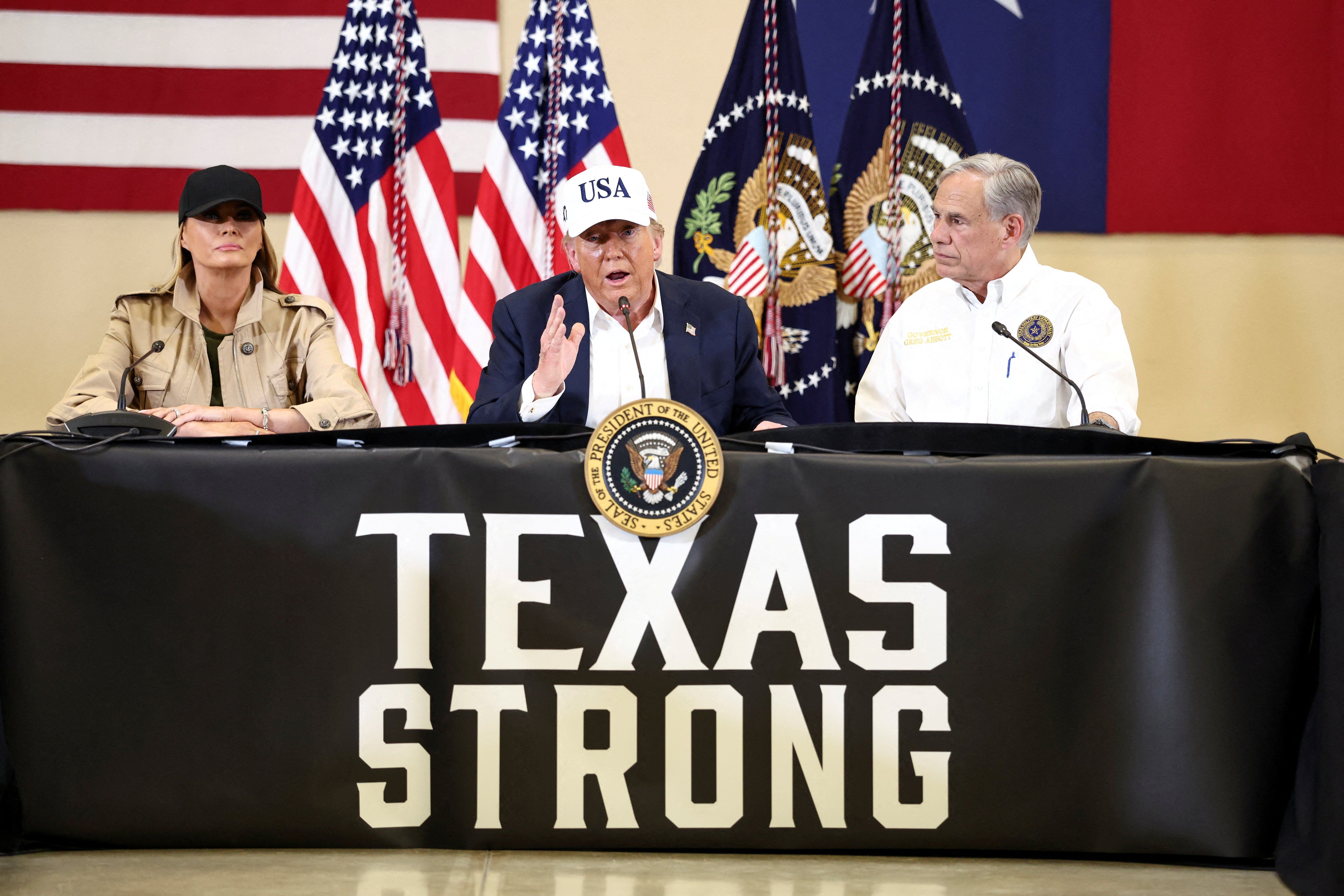
U.S. President Donald Trump, first lady Melania Trump and Texas Governor Greg Abbott at Hill Country Youth Center, in Kerrville, Texas, U.S., July 11, 2025. REUTERS/Kevin Lamarque/File Photo
It is now 38 days until the Nov. 3 election and the thought back in May was that there's really no chance of flipping as many as 40 seats in Congress, The Los Angeles Times wrote. It appears that thinking has changed.
Slate reported on Saturday that if Democrats vote in significant enough numbers and MAGA voters stay home, even in red states, safe Republican seats will end up close, if not flip entirely.
The adage has always been that, due to gerrymandering of congressional district lines, so many seats are drawn to ensure that lawmakers from either party can maintain their seats with little effort. In an election with poll numbers seen this month, that could change if the electorate matches the polling.
AlterNet has reported on the mistake that Texas made by redistricting its congressional lines based on 2024 election data. Now, however, even Republicans are warning incumbent lawmakers that they're probably further behind than they think.
The most recent Cook Political Report, released on Friday, shows the Republicans losing, but how much will determine how deep the GOP sinks.
"How deep will this red-state incursion go?" Slate asked. "Already, national Republicans have all but given up purple-state Senate races like Georgia and North Carolina, as more and more money will have to go to defensive measures in Texas, Ohio, Alaska, Iowa, and Kansas. Nebraska? Maybe South Carolina and Mississippi? As National Republican Senatorial Committee Chairman Tim Scott told GOP senators this week, senators in deep-red states need to run as if they’re behind so all resources can go toward the 'record number of toss-up races' on the map."
Last week, Larry Sabato’s Crystal Ball moved "eight races toward Democrats, including four previously thought to be safe GOP seats, on Wednesday—the latest warning sign for Republicans ahead of the November midterms," Newsweek reported.
Writing for The New Yorker,Susan Glasser said that for most of the summer Republicans assumed they'd lose some seats but it wouldn't be the kind of bloodbath they saw in 2018, for example. It was Trump's first midterm election, and he had 40 percent popularity. Democrats flipped 40 GOP seats that year. The question is what happens when Trump's approval is in the low 30s and he's even losing MAGA support.
It was once thought that voters only started paying attention to the elections after Labor Day. Candidates came back from August Recess vacations and really stepped on the gas of their campaigns. Republican pollster Lee Hartley Carter echoed the tendencies, but explained in a FoxNews.com op-ed that that didn't happen this year.
"And politics has developed a very bad habit of confusing the people who are paying the most attention with the people who will ultimately decide the election. We confuse loud with large," she said. The translation is that social media does not represent real life.
"A few thousand furious people can generate an enormous amount of internet. Millions of people wondering why their grocery bill is still so high can generate almost none," she wrote.
The Slate report cautioned that Democrats shouldn't get cocky, expecting they could win 50 GOP seats and take eight Senate races. But if they show up, even the GOP's huge money advantage won't matter.
"Trump will pull some gimmick with diesel prices, like an export ban, that will be terrible policy but might offer relief for a hot second. And many swing voters, while livid at Republicans, still do consider Democrats to be helpless freaks. But this week? Take in the GOP panic. Marinate in it," Slate writer Jim Newell encouraged.
Ultimately, in a wave election, individual skill and favorable partisan geography may not be enough. When voters want to punish the party in power, the wave can reach far beyond the seats everyone was watching, the report closed.