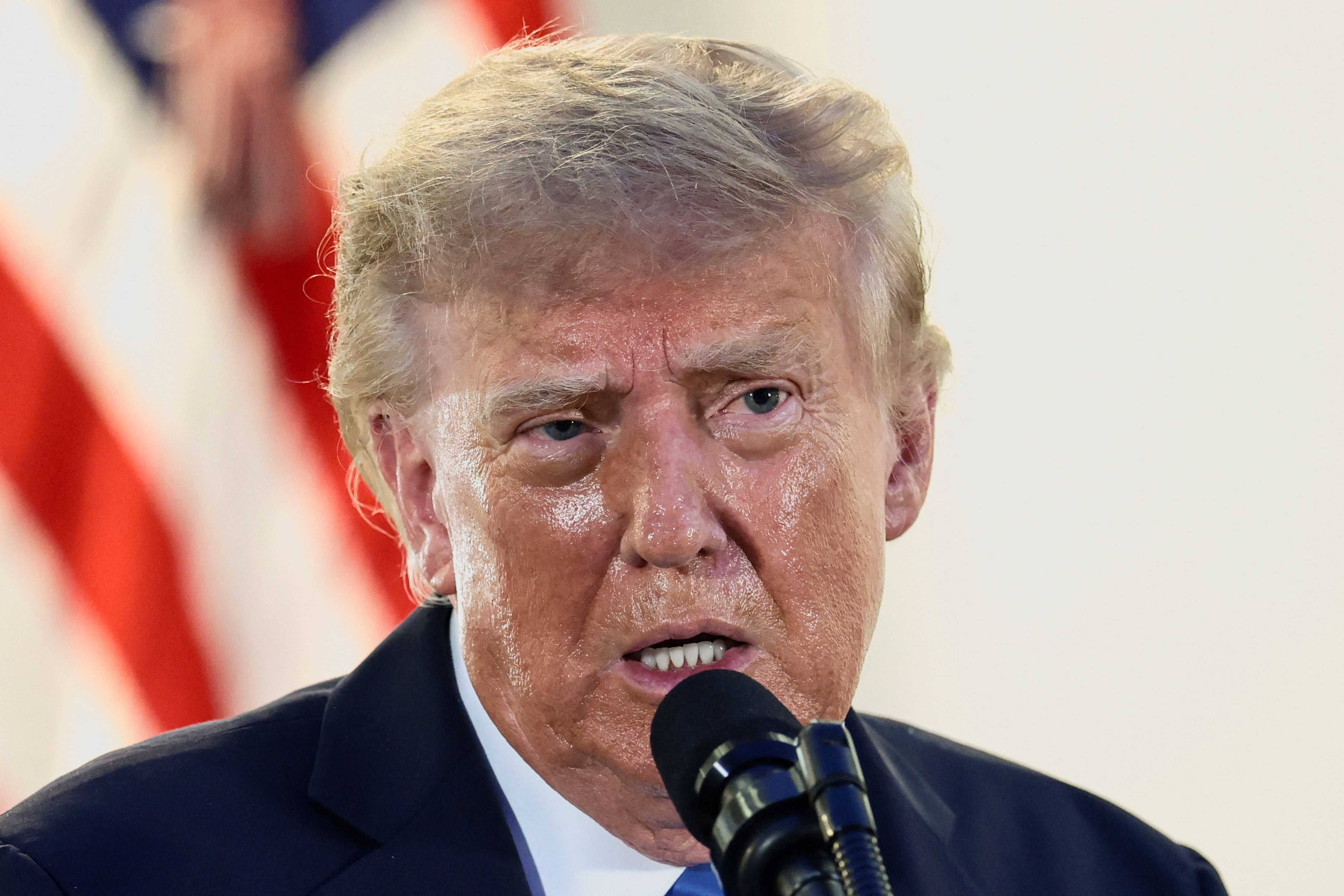
The Wall Street Journal editorial board penned a bombshell column late Monday where the board labeled President Donald Trump as the GOP's biggest liability.
The editorial began by remembering how angry Trump was after losing the 2020 election, particularly in Georgia, which had been a reliably red state until a colossal effort to register more voters and get them to the polls resulted in a Democratic victory. Instead of continuing his fight for the GOP, "Trump proceeded to make the races a referendum on his claim that the November election had been stolen."
The GOP turnout was so bad that Democrats won both seats.
It prompted them to question, "Is Mr. Trump about to cost the GOP the Senate again?"
Republicans can afford to lose no more than three Senate seats in November, but at least six races are now considered highly competitive. GOP seats in Alaska, Ohio, Texas, Iowa, Kansas and Nebraska are all vulnerable, while Michigan and New Hampshire appear to offer the GOP's its best pickup opportunities.
With the elderly president's approval rating hovering around 39.7 percent, Democrats have the wind at their backs. Trump is particularly unpopular on the economy and inflation. Immigration policies involving mass deportations, violence and harsh detention have also created political problems for Republican candidates.
In Maine, deportation roundups are hurting endangered GOP Sen. Susan Collins (R). Meanwhile, unpopular tariffs and high fuel and fertilizer costs are "making the Farm Belt a possible disaster for the GOP." It has turned Iowa into a competitive race.
"Republican Ashley Hinson, the party nominee for Senate in Iowa, is capable," the WSJ said. "But the mood in the state is negative as tariff retaliation has cost export markets, and fertilizer and equipment prices are rising."
Then there's the problem with Trump's targeting of reliably Republican lawmakers "who weren’t as deferential as he likes." Lawmakers like Sen. Thom Tillis (R-N.C.) could normally have kept his seat, even in a year hostile to Republicans. But Trump targeted him with public attacks, and the two-term senator threw up his hands and walked to the exit. It opened the door for a popular governor to step into the race for a likely pick-up.
The same thing is happening in Texas, where Sen. John Cornyn (R) voted with Trump 99 percent of the time. Still, he didn't seem as loyal as Attorney General Ken Paxton. Cornyn warned that Paxton wouldn't be a good candidate, but Trump ignored him and Paxton became the nominee. Now Trump is being forced to rush in and try to save Paxton.
"Paxton is now trailing Democrat James Talarico, forcing Republicans to spend millions defending a seat they might otherwise have held comfortably," the Journal said.
At the same time, Trump has been attacking Republicans for holding up his pet projects and trashing them for failing to pass whatever laws he demands.
"He rails against Majority Leader John Thune (R-S.D.)," the column continued. "As in Georgia in 2021, he’s giving conservative voters an excuse to stay home."
They wrote that Trump could very easily be at events all over the country talking about an increase in defense spending or what the Journal called "more government reform" and "pro-growth policies."
"Instead, he’s fixated on his Washington vanity projects, including the White House ballroom and the District of Columbia Trump Arch. Polls show these don’t matter to swing voters, who can be forgiven for wondering what Republicans want to do if they keep Congress," the editorial board complained.
They closed by saying that it seems that the GOP has decided the election will be between GOP capitalism and Democratic socialism, but none of that speaks to the mom at the grocery store trying to make ends meet after losing her healthcare subsidies.
"That might work if Republicans can pin specific radical policies or votes on Democratic candidates," the Journal said.
But even Trump doesn't seem clear on what socialism is, much less able to articulate the policies that Republicans can deliver after failing to do so for the past two years with the GOP controlling all three branches of government.
The Journal closed by saying that even Vice President JD Vance can't seem to help drag someone like Collins over the finish line. The board implores Trump to spend his $400 million campaign war chest to help save Republican candidates. But those who stand between Trump and his financial interests can end up in a battle against a powerful, combative adversary.