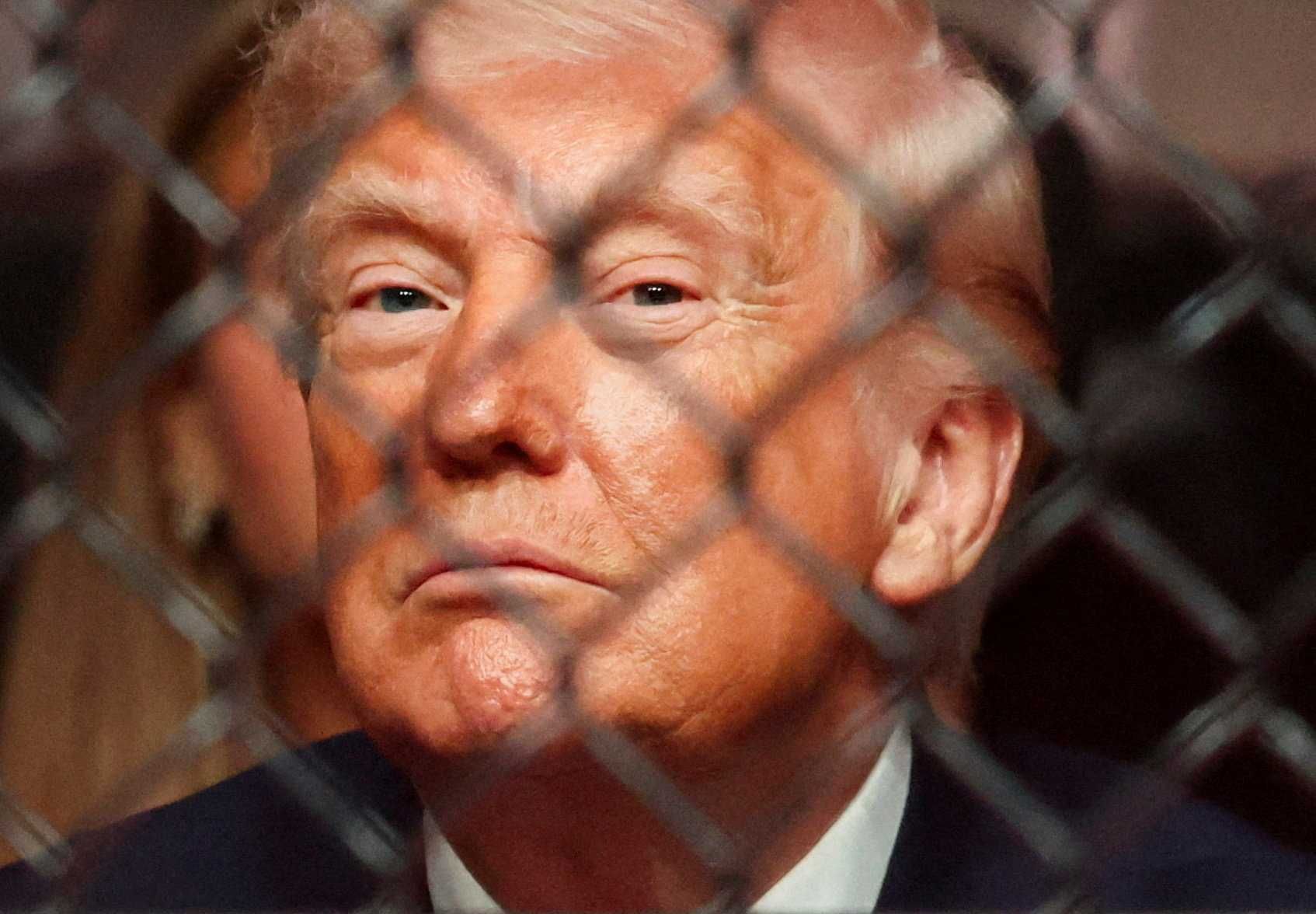
By installing an MMA octagon on the most symbolically charged turf in American democracy, Donald Trump is doing more than celebrating a sport. He is staging a vision of power in which the head of state no longer serves the nation – he embodies it, as a champion who dominates and subdues.
With his administration navigating one of the gravest international crises of his second term, Trump appears consumed by two preoccupations: his plans for a grand White House ballroom and the UFC fight event scheduled on the South Lawn for June 14th. He has compared the structure being erected – a 27-meter-high octagon called “The Claw” to the Eiffel Tower, and has suggested it might never come down.
The event was deemed significant enough that according to Politico, the G7 schedule was adjustedG7 schedule was adjusted to avoid a conflict.
Claiming ownership of national symbols
Organisers have framed the event as a patriotic and apolitical celebration of American history: between bouts, the UFC plans to air segments honouring national heroes, the nation’s founding, and the 250th anniversary of the United States. Yet none of the commemorations invoked actually fall on that date. The 250th anniversary of independence will be marked on July 4 2026; the flag’s 250th anniversary comes in 2027; and the Army’s bicentennial was already observed in 2025.
The only milestone that actually falls on June 14 is Donald Trump’s 80th birthday. Under the cover of national commemoration, the event functions first as a presidential birthday party – and a political and financial operation.
The broadcast will air on Paramount+, whose parent company was acquired in August 2025 by David Ellison, the son of Oracle’s co-founder and a figure closely associated with Donald Trump. The audience has been carefully selected: military personnel selected by the Pentagon under specific fitness criteria will serve as the televised backdrop. Trump has personally acquired shares in TKO Holding Group, the UFC’s parent company, which he has been promoting for months. This is not a sporting event honoured by the president’s presence. It is a presidential event dressed up as an MMA gala.
A long-standing fascination with combat sports
Trump has long been drawn to combat sports and the spectacle of violence – this despite having avoided military service during the Vietnam War through a diagnosis of bone spurs provided by a physician who was a family acquaintance.
In the 1980s, he cultivated close ties with professional wrestling’s WWE. In 2007, he staged a scripted showdown with WWE owner Vince McMahon in an event billed as the “Battle of the Billionaires”.
Professional wrestling operates according to the logic of kayfabe – a convention by which audiences are invited to engage with a narrative everyone knows to be scripted. This dynamic illuminates much about how Trump operates. He grasped early that politics worked on the same principle: he did not turn politics into spectacle, he revealed that it already was one.
The UFC, however, belongs to a different register. The fights are real. Trump’s interest dates to the early 2000s, when he hosted several UFC events at his Atlantic City casinos. Dana White, the UFC’s CEO, regularly recalls the support Trump allegedly provided when the organisation was still struggling for legitimacy. This closeness is not a recent enthusiasm – it reflects a long-standing relationship with a cultural world that has become central to a significant strand of the contemporary American right.
From civic hero to fighting champion
To appreciate the full weight of this choice, it helps to trace how the figure of the heroic American president has evolved. From the founding era onward, presidents have frequently been associated with a form of heroism – beginning with George Washington, whose greatness derived not from force but from his willingness to relinquish power after victory. Lincoln embodied moral authority rather than military might. In the twentieth century, the president-as-hero – from Roosevelt to Eisenhower – drew legitimacy from the idea of service: suffering, sacrifice, putting the nation before oneself. The democratic hero existed to serve something larger than himself.
That model began to fracture after September 11, 2001. American political rhetoric gradually displaced it with the notion of toughness – hardness, resilience, the will to dominate.
The hero was no longer expected merely to serve; he was expected to win. George W. Bush landing on an aircraft carrier in a flight suit, already gestured towards this shift. But it was still largely stagecraft.
The poster released by the White House to promote the June 14th event illustrates this transformation in striking terms.
The historic Uncle Sam – the lean, austere figure created in 1917 for military recruitment posters – has been replaced by a hyper-muscled colossus rendered in an openly AI-generated aesthetic.
The title reads: “America Needs a Champion.” The image draws heavily on ideals of physical strength and masculine authority. Political scientists and gender scholars use the term ‘hegemonic masculinity’ to describe cultural ideals of male authority associated with strength, dominance and competitiveness.
Days earlier, Trump had posted his own image as Uncle Sam on his Truth Social platform. The transformation is complete: the champion no longer represents the nation – he personifies it.
In combat sports culture, the champion does not merely defeat his opponent – he submits him. Transposed into political metaphor, that describes precisely the relationship to power Trump is performing: less a vision of governance than a performance of dominance.
MMA as a political vehicle
This event is not just about imagery – it also reflects deeper shifts in American political culture.
Research has shown that the UFC has become a powerful vehicle for male socialisation, promoting a model of masculinity grounded in physical hierarchy and competition. In 2024, according to CIRCLE/AP VoteCast, 55 percent of men aged 18 to 29 voted for Trump – 14 points more than in 2020. The shift was even more pronounced among young Latino men.
The June 14th event fits squarely within this logic: consolidating a male electorate around an imagery of strength, at a moment when polling suggests Trump’s support is eroding. But the stakes go beyond electoral tactics. Unlike Putin or Kadyrov’, Trump does not enter the arena himself, he imports it to the White House to drape himself in the values it represents: warrior masculinity, physical hierarchy, and hyper-masculine dominance.
Power in a cage
The fight cage erected on the White House grounds is more than a publicity stunt. It reflects the logic of kayfabe, where performance stands in for reality and displays of strength replace lived experience. While the UFC celebrates the victorious warrior under the spotlight, the crisis with Iran highlights what Trump has been reluctant to confront politically: the human costs and risks of actual warfare.
The spectacle has inevitably drawn comparisons with Roman emperors and their gladiators. Yet Trump operates within a democracy where opposition remains visible and criticism can still be voiced openly. One source of his political resilience is his ability to absorb dissent into the spectacle itself. Outrage, denunciation and protest often become part of the performance, reinforcing the attention economy on which it thrives. This is a form of democratic kayfabe: politics that relies less on coercion than on the normalisation of spectacle.
The symbolic battle is not settled. Lawsuits have been filed in an effort to block the event, while the “No Kings” movement has planned demonstrations on June 14, presenting itself as the defender of the very founding principles the UFC fight claims to honour. Ultimately, the controversy raises a broader question beyond Trump himself: who defines the nation’s symbols and values – the leader who seeks to embody them, or the citizens who view resistance to power as a patriotic duty?
Jérôme Viala-Gaudefroy, Spécialiste de la politique américaine, Sciences Po
This article is republished from The Conversation under a Creative Commons license. Read the original article.