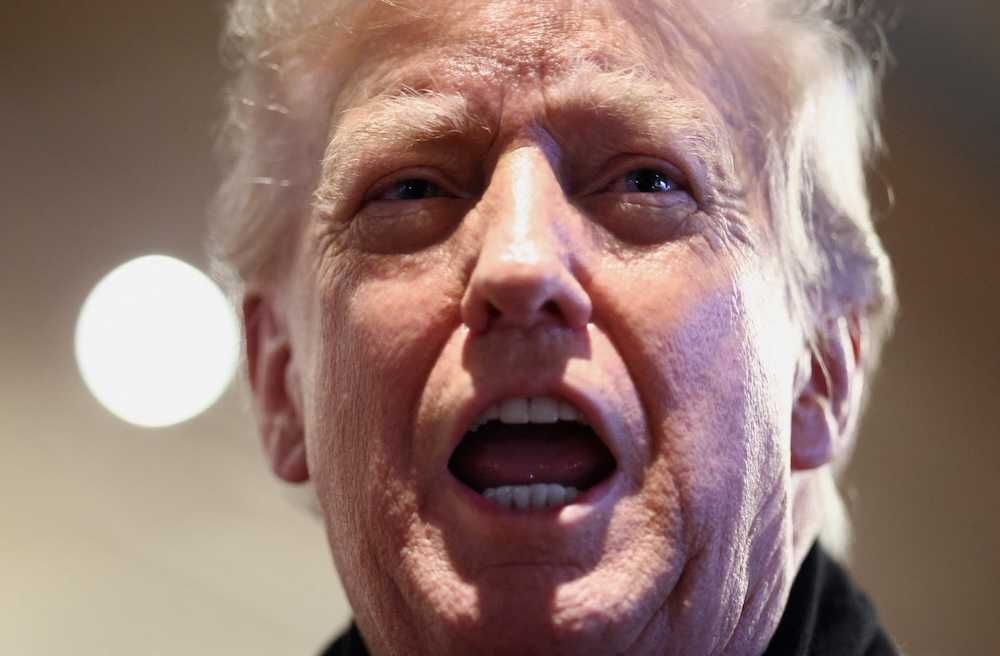
U.S. President Donald Trump speaks as he visits Machine Shed restaurant in Urbandale, Iowa, U.S., January 27, 2026. REUTERS/Kevin Lamarque
It was reported on Tuesday that the Justice Department was secretly giving a "settlement" to President Donald Trump after he dropped his own lawsuit against the IRS. Trump dropping the case means there can be no legitimate legal settlement. U.S. District Court Judge Kathleen Williams made a similar comment in her filing Monday.
"Because the Notice does not reference any settlement or include a stipulation of settlement, there is no settlement of record," she wrote.
Politico legal reporter Josh Gerstein uncovered a one-page document on the Justice Department website that shows a "sweeping release under which the IRS is 'forever barred and precluded' from pursuing 'examinations' of Trump, 'related or affiliated individuals,' and related trusts and businesses."
The DOJ demand includes “tax returns filed before the effective date” of the so-called "settlement" between Trump and the U.S. government.
But legal analysts were quick to object.
Legal reporter Chris Geidner called it "Unfathomable levels of corruption." He later added, "It's the underscore waiting to fill in the date that really does it for me."
He's referencing the document's date at the top of the page which was typed out "May _____, 2026." Then 19 was later added in.
Legal analyst Harry Litman pointed out, "New addition just inserted in settlement agreement: a promise that the IRS won't go after Trump, his companies, and his families for unpaid taxes. Potential huge additional cost to Treasury -- i.e., us -- all in exchange for, well, nothing, an uncognizable lawsuit."
"Todd Blanche sure angling for a blanket pardon for the crimes he's committing as AG," D.C. based journalist Brad Johnson wrote on BlueSky.
New Mexico civil litigator Owen Barcala posted a thread on the matter, explaining that the whole panel, "settlement," and agreement is an impeachable offense.
"I assumed we would never see the 'settlement agreement,' or whatever you want to call it, but evidently, DOJ went ahead and posted it on its website. A couple things are interesting if you can steel your mind for the outrage and horror of its general nature," Barcala began.
"It purports to be a settlement not just of the Trump v. IRS case, but other 'Pending Agency Claims.' This includes two Tort Claims Act claims that Trump has supposedly submitted related to the document search at Mar-a-Lago and the 'Russia-collusion hoax,'" he continued.
Barcala noticed that a paragraph defined "Lawfare" as the "sustained use of the levers of government power by Democrat elected officials." It is in the agreement "describing a settlement of Trump with himself so he can give his allies $1.8 billion is rich enough to make my eyes bleed."
"Must be nice to have figured out the One Neat Trick to avoid Congressional appropriations. Just sue yourself, direct yourself to settle for billions, and agree with yourself that you can put that money wherever you want," he fumed. "Entities can also make claims, making it possible that Trump Org could make a claim for the NY litigation. To be eligible for relief, you only have to make a 'legal claim' stating that you were a victim, presumably in some kind of crayon."
Criminal law expert Christian Mott wrote that the release language is specifically written to exclude the fund claim process.
"It seems like you'd only do this if you are anticipating that Trump will make a claim," Mott said. "The agreement also appears to allow Trump to continue pursuing his monetary damages claims through the Fund set up in the agreement. See Sec. III.B. So, he has effectively created a more favorable forum for himself, which is a huge benefit given that several of his claims were very weak."
"I know it's quaint to believe such things matter, but under 26 USC 7217 it's a crime for POTUS 'to request, directly or indirectly, any [IRS] officer . . . to conduct or terminate an audit or other investigation of any particular taxpayer,'" Lawfare's senior editor Eric Columbus wrote on BlueSky.
He then linked to the law, which discussed the "prohibition on executive branch influence over taxpayer audits and other investigations."
Law professor Brian Galle responded, "A question for all, and I do mean all, the individuals involved here to consider: aiding and abetting liability. While 7217 only prohibits 'applicable' persons, a non-prohibited person can usually be guilty of abetting acts by a prohibited person (think: felon in possession of a firearm)."
"This seeming technicality is potentially highly significant," he prefaced in another comment. "As we saw in my thread this am, 28 USC 1304 does authorize settlement payments (tho not on these facts, arguably). This takes us outside 1304 and into 'whoever cuts this check commits a federal crime' territory."
California state Sen. Jim Stanczyk (D) asked whether voters had Fifth Amendment standing for a due process violation because the government's spending violates the Constitution. It would be a "novel case," he conceded, but the administration also "misappropriated DoD funds earlier and DHS funds during the shutdowns. Who would have thought that Congress just allowing that to happen, the boundaries would get pushed more?"
He also added a comment about who could have standing to sue over such an agreement. In the wake of the 2008 big bank bailout, a law was passed under 12 USC Chapter 51.
"The law was written to 'protect taxpayers.' ... it seems it would have allowed taxpayer standing," said Stanczyk.