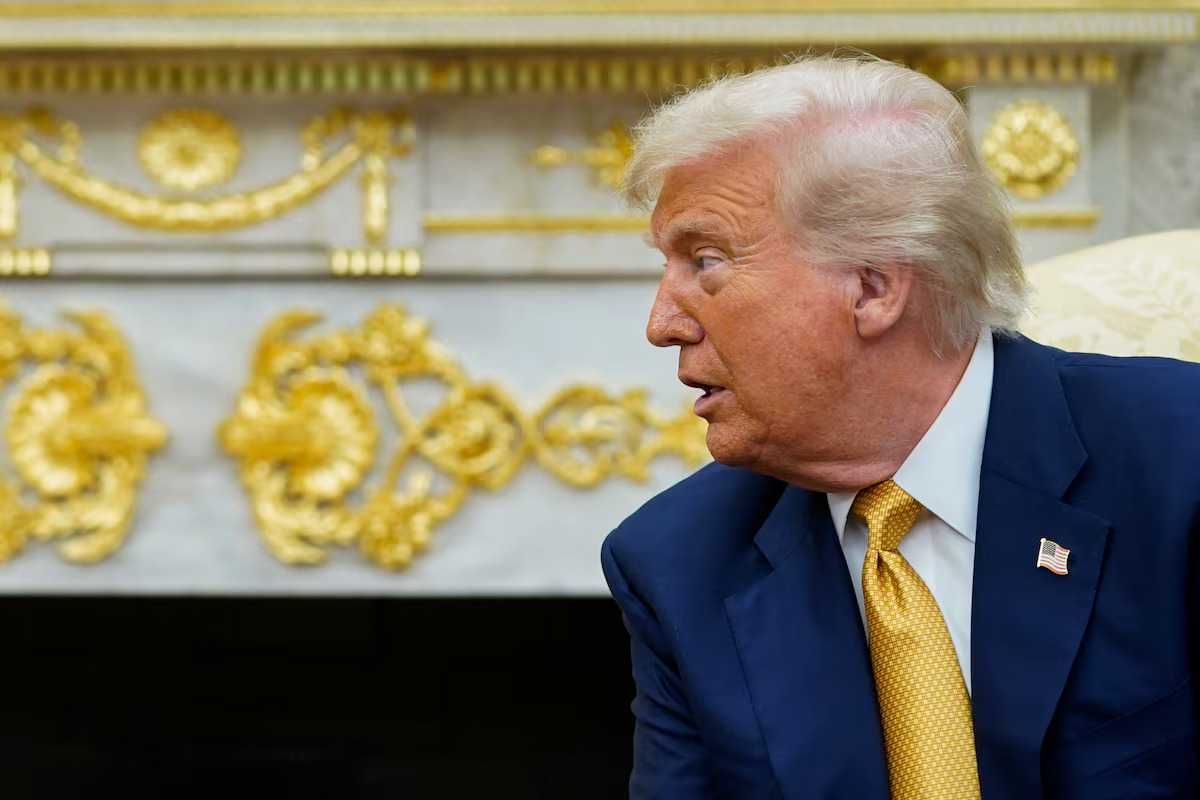
U.S. President Donald Trump speaks in the Oval Office at the White House in Washington, D.C., U.S., July 16, 2025.
Trump is trying to get his construction projects done before Democrats can stop him when they take control of Congress in two months after last night’s spectacular victories. There’s an urgent reason for that, from his perspective.
Monday afternoon, on the eve of the midterm election, Trump stood at the Lincoln Memorial Reflecting Pool and delivered his closing argument.
But instead of talking about healthcare, inflation, housing costs, education, or the challenges working families and farmers are facing as the result of his and the GOP’s policies, he went off on an extended, rambling rant about fountains, marble, the “arch,” and his other construction projects. And, repeatedly, about Corinthian columns.
As Barack Obama noted last week, Trump has an obsession with gluing gold-painted decorations to the walls of the Oval Office; Obama called it “arts and crafts.” He’s covering things with gold trim, gold gilded picture frames, elaborate ornamentation, and even regilding monumental statues in DC. He’s torn down the White House’s East Wing, is building a massive ballroom, is ripping up an historic DC golf course, and wants a triumphal arch.
What’s going on here?
Just ridiculing this as “arts and crafts” misses an enormously important aspect of what Trump’s up to; this isn’t simply the vanity of a former real estate developer who likes shiny stuff.
Historians will tell you that there’s a long and disturbing history of brutal authoritarian leaders, particularly fascists, being obsessed with architecture, massive construction projects, and remaking capital cities in their own images.
And now Trump’s doing it to America and few people seem to realize its importance.
— Adolf Hitler was obsessed with architecture; he spent countless hours with Albert Speer planning the transformation of Berlin into “Germania,” a gigantic imperial capital with buildings designed to dwarf anything built by previous civilizations. His proposed People’s Hall would have a dome nearly 1,000 feet high: Hitler wanted buildings so massive that ordinary human beings would feel insignificant standing before them, buildings that would last like the monuments of ancient Rome.
— Benito Mussolini did the same thing in Italy, demolishing historic neighborhoods in Rome to construct grand avenues and massive government buildings; he was deliberately invoking the architecture of the ancient Roman Empire, saying his fascist regime was the rebirth of Rome’s long-lost “greatness.” Future generations, he said, would see his buildings and remember his name and its imprint on the Eternal City.
— Joseph Stalin, who called himself a communist but ruled like a fascist, planned an enormous Palace of the Soviets featuring a gigantic, larger-than-life statue of Lenin.
— In Romania, dictator Nicolae Ceaușecu ripped up entire neighborhoods of Bucharest to build his enormous Palace of the Parliament, burning through billions while ordinary Romanians were struggling just to get through life day-to-day.
— And let’s not forget Louis XIV, the Sun King of France, who turned Versailles into a world-famous monument to his iron-fisted monarchy. It featured gold everywhere, elaborate ornamentation, massive ceremonial spaces and ballrooms, and was created to tell his subjects that he wasn’t just running France: he was France.
There’s a reason these men did these things, and it’s the same reason Trump is following in their footsteps.
Speeches and campaigns last moments to years; buildings and monuments can last for centuries, even millennia. They reshape how people experience the power of the state and its monarch, delivering his message long after their builders are dead.
Triumphal arches tell people that somebody conquered something, in this case Trump conquering Washington, DC. Covering the White House with gold tells average Americans that its resident is enormously wealthy and powerful, making the rest of us feel small, poor, and insignificant.
Collectively, their message is that the nation and its ruler are one and the same, and that’s precisely the message that Trump is trying to convey.
This is — quite literally — precisely what this nation’s Founders were trying to prevent. They’d seen the palaces of the European monarchs, were disgusted by their ostentatiousness, and had just fought a successful revolution against the most powerful among those rulers.
They intentionally created something radically different: a republic, where the sovereignty of the nation rested with its institutions and its people, rather than any one individual. The president was to be a temporary public servant: no individual was ever supposed to become synonymous with our nation itself.
George Washington famously endorsed that idea, voluntarily surrendering power after two terms, establishing the precedent of America’s president as a servant of the people rather than their ruler.
The White House was intentionally built to be modest; it was supposed to be the small-r republican opposite of Windsor and Versailles. The National Mall was designed to belong to the people, not a ruler who’d try to name parts of it after himself. They belong to us, not the guy living temporarily in the White House.
This is why Trump’s architectural obsession is far more dangerous to the future of our republic than his public admiration of Nicki Minaj’s ass, his grifting billions, or even the allegations of child rape that have been leveled against him.
Trump’s goal — like Hitler’s, Mussolini’s, Stalin’s, Ceaușecu’s, and Louis XIV’s — is to physically remake the symbols of our republic into symbols of his pseudo-imperial rule. He’s creating his own personal mythology and legacy in stone and concrete, replacing the institutional continuity and modesty that republican government is supposed to represent.
We’re witnessing what German philosopher Walter Benjamin wrote about when he noted that “fascism transforms politics into spectacle,” presenting grand displays of “national greatness” while stripping the nation’s people of their wealth, political power, and ultimately their personal freedom.
As Obama noted, while millions of Americans are struggling with the cost of housing, healthcare, groceries, transportation, education, and retirement Trump is treating us to rambling monologues about gold decorations, marble columns, triumphal arches, and gigantic ballrooms. It is, quite simply, a spectacle of “greatness” instead of the substance that government is supposed to provide to the people of a democratic republic.
Architecture defines history: while a president can be voted out of office, his buildings last forever. Replace a humble, inexpensive public golf course that many Black residents of DC love to use with an elegant “five star” course that only the rich can afford. Build ballrooms and arches and other monuments to Trump that will cause future generations to think such garish displays of wealth and power are a normal part of the American national identity.
When children grow up surrounded by monuments to kings, they learn that kingship is how things are supposed to be.
Citizens walking through public spaces that awe them and invoke one single leader take in an entirely different message about the meaning of America than those who visit spaces that celebrate constitutional government, remember democratic struggles, or memorialize national accomplishments.
This is why fascists and authoritarian rulers all the way back to ancient Rome have been obsessed with redesigning their capitals: they’re building a new political consciousness, reshaping the citizenry’s understanding of what it means to have the power to control that country’s government.
Like every fascist movement in history, Trump’s MAGA has long embraced the language of national rebirth, of a renewed “greatness,” of hostility to independent institutions that might check a leader’s power (it’s why he’s hanging banners with his face on them over our federal buildings).
This is why historians repeatedly draw this parallel between fascist movements and their obsession with architecture.
The danger to our nation isn’t that Trump loves gold; it’s that he’s using the power of his presidency to remake Washington DC in his own image, to normalize the idea that he’s bigger than the institutions and the nation he’s supposed to be serving.
Our Founders understood — and wrote repeatedly — that our republic depends on a culture in which our public officials know they’re the servants of the people, not the owners of the country. That culture is expressed in our laws and traditions but also — as the original architects of Washington DC, the Capitol, and the White House knew — our buildings and monuments.
Destroy those traditions and symbols, remake the architecture of the nation’s capital, and you rip down our republic without once taking a pen to the Constitution.
If we allow Trump to continue to transform our nation’s seat of governance into a monument to one man’s ego and power, we lose what took us a revolution and a civil war to establish: that America doesn’t belong to a king and doesn’t have a royal family.
It belongs to us.
The question that this new Democratic Congress now faces is whether they’re willing to defend that idea before Trump makes his fascist version of America permanent.
And whether, in the two months between now and then, the judges of America take heart and continue to stand up to this wannabe dictator’s fascist efforts to reshape our country and its capital.
Now the hard work starts.