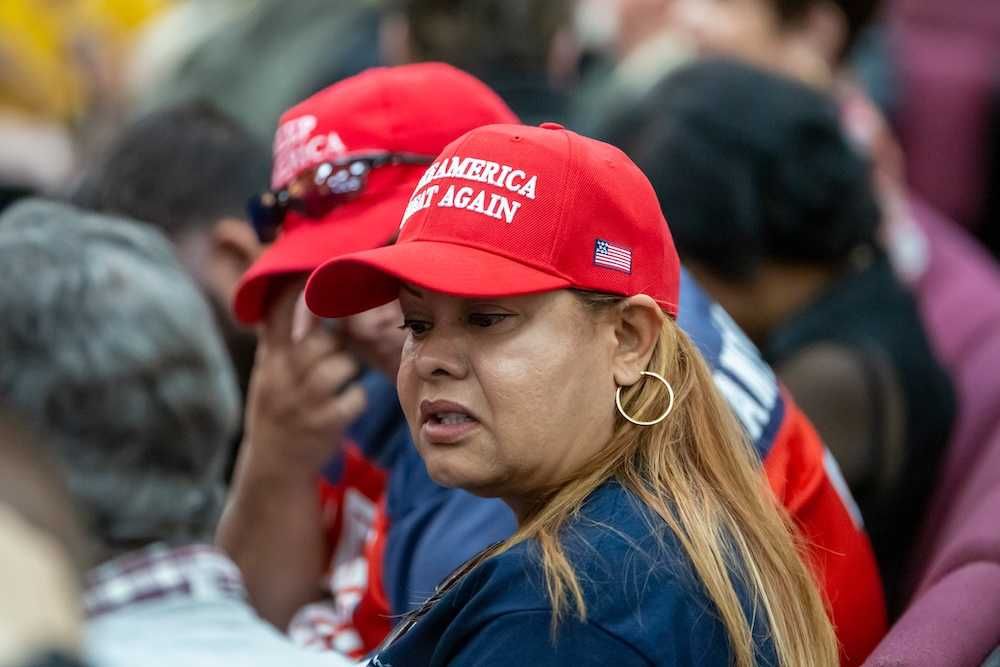
A woman wearing a MAGA hat at a "Latinos for Trump" event in Kissimmee, Florida on January 16, 2020 (Image: Shutterstock)
President Donald Trump continues to lose pieces of the coalition that helped get him elected in 2024, and he's starting to feel "betrayed."
The Washington Post reported that Trump's war in Iran is turning off his young male voters. A North Carolina focus group showcased some of these voices, who explained why they are breaking with the president after only a year in office.
These are individuals who voted for Trump in 2024, but who now say they are "exhausted" and "struggling to get ahead despite working multiple jobs." They're also "confused" as to why Trump went to war.
“I wouldn’t say it’s living,” James Wiest, a 23-year-old Republican, said about his life. “It’s survival.”
“I feel betrayed,” 26-year-old Joshua Byers told The Post after participating in the focus group of young voters near Charlotte, North Carolina. “I don’t know why we are fighting [in Iran] if we have never been attacked. I just don’t understand why.”
“The more these things actually have an impact on everything … the more shut down I want to be,” said Byers. “I just want to opt out of the system.”
“I don’t really want to vote anymore,” Byers said. “I’m really starting to just think it just won’t matter. … I don’t want to feel responsible for taking a vote and feeling misled, or misjudged, or making a wrong move.”
There were about two dozen young people in the state who cast ballots for Trump in 2024, which will be key for the midterm elections.
While Trump is focused on international issues, young people are worried about the economy. They can't get ahead. It's a constant scramble, particularly with the added cost of a college degree, the report said: "no longer [is] enough."
Lilly Burrow said, "I am not happy with him right now." After voting for Trump in 2020 and 2024, Burrow believed Trump when he promised: "there would be no new wars, and he said that gas would be below $3 a gallon." The teacher said that this "does change how I feel about Trump."
Republican Faith Peavey cast her ballot for Trump in 2024 with "caution." The Harris campaign seemed like a mess, she said.
“Did you mention that you were planning on attacking these countries? We are fighting the wrong battles," Peavey complained.
“It has definitely been frustrating to see him doing things that were not things he promised to do and not doing things that he promised to do,” she said.
Their attitudes aren't unique; the 18-29-year-old demographic is more likely to oppose Trump's war in Iran. It's more fuel to the fire of an already angry demographic. Just last month, a Post-ABC-Ipsos poll found 70 percent of 18-to-29-year-olds were unhappy with Trump's handling of the job. Just 29 percent approved.
Where it is likely to make a huge difference for the GOP is that many of the voters under 40 who cast ballots for Trump in 2024 are less enthusiastic about voting in 2026. Only about 51 percent say they are certain to vote, whereas 77 percent of those in the same age group who voted for former Vice President Kamala Harris will be casting ballots.
They are the kind of numbers that can make the difference between a rough GOP election and an absolute bloodbath.