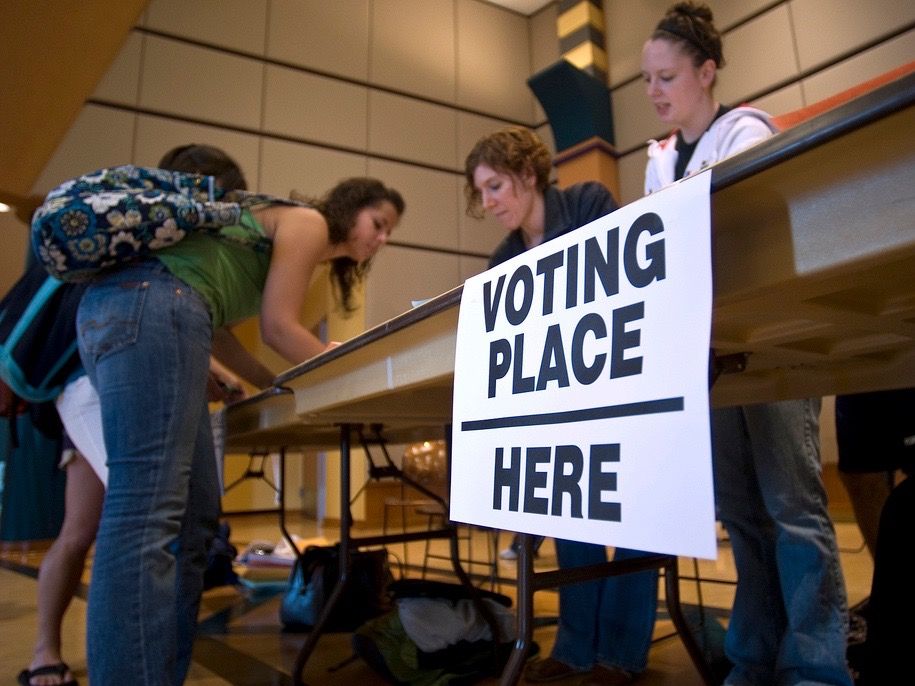
Polling Place: Photo via Reuters Meaghan Ellis
The Justice Department was in court on Monday after the Service Employees International Union (SEIU) asked the federal government for a temporary restraining order against threats to election workers.
SEIU along with AFSCME, the NAACP, LULAC and other allied groups are trying to stop the Department of Homeland Security (and DOJ) from pressuring California election workers to set aside ballots based on unproven claims that voters are noncitizens.
DHS claims one of its databases showed 20,000 illegal voters, but a small spot check revealed a very high error rate. Though this version of the case isn't about the list itself, it's about the workers, it did raise questions about the list.
Before the judge on Monday, "Law Dork"Chris Geidner heard Assistant U.S. Attorney Kenneth Kao admit the generated list wasn't entirely accurate. The judge questioned whether it was "fair" to say that the federal government's list had a "high" error rate. He agreed.
At one point, Judge Trina Thompson even asked whether the list was generated by artificial intelligence, and Kao said he had no idea how the federal government generated the list or what it did to ensure the list was accurate.
A federal judge has already issued a temporary restraining order blocking the list from being used to stop ballots from being counted, but the groups brought the DOJ to court to stop it from acting on its threats to arrest election workers who count the ballots from those individuals on the list.
Geidner posted a screen capture of the court filing, highlighting one sentence in particular.
"In this case, this Office has been informed that the United States has identified more than 20,000 individuals who appear to be registered to vote in California based on publicly available information at the time that information was received, but who, in the United States' view, are likely not U.S. citizens," the filing said.
"I think it might be physically impossible to wedge more hedge words in a single sentence," he said. "This is honestly one of the funniest, saddest legal sentences I've ever read."
Kao also requested that the ruling from the judge be limited to only the northern district of California and not the southern, but the petitioners' lawyers called that inappropriate.
The judge didn't rule from the bench as the hearing concluded. For now, California election workers can continue processing and counting ballots under state and federal law without facing federal prosecution threats tied to the administration’s voter-eligibility claims.
The California case is quickly becoming a major test of whether federal officials can pressure state and local election administrators during an active election.
While the DOJ hasn't said one way or another, the administration is likely to appeal whatever the lower court rules.