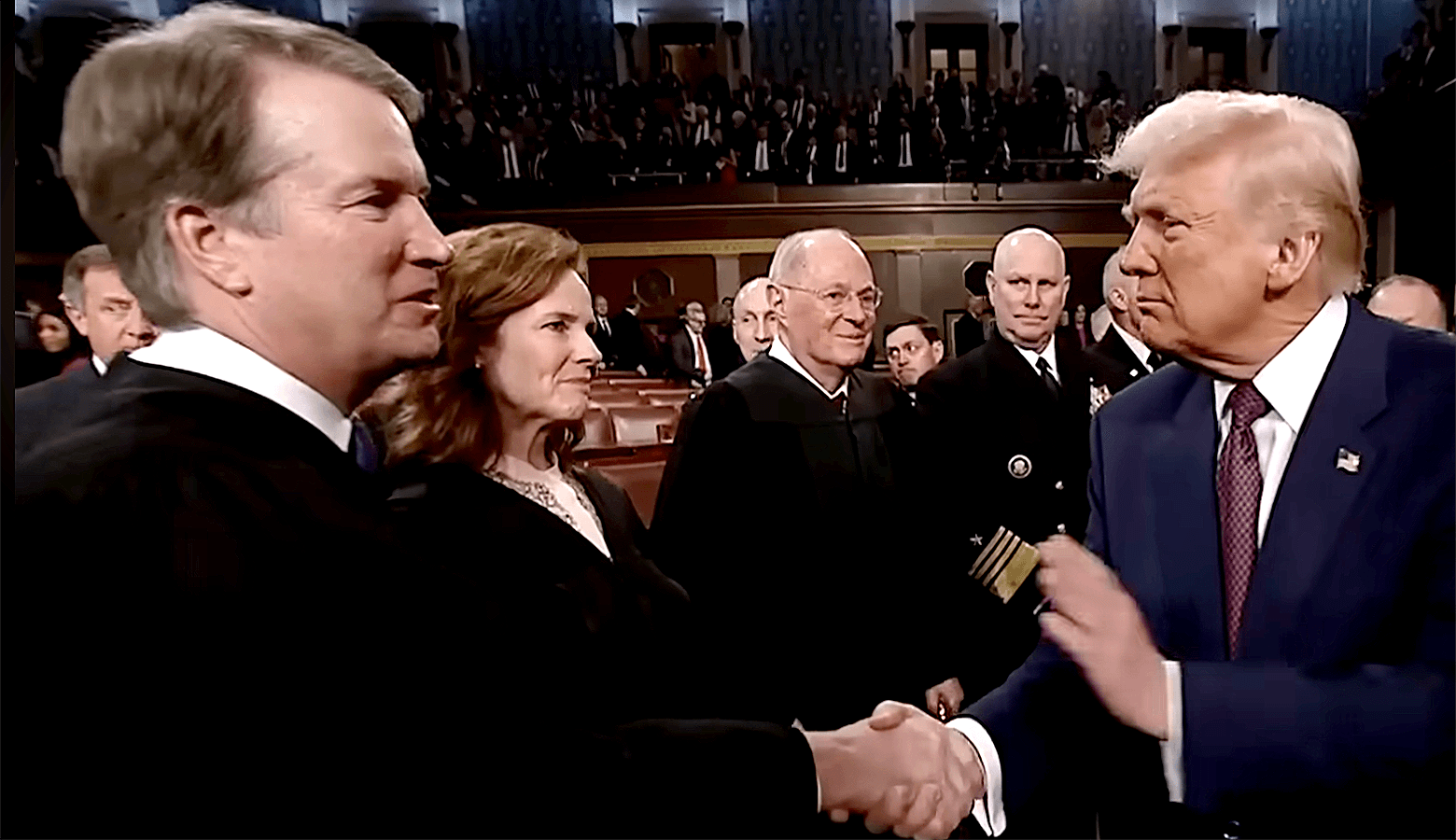
President Donald Trump greets Supreme Court justices after addressing a joint session of Congress, March 4, 2025. Image via Screengrab / PBS.
Nine months after the Supreme Court struck down President Donald Trump's initial round of tariffs, he is poised to reimpose similar levies under a different authority, The Wall Street Journal reported exclusively.
U.S. Trade Representative Jamieson Greer could announce the findings of a months-long investigation into foreign industrial subsidies as early as this week, according to people familiar with the matter, the Journal reported. They cautioned that the timing could change. The investigation looked into subsidies provided by China, the European Union and 14 other countries.
The tariffs would apply to most exports from those countries, including Japan, South Korea and the 27 member states of the European Union. But steel, aluminum and vehicles are likely to be excluded since those sectors are already under tariff through a separate national security authority.
Officials have said the administration plans to impose tariffs similar to those set by Trump in 2025, before the Supreme Court struck them down in February. Nations that made trade deals with Trump before the court's decision would likely face rates in line with those agreements. The European Union, Japan and South Korea would likely see rates at or below 15 percent, while countries like Vietnam and India may face higher tariffs.
China is expected to be hit harder than many other nations, the sources said. The administration may also include language that would allow it to increase tariffs if a country's industrial overproduction gets worse or if it fails to make policy changes in future negotiations.
The new tariffs will likely be layered on top of another round of tariffs announced by Trump in July. That order imposed 10 percent to 12.5 percent tariffs on 60 economies over their failure to prevent the trade of goods made with forced labor. That move is being challenged in court.
Greer has said that subsidies from foreign countries have led to excess industrial capacity abroad, which allows those countries to flood the world with inexpensive goods and undercut American producers. His office declined to comment on the matter, and the White House did not respond to the Journal's request.
The timing may work to Trump's benefit, the Journal reported, noting that the announcement "could help divert attention" from a controversy brewing around Nvidia CEO Jensen Huang and what the government knew about the company's alleged smuggling of advanced AI chips to China. Lawmakers from both parties have questioned the Trump administration's approach to China because of this issue.
That controversy deepened Monday, as Nvidia's board reinstated Huang and Trump told The New York Times his administration played a big role in getting him reinstated.
"The stock is up," Trump said.
Huang is expected to be asked about Trump's role when he testifies before Congress next week.