'America First' backfires as Trump policy hurts US business and helps China
19 February
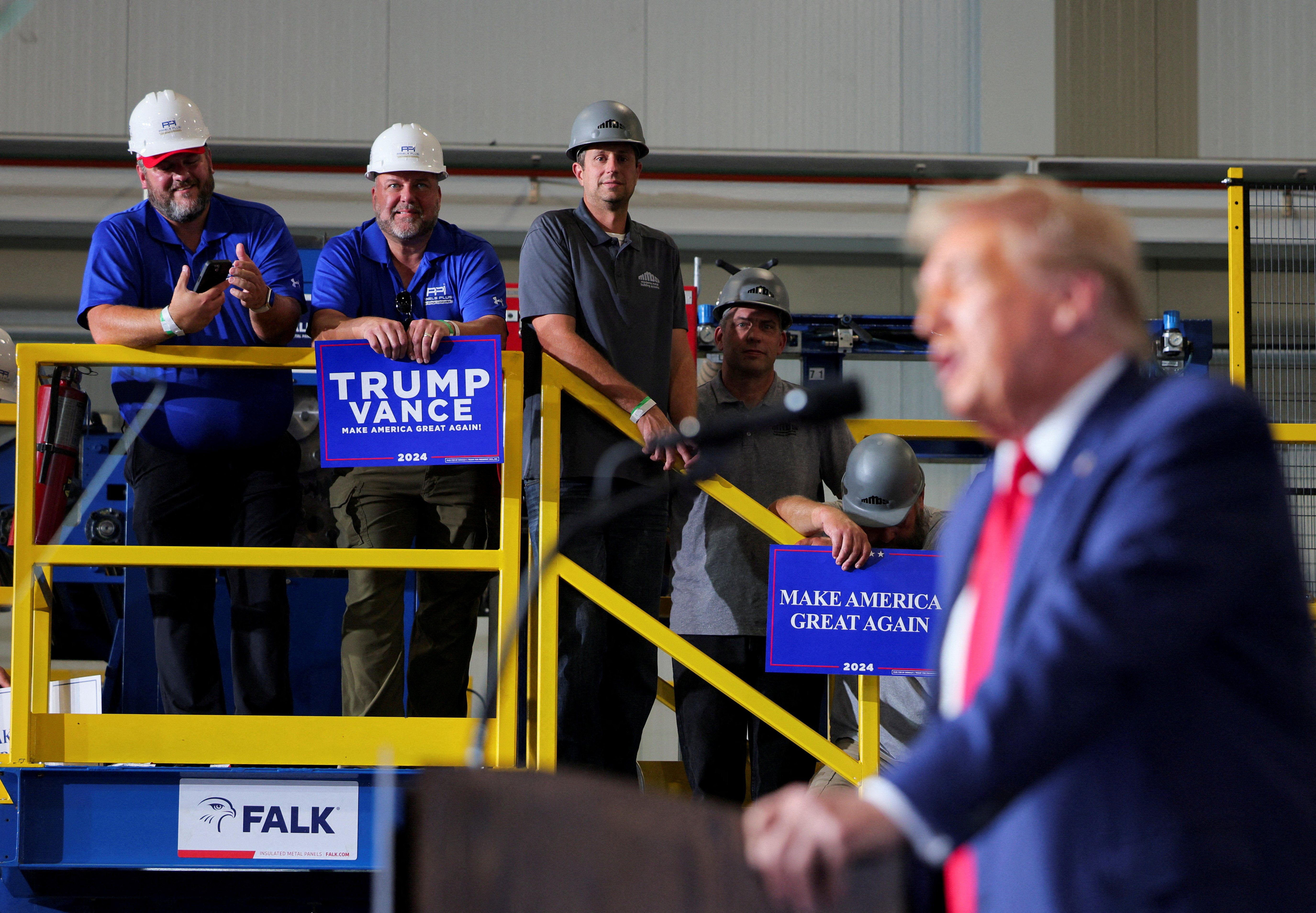
Donald Trump as he makes a campaign stop at manufacturer FALK Production in Walker, Michigan, U.S. September 27, 2024. REUTERS/Brian Snyder/File Photo
A new report from the JPMorganChase Institute confirmed that Americans are the ones paying for the higher tariffs President Donald Trump claimed other countries would pay for.
The Daily Beast cited the report in a Thursday piece that mid-sized businesses employ around 48 million Americans and account for approximately one-third of gross domestic product (GDP) coming from the private sector.
"We identified likely tariff payments made by midsize firms," the report said. "A stable trend was interrupted by a sharp increase starting in April 2025, coinciding with the implementation of the first tariff rate increases during that year."
Trump announced his "Liberation Day" tariffs on April 2, 2025.
"Total payments continued rising throughout 2025 and eventually reached a level of roughly three times what it had been until early 2025," according to the report. "These likely tariff payments potentially encompass certain other trade-related fees in addition to tariffs. However, we see the timing and magnitude of the increase in these payments as a strong indication that we do indeed mostly capture tariff payments."
As the Associated Press reported, those mid-sized businesses have absorbed the cost by raising prices or accepting lower profits. Either way, the tariffs are hurting them.
“That’s a big change in their cost of doing business,” said Chi Mac, executive director at the JPMorganChase Institute and one of the authors of the report. “We also see some indications that they may be shifting away from transacting with China and maybe toward some other regions in Asia.”
JPMorganChase noted that these companies are “highly involved in trade,” but they are also often “underrepresented in policy discussions and aggregate statistics.”
One of the major problems, the Financial Times pointed out, is that many of these companies aren't large enough to have leverage over suppliers. The U.S. still doesn't have the manufacturing base to produce the supplies needed for the products offered by these companies. So, duty payments to foreign importers increased by 316 percent from where they were before Trump.
“They may be large enough to be local or regional anchors but not so large that they can easily offset losses in one area with gains in another,” the report said. “When responding to changes in trade policy, they may be more agile than larger firms but lack the negotiating leverage of their larger counterparts. In this way, they may be more representative of the typical U.S. firm.”
JPMorganChase explained that there is an "unpredictable nature" to Trump's tariff announcements and the ongoing legal battles around them. As such, under Trump's International Emergency Economic Powers Act (IEEPA) "some firms may have delayed strategic decisions about imports."
That means that while 96 percent of tariff costs have been borne by companies and consumers in the U.S., by Oct. 2025, 43 percent of those costs had been passed on to consumers through higher prices. It means that 57 percent are being eaten by these businesses.
As the report said, however, "this may not be tenable" in the long term. So, while some companies have managed to do what they can to keep costs low, "even if tariff policy were to remain unchanged from now on, the effects of previously implemented changes could continue to unfold for years."