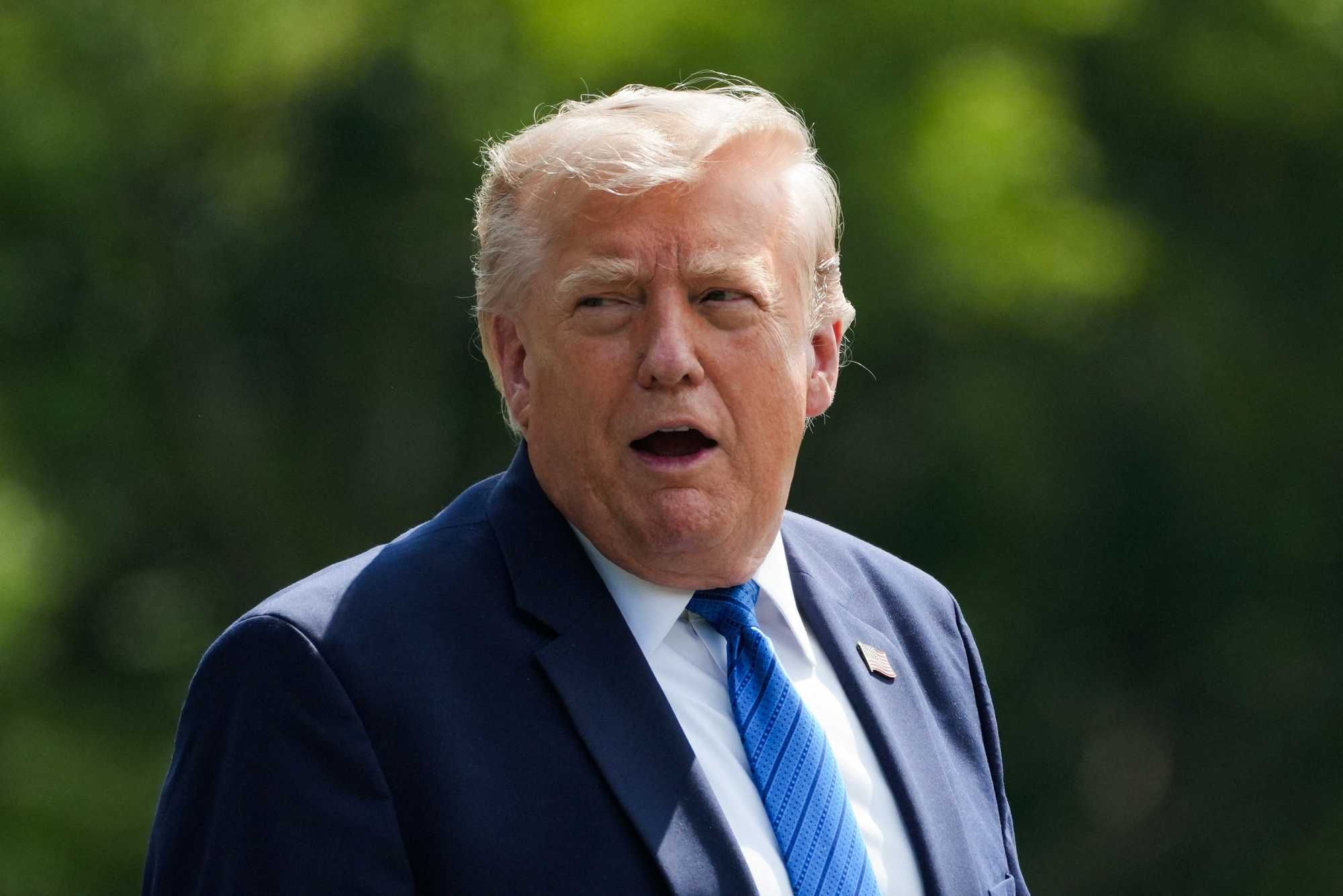
U.S. President Donald Trump departs after a Cabinet meeting at Camp David in Thurmont, Maryland, U.S., July 31, 2026. REUTERS/Nathan Howard
While a small band of congressional Republicans has become “increasingly defiant” toward President Donald Trump and shown a growing willingness to stymie his “worst instincts,” the Senate could soon become “more Trumpy.” This is according to the Economist, which on Thursday shared its assessment of Republican infighting as the midterms loom.
“Congress remains largely pliant to Mr Trump,” writes the Economist. “But a small band of Republican senators are increasingly defiant.” This has made it difficult for Trump to push through his agenda, as Republican holdouts have forced him to narrow his controversial “slush fund” settlement and shot down his demand to nuke the filibuster in order to pass his election overhaul bill, the SAVE Act. Senate Majority Leader John Thune (R-SD) has spoken on no uncertain terms about the matter, saying, “Republicans are not getting rid of the legislative filibuster. It’s just a fact, and the facts don’t change.”
According to the Economist, “Thune is also loath to use the budgetary tool known as reconciliation as a workaround. The Senate would need only a simple majority to pass parts of the SAVE Act using reconciliation, but the process is meant primarily for spending measures. That procedural reason is matched by a political one: reconciliation would force vulnerable lawmakers to make contentious votes right before the midterms. Senate Republicans ‘have no intention of putting skin in the game on Trump’s behalf,’ explains a Republican operative.”
The Economist notes, however, that many of these holdouts are either leaving office soon or likely to do so. Senators Thom Tillis (R-NC) and John Cornyn (R-TX), for example, “are on their way out, so have little to lose and are picking more fights.” Senator Susan Collins (R-ME) has also resisted some of Trump’s moves, but faces a strong Democratic challenge in November.
What’s more, the outgoing senators could result in an important compositional change for the Republican conference. As The Economist explains, “The seats occupied by Mr Tillis and Mr Cornyn will next year be held either by Democrats or MAGA newcomers. Two other Republicans leaving the Senate, Bill Cassidy of Louisiana and Mitch McConnell of Kentucky, will almost certainly be succeeded by acolytes of Mr Trump. In Louisiana Julia Letlow was personally recruited by the president, while Kentucky’s Andy Barr has vowed ‘to stand with President Trump 100 percent’.”
“The Senate will become more Trumpy, ideologically,” predicts Matthew Glassman of Georgetown University. This will have major consequences for the Party.
“As the Senate’s MAGA wing gains greater influence, Mr Thune’s job will get even more difficult,” asserts the Economist. For example, Trump-ally Senator Mike Lee (R-UT) is poised to be the top Republican on the Judiciary Committee next year. He and other Trump-aligned senators may push for Thune to accept controversial nominees or even give in should Trump attempt to re-establish the slush fund, “as Republican strategists murmur that he will.”