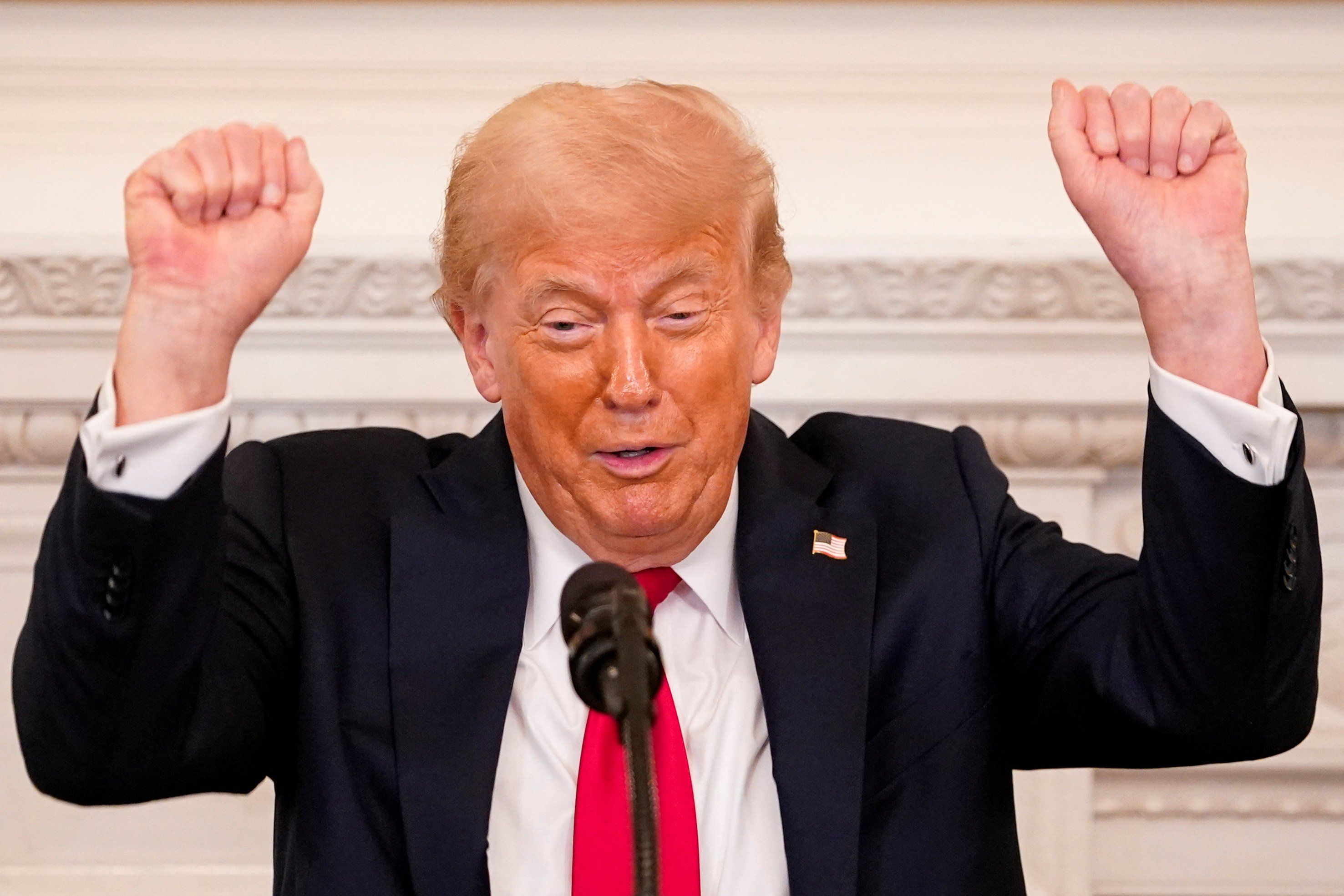
U.S. President Donald Trump gestures during the White House Faith Office Luncheon at the White House in Washington, D.C., U.S., July 14, 2025. REUTERS Nathan Howard
I vividly remember the day when I interviewed two men who had just been offered up to President Vladimir Putin by President Donald Trump.
It was July 2018. Trump had met with Putin in the Finnish capital of Helsinki and met for two hours with only their interpreters present. After the meeting, Trump casually suggested handing over a former US diplomat and British billionaire — Michael McFaul and Bill Browder, respectively — because Putin was displeased at them for criticizing his regime.
Did Trump knowingly disregard the American tradition of defending free speech and opposing dictators? Was he so transactional that he had decided to turn over two innocent men simply because it served his business interest? What if he was instead a puppet being manipulated by the Russian government? Could he be insane, or at least in some way so mentally unstable as to be unfit to serve?
Fortunately for McFaul and Browder, who I interviewed at the time and who were confident America's laws would protect them, Trump eventually got distracted and moved on to other things. This is an example of what psychiatrist Dr. David M. Reiss, best known as a contributor to the landmark book "The Dangerous Case of Donald Trump," describes as "impressionistic thinking."
What does he mean by that? How can he explain Trump's various behaviors? AlterNet spoke with Reiss in depth to learn more.
The following interview has been lightly edited for clarity, context and length.
President Trump is deteriorating.
Rozsa: You’ve said the president seems to be deteriorating. Sometimes he seems more scattered, sometimes he seems openly bizarre, such as when he praises a senator’s backside or rambles about architecture when we’re fighting a war. But you also say we can’t tell which factors are driving it: age, stress, lack of sleep, neurological decline, other illness or medication. Why is it so hard to separate those, and why do you think it’s probably a mix of at least some of them?
Reiss: Because we really have no valid information about any of them. We don’t have any reliable medical information. And so all I can do as a physician is say, “Well, these are the possibilities.” I have some ideas, but I really can’t with any reliability say which is more or less likely, other than probably some mixture of all of the above. All of them are possible, and without information proving they’re not happening, they’re possible.
Rozsa: You describe the main issue as, quote, “impressionistic thinking,” where his thoughts follow the emotion of the moment rather than logic or consistency. He has described this as “the weave,” a term that was popularized by the New York Times, and which he employed to charm voters during, for example, his appearance on the Flagrant podcast during the 2024 election. What does this impressionistic thinking mean in terms of A, his ability to implement policy, and B, how his worst qualities such as corruption and narcissism are going to get worse?
Reiss: I can make that real simple, in that we all do that to some extent, because that’s what we do as kids. We carry some of that with us. So impressionistic thinking of itself isn’t a pathology. The pathology is not stepping back and saying, “I have this thought. Let me take a look and analyze it a bit. Does this fit the specs? Does this fit what’s realistic? What are the consequences?” As opposed to, “This is what I feel, so that’s it. I’m doing it.” So the pathology is not so much that he has impressionistic thoughts, but that there’s no standing back and comparing it with facts and rationality and logic and consequences. And as opposed to the first term, there’s no one there saying, “Geez, have you thought of this? Have you thought of that?” or putting any guardrails on it.
So the problem is that when he feels it, he takes that as fact, not just as “a thought I have, let me see if it’s logical or not.” He takes it as, “If I feel that way, it is the truth.”
Rozsa: But you didn’t answer both parts of my question. One involves the policy consequences, the other involves his corruption and narcissism.
Reiss: The policy consequences are that he’s going to do things that are not thought through in terms of logic and consequences. They’re just what strikes him at the moment. That’s not how you do policy. Yes, you want a wide range of ideas, but then you want to sort them out. What are the consequences? What’s more likely? What’s the expense? And put reality in to modify which ideas are best. He’s not doing that. He’s just pulling the idea out of the hat and it goes. So it means the policy isn’t really going to be policy. It’s going to be just whatever’s pulled out of the hat, with no logic to it, just the emotion. And the second part, what was the second part?
Rozsa: Narcissism and corruption.
Reiss: In terms of corruption, it ties in, in that if something is self-serving, whether it’s financially or power, then it’s good, because there’s no thinking through of what are the consequences, what’s logical, what’s reasonable. It feels good, so it is good. So when he has a corrupt thought, he doesn’t even necessarily recognize it as corrupt. “This is what I feel, so this is reality, so I’m going to do it.” And because he’s so immature, what he feels is what a kid would feel. If you pass a bank and say, “Hey, I want to go in and grab the money,” everybody may think that, but then you’re going to say, “That’s not a good idea.” He doesn’t get to that point. The narcissism is not getting to the point of “That’s not a good idea.” It’s, “I think that would feel good. Okay, done.”
President Trump is the perfect puppet.
Rozsa: I want to talk now about your interactions with other mental health professionals. The Goldwater rule states that you’re not supposed to diagnose a public figure who you have not clinically assessed. Yet you and other professionals aren’t supposed to discuss publicly the pathologies of figures who you have clinically assessed, at least not without their permission. Am I wrong?
Reiss: Correct. And that’s actually much harder. The Goldwater rule is something the American Psychiatric Association made, and if you’re a member, you’re supposed to follow it, but it’s not a legal rule or anything like that, as opposed to patient confidentiality, which is.
Rozsa: Do they take action against members who veer from the rule?
Reiss: I’m not sure. Maybe they do, maybe they don’t, because I’m no longer a member of the APA. I quit them a long time ago because of their relationship with Big Pharma. So I really don’t care that much. I have my own ethics. I don’t need them to set the ethics for me. So I really don’t know what they do with that anymore. I was a member for years, but not now.
But the thing is, and this is where I have disagreement with some of my colleagues, that’s why I will not say he has dementia. Now, can I as a physician say that’s a rule-out? Yes, because we’re seeing behaviors that could be consistent. That’s not making a diagnosis. That’s like saying, “Hey, this guy’s limping. There’s probably something wrong with his leg.” That’s not saying, “Is it the ankle? Is it the knee? Is it the muscle?” That would be a diagnosis. I won’t give an Axis I diagnosis: anxiety, depression, dementia. On the other hand, Axis II, which is the character — what we’re seeing are behaviors that are consistent with these character types. Now, does that mean he acts that way at home and that’s who he is? I don’t know. The evidence is he probably is, obviously, but it’s not a diagnosis. We’re just talking about how you would describe the behaviors you’re seeing. That’s very different from saying, “I’m diagnosing anxiety,” or “I’m diagnosing dementia.” No, I am observing bizarre statements. When they’re bizarre statements, they could be A, B, C, D, and like I said before, without an examination, without knowing the medication he’s on, it’s a guessing game. I can say it’s probably a bit of both, but I have no data and I offer no diagnosis.
I just say, “These are the things that could be consistent with it.” And obviously, the more behaviors you have, the more likely it is, but that still does not make a diagnosis. Now, I have some colleagues who even stay away from that, in terms of naming the behavior. To me, if someone’s corrupt, they’re acting sociopathically. That’s not diagnosing them, that’s just describing it. There are others who say, “Well, he has dementia, his frontal lobe.” I’m not going there. I haven’t seen his CAT scan. He might, he might not.
Rozsa: You argue that trying to figure him out is a “strategic zero,” and that is your quote, because the real planning is being done by people like the budget director, Russell Vought, and the chief of staff, Stephen Miller, and Secretary of State Marco Rubio and Secretary of Defense Pete Hegseth, although the last two might be leaving soon. Why would his unpredictable mindset be an asset to them rather than a liability?
Reiss: Because it’s a distraction. Every time we’re seeing a clip of him saying something and no one knows, is it — is he being dumb — what we’re not seeing is the consequences of his actual behavior, his actual policies. So I think it’s a useful distraction.
Rozsa: Do you think that Trump has the psychology of a man who is in some ways ideal to be a puppet, whether for his immediate advisers or for foreign despots with whom he seems smitten, like Russian President Vladimir Putin?
Reiss: Well, let me put it this way. It’s a little facetious, but it’s not facetious: If he’s not, he’s doing a good act of it. So is that what it appears? Yes. Can I absolutely say it’s not all totally an act? If I bet on Kalshi, which I wouldn’t, I’d give you a hundred to one against that. But can I absolutely say it’s not just an act, and in his personal life he acts differently? No. I’m not there when he’s with his wife or his son or whoever. But from what we see, this is what we see.
Rozsa: Your response reminds me of July 2018, when Michael McFaul, who was President Obama’s ambassador to Russia, was offered up to Putin by Trump, along with a British billionaire named Bill Browder, who had been a whistleblower, as a possible, I suppose, offer of friendship during the Helsinki summit. And when I interviewed McFaul at the time, he told me, “I was deeply disappointed. The generous interpretation is that Trump didn’t understand what he was talking about. But let’s be clear, what Trump was doing was assigning moral equivalency to a legitimate indictment with lots of evidence against several Russian military intelligence officers for violating American sovereignty in 2016 during the presidential elections with a completely fabricated cockamamie story invented by Putin. To even for a moment give any kind of dignity to what President Putin proposed was not in America’s national interest from my point of view.”
Now we are looking eight years later. Russia, since that interview, has invaded Ukraine, and Trump as president has often seemed to side with Russia over Ukraine. My question for you is, does this anecdote speak to the themes we were broaching earlier about him being easily manipulated, and about how his impressionistic thinking makes him a danger in terms of guiding American policy?
Reiss: Yes. Now, what we don’t know, and people say some or all: Is he being blackmailed? Does he actually agree with Putin? Is it just that Putin kisses up to him and makes him feel good? Is he getting paid off? It could be any or all of those, and it may fluctuate over time. The behavior, as McFaul said, is not well thought through. Now, is it coming from being paid off, being blackmailed, just feeling good? I don’t know what percentage, and probably on different days it’s different things. But the behavior shows no thinking through of the consequences or the significance. Probably all he knows is, “This is what feels right to me right now.”