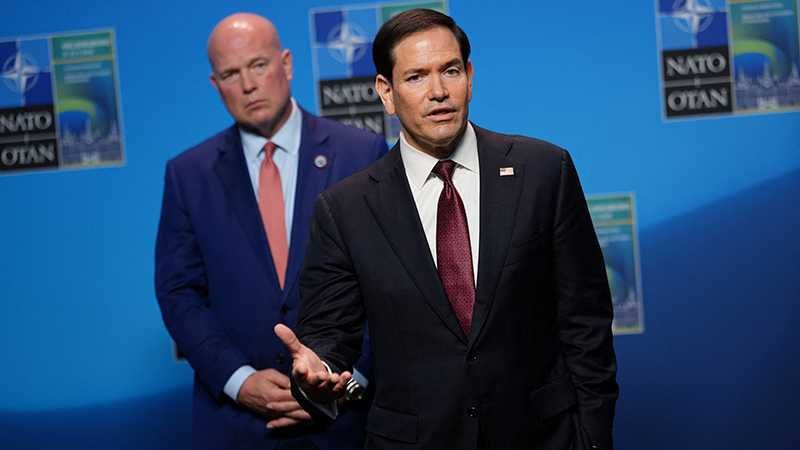
United States Secretary of State Marco Rubio speaks with journalists during a meeting of NATO foreign ministers in Helsingborg, Sweden, Friday, May 22, 2026. Julia Demaree Nikhinson/Pool via REUTERS
United States Secretary of State Marco Rubio speaks with journalists during a meeting of NATO foreign ministers in Helsingborg, Sweden, Friday, May 22, 2026. Julia Demaree Nikhinson/Pool via REUTERS
President Donald Trump withdrew 5,000 soldiers from Germany earlier this month, and now allies are confused by the flip-flops about withdrawing soldiers from Poland.
North Atlantic Treaty Organization (NATO) allies and defense officials were confused as Trump decided to send in 5,000 soldiers into Poland when he'd just decided to withdraw 5,000 other soldiers, ABC News reported on Friday.
Secretary of State Marco Rubio is on hand at the NATO summit this week, meeting with counterparts and explaining
“It is confusing indeed, and not always easy to navigate,” Swedish Foreign Minister Maria Malmer Stenergard told reporters.
“We just spent the better part of two weeks reacting to the first announcement. We don’t know what this means either,” one of two officials told reporters anonymously.
For the past several weeks, it is as if Trump has forgotten or changed his mind about the goals and aims of his administration when it comes to the U.S. military footprint in Europe. There have been conflicting statements as Trump announced that he intended to draw down soldiers even more than the initial withdrawal from Germany, the Associated Press said.
German Chancellor Friedrich Merz caused a stir at the end of April when he said that the United States was being "humiliated" in Iran.
"The problem with conflicts like these is always the same: it's not just about getting in; you also have to get out. We saw that all too painfully in Afghanistan, for 20 years. We saw it in Iraq," said Merz.
It was then that Trump announced the troop withdrawal.
U.S. Lt. Gen. Alex Grynkewich, promised on Wednesday, "We’re going to stay well-synchronized with our allies moving forward."
The U.S. has about 80,000 soldiers stationed in Europe and the Pentagon is required by NATO rules to keep 76,000 soldiers there along with major equipment. The drawdown could only happen with consultation with allies. Ahead of Trump taking office, Congress passed a measure that protected the alliance by requiring that the U.S. not withdraw from NATO without congressional approval.
"The president's view is, frankly, disappointment at some of our NATO allies and their response to our operations in the Middle East," Secretary of State Marco Rubio said on Friday.
Writing for Carnegie Europe, Rym Momtaz alleged this week, "Trump has transformed the alliance from an instrument of deterrence against Russia into an instrument of coercion against Europe."
He called it "pernicious and dangerous."