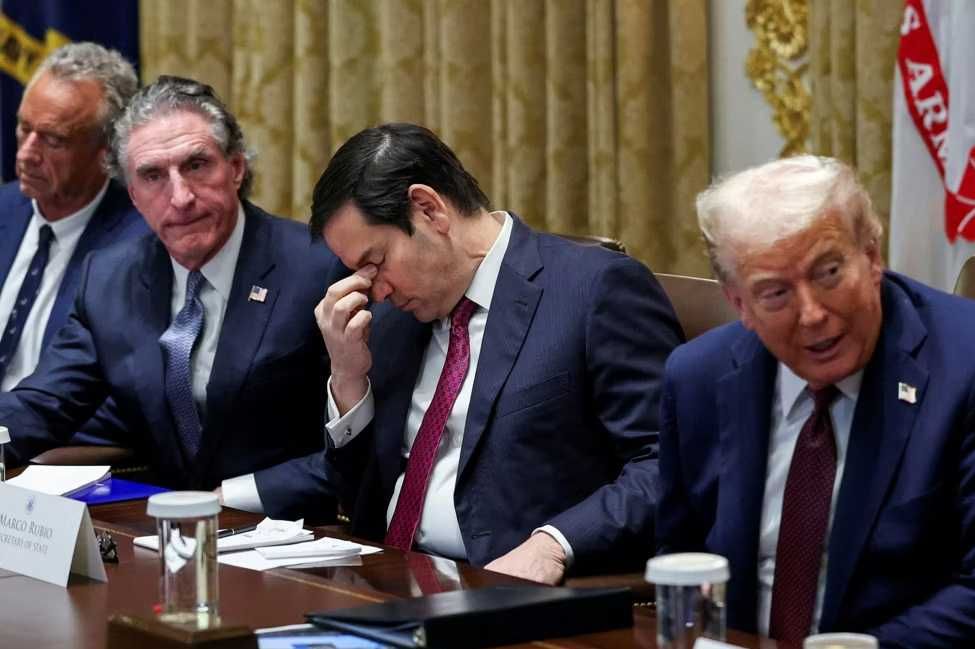
U.S. President Donald Trump, Secretary of State Marco Rubio, Interior Secretary Doug Burgum and U.S. Health and Human Services (HHS) Secretary Robert F. Kennedy, Jr., attend a cabinet meeting at the White House (Reuters)
President Donald Trump's economic program providing money to every newborn American citizen is good in theory, according to one economist — but his execution has made it "icky."
"This is contrary to what the statute says," The Bulwark's economist Catherine Rampell told MS NOW anchor Katy Tur on Friday. "Look, of all of the things that Donald Trump has done that may or may not violate the law, I’m sure this is pretty far down on the list. It’s just sort of disappointing that, again, there was this potentially good program to help kids, and Trump had to make it icky. You know? Trump being Trump, he could not help but make a program that was supposed to help kids something that had his name on it, that helped his fellow billionaires. And look, maybe Congress will go after him for it. Again, I assume it’s pretty far down the list of priorities."
Along with journalist Peter Baker of The New York Times, Rampell criticized the Trump Accounts for requiring recipients to hold investments in stocks for businesses that may not be stable or which (because of the far right politics of the owners) may run contrary to their own moral beliefs. Also, notably, the idea for these accounts long predates Trump's presidency, yet he insisted on calling them Trump Accounts.
"This is a White House for whom, or for which, the line between personal, private, and public interest has been so muddied, so blurred, that it’s hard to even see that it exists anymore," Baker told Tur." I mean, my colleagues have been writing the last few days about this deal that Jared Kushner and Steve Witkoff are helping to broker to transfer many Russian oil assets into the hands of friends and associates of the Trump administration envoys."
He added, "And we see time and time again: the president is having his G20 summit (we talked about this the other day) at his own golf club in Florida. The president signs legislation promoting cryptocurrency at the same time he’s making hundreds and hundreds of millions of dollars from it through a family business. The line between private and public interest at this point doesn’t exist in the way it did in past administrations."
Baker concluded, "Now, it’s always been a question. It’s always been an issue of private interest trying to find a way to scam or, you know, get the government to do what it wanted. But we’ve never seen, I think, anything quite so open and explicit and comprehensive as we’re seeing right now in terms of the ability of people with certain assets and certain connections to take advantage of their connections to this administration."
Rampell and Baker are not alone in being skeptical of the Trump Accounts. Writing for The Wall Street Journal in June, journalist Adam Michel said that "mMy 1-year-old son qualifies for a Trump Account, and I’ve opened it to claim the $1,000 government deposit. But I won’t be putting any of my personal after-tax wages in it, and neither should most parents. That is a shame. Trump Accounts are a good idea, poorly executed. A simple reform could make them worthwhile.”
As TheStreet's Damilola Esebame's wrote in May, “The federal government is less than two months away from opening Trump Accounts for private contributions on July 4, 2026, and a debate over what should go in them has begun. White House and Treasury officials have discussed allowing wealthy donors to contribute shares of stock directly into the children's savings accounts, a shift that could reshape the program.”
This is not Trump's only questionable economic program. In October, former Social Security Commissioner Martin O'Malley told AlterNet that Trump's promise to give $5,000 to every American adult if Republicans retained Congress during the midterms was a form of "bribery."
"I don’t think that’s socialism or capitalism, that’s bribery," O'Malley said. "That’s paying people to vote a certain way. If he stood outside a polling place in Baltimore and around the corner from it was offering to give people $5,000 to vote for him, they’d put handcuffs on him, if he were a citizen. So that’s not capitalism or socialism, that’s just straight-up bribery."