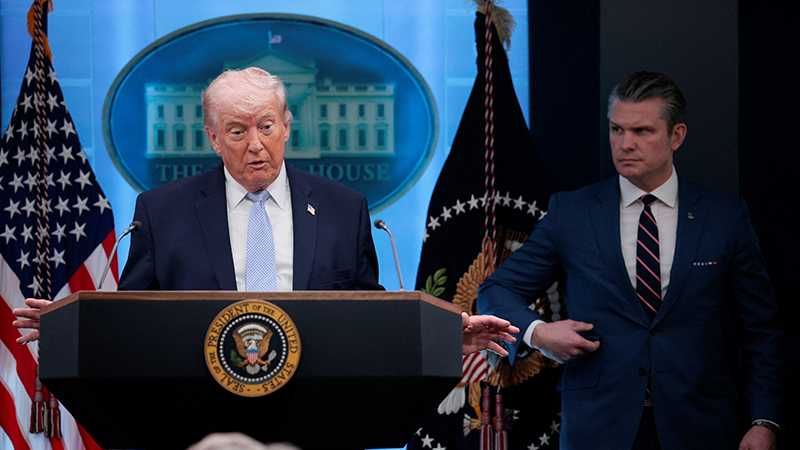
U.S. President Donald Trump holds a press conference accompanied by U.S. Secretary of Defense Pete Hegseth in the James S. Brady Press Briefing Room at the White House in Washington, D.C., U.S., April 6, 2026. REUTERS/Evan Vucci
President Donald Trump and Secretary of Defense Pete Hegseth have "debased" the U.S. military one analyst wrote in a blistering column.
The New Republic's Brynn Tannehill, a former naval aviator and defense analyst, warns that the volatility of the Iran war mixed with "Trump’s temperament, means [the U.S.] may be back to hostilities next week or tomorrow."
Tannehill explained that the situation has become a mess and the "ceasefire" seems to be causing more questions than answers. More importantly, however, Tannehill cautioned that "there's a deeper story that’s been happening with the military during Trump’s second term, of which too few Americans are aware."
Trump and Hegseth have been systematically dismantling Pentagon checks against illegal/immoral orders. Their moves pave the way for war crimes in the escalating Iran war.
She began with the pardon Trump made in his first term of Navy SEAL Eddie Gallagher, who posed with a teenager's murdered body and was accused by teammates of targeting civilians. Tannehill said that it was the first signal of Trump's ethos. Meanwhile, Hegseth echoes the sentiment, celebrating "warriors" over ethics.
"One of the first acts of the Trump-Hegseth Pentagon was to purge the military of its top lawyers (also known as JAGs, or judge advocate generals)," the column explained. "JAGs perform the critical function of assessing the legality of anything done within the military. One piece at The Atlantic correctly described them as the 'conscience' of the military."
Then they "dismissed the Joint Chiefs chairman, the chief of naval operations, and Air Force vice chief," recalled Tannehill.
Hegseth claimed that it was because he didn't want any “roadblocks to orders that are given by a commander in chief.” That has never been an issue in the past. So, Tannehill believes that his real "goal was to remove anyone who might raise ethical objections to anything the military was ordered to do by the administration."
The firings have continued: Adm. Alvin Holsey retired over disputed Caribbean airstrikes on drug vessels; Army Chief Gen. Randy George was ousted for refusing to scrub female/Black troops from promotions; Chaplain Corps chief Maj. Gen. William Green and Gen. David Hodne were axed amid the Iran conflict, an unprecedented move.
Remaining officers despair, explained Tannehill. She explained that quitting harms troops in the field, and replacements willing to obey blindly makes things worse. It can put the U.S. into a Vietnam-like escalation spiral. U.S. lacks a coherent Iran plan beyond bombing, she said.
Now Iran is reacting by controlling the Strait of Hormuz, causing a 93 percent drop in traffic of goods and oil to cease altogether. It has crippled Asian economies, and now Iran is demanding that it control it completely. They've put $2 million tolls on each oil ship, and thus far, Europe has refused to pay them.
Earlier this week, Trump threatened to bomb Iran’s electrical grid, making a "dual-use" argument. Roads, bridges and power plants are used by both civilians and the military. The larger problem is that the military isn't likely to be the casualty; civilians are. Experts warn it risks war crimes if disproportionate civilian harm occurs. Iran isn't expected to give in. Even if the power grid is hit, it is fairly decentralized and generators are common.
With no nukes (Russia fears), no invasion (draft needed) and humiliation unacceptable, water infrastructure attacks seem the only option.
"While destroying the electrical grid will result in some civilian casualties, depriving the country of water is likely to cause mass death in the millions, governmental collapse, and a refugee crisis unlike anything the world has seen in modern times. Iran is already teetering on the brink of disaster with its water supply: Destroying dams and desalination plants would almost certainly push it over the edge," warned Tannehill.
"Americans may not just be remembered for electing a felon in 2024, or a demagogue or the best friend of a child rapist," she closed. "They may be remembered for electing a mass-murdering regime that telegraphed its intent for years."