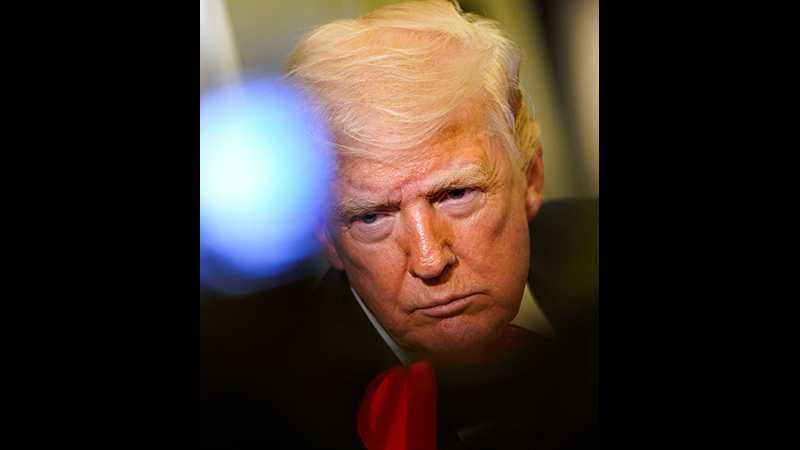
U.S. President Donald Trump looks on as he speaks to members of the media aboard Air Force One en route to Joint Base Andrews, Maryland, U.S., March 29, 2026. REUTERS/Elizabeth Frantz
U.S. President Donald Trump looks on as he speaks to members of the media aboard Air Force One en route to Joint Base Andrews, Maryland, U.S., March 29, 2026. REUTERS/Elizabeth Frantz
"Hundreds" of top American soldiers were officially confirmed to be sent to the Middle East.
CBS News reporter Jennifer Jacobs reported Monday that elite forces like "U.S. Special Ops military personnel, including Navy SEALs and Army Rangers, are now in the Middle East." She noted that they join the already deployed Marines and Army paratroopers that President Donald Trump sent earlier this month.
While Republicans have argued so far that the bombing of Iran is not a "war," putting boots on the ground will likely be seen by Americans as a definitive war.
CBS reported on March 20 that sources claimed "Trump has been deliberating whether to position ground forces in the region. ... It was unclear under what circumstances he would authorize the use of troops on the ground."
Republican lawmakers spoke out last week, arguing that they would absolutely not support "boots on the ground" in Iran. That said, the lawmakers just left Washington for a two week break.
The Washington Postconfirmed on Sunday that the Pentagon is preparing for ground operations in Iran.
Trump even went so far as to tell reporters on Air Force One Sunday night, "I think we've had regime change. You can't do any better than that."
Jacobs cited a New York Times report explaining, "The deployments serve to give Trump options in Iran, including potential operations involving Strait of Hormuz, Kharg Island or Iran's enriched uranium."
However, an exclusive from the Wall Street Journal Sunday night confirmed that Trump was considering a "risky" operation that would seize the enriched uranium from Iran. U.S. officials called the move a significant escalation in the war.
Calling it "nuclear dust," Trump said that Iran must give up the enriched uranium and that if they refuse to do so "they’re not going to have a country.”
The Post said, "Any potential ground operation would fall short of a full-scale invasion and could instead involve raids by a mixture of Special Operations forces and conventional infantry troops, said the officials. All spoke on the condition of anonymity to discuss highly sensitive military plans that have been in development for weeks."
The report argued that putting the soldiers on the ground could expose them "to an array of threats, including Iranian drones and missiles, ground fire and improvised explosives. It was unclear Saturday whether Trump would approve all, some or none of the Pentagon’s plans."
An X account that follows military flight logs found updated information showing that in the past two weeks, a considerable number of special operations forces (SOF).
The account also compiled data on the bases from which the soldiers would arrive.
Such an operation to seize the enriched uranium will likely mean U.S. soldiers would go deep into Iran and be under constant attack. Handling such dangerous material would also require highly skilled staff with "40 to 50 special cylinders that resemble scuba tanks" to carry the material, the Journal reported. Those cylinders would also need specialized transportation to ensure it didn't explode.
“This is not a quick in and out kind of deal,” the Journal cited retired Gen. Joseph Votel, the former commander of U.S. Central Command and U.S. Special Operations Command.