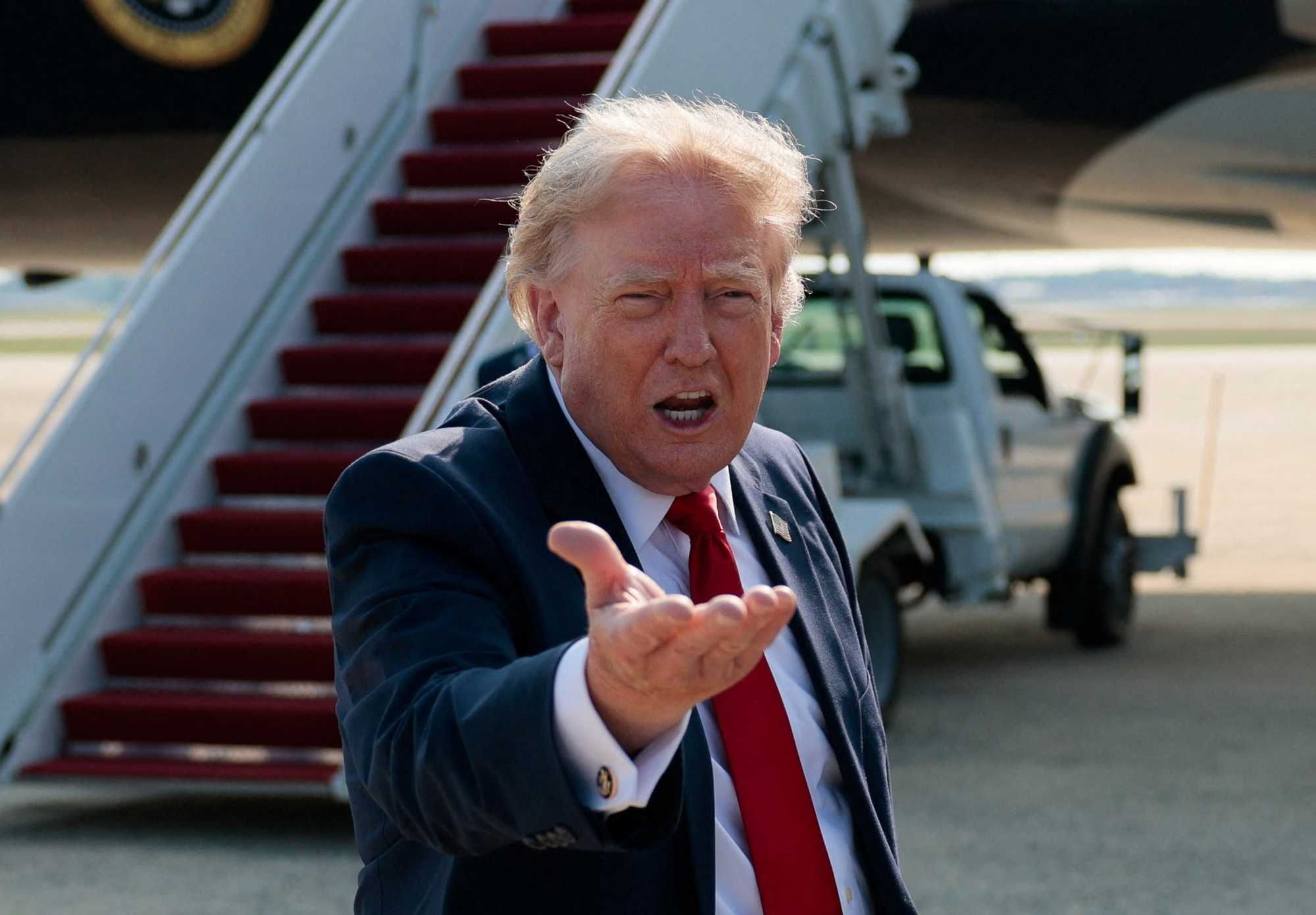
U.S. President Donald Trump gestures as he speaks with reporters before boarding the new Air Force One, a plane gifted by the Qatari government, at Joint Base Andrews, Maryland, U.S., July 1, 2026.
On Thursday, Nobel Prize-winning economist Paul Krugman warned that President Donald Trump has set a ticking inflationary time bomb that is about to explode. According to Krugman, while the very worst of the economic shocks caused by the war with Iran have so far been held at bay, the evidence suggests that is about to change.
As Krugman explains, “Trump is not a well man. He is, unfortunately, also President, which means that we all pay a price for his inability to accept reality. Notably, while he insists that he has ‘total control over the Strait of Hormuz,’ shipments of oil through the Strait will remain minimal unless Trump can find a way to smuggle oil out in catering carts — or until he makes a deal with Iran. And we won’t have such a deal until he faces up to the reality that he lost his war of choice. The Hormuz closure means, in turn, that oil prices — which briefly fell most of the way back to prewar levels on hopes that a deal was really coming — will remain high for the foreseeable future.”
But as Krugman points out, the fact that oil prices aren’t even higher than they are now has puzzled many. While they’re still elevated, they’re down from their peak earlier in the war, and while the price has been marching back up recently, it’s still “only” $25 above pre-war levels. According to Krugman, however, oil prices are actually higher than they seem, and this becomes clear if you look at the right numbers.
“So,” writes Krugman, “what do I mean by looking at the right numbers? Nobody burns crude oil directly. Instead, they burn products refined from crude, mainly gasoline and diesel. And these prices, after falling for a while on fake news of peace, are back most of the way to their recent peaks.” Here Krugman notes the example of diesel prices, which have nearly reached the point of their early-war high.
According to Krugman, the difference between the cost of a barrel of crude and that of the products refined from that barrel is known as the “crack spread,” and since the beginning of the war, that spread has “exploded,” rising by roughly $35 per barrel. That’s outpacing the cost increase of the barrels themselves. That results in a total cost increase of roughly $60 per barrel, “putting it in the range of middle of the road predictions of what would happen as a result of a long-term Hormuz closure.”
Krugman explains that the crack spread has widened due to a combination of the closure of Hormuz and the Russia-Ukraine war, which have diminished global refining capacity. “The shortage of refining capacity has, in turn, held crude prices down,” writes Krugman. “Buyers aren’t willing to pay extremely high prices for crude oil they can’t refine. Or to put it a different but equivalent way, the cutoff of oil shipments through the Strait of Hormuz in effect required a large rise in global oil prices to ration demand, but much of that rationing has taken place through a rise in the crack spread rather than a rise in crude oil prices.”
The wider economic impact of this, asserts Krugman, is inflation, which has so far been kept relatively low. But inflation “is set to rise again in next month’s data. And everyone can see that gasoline is back above $4 and diesel back above $5.”