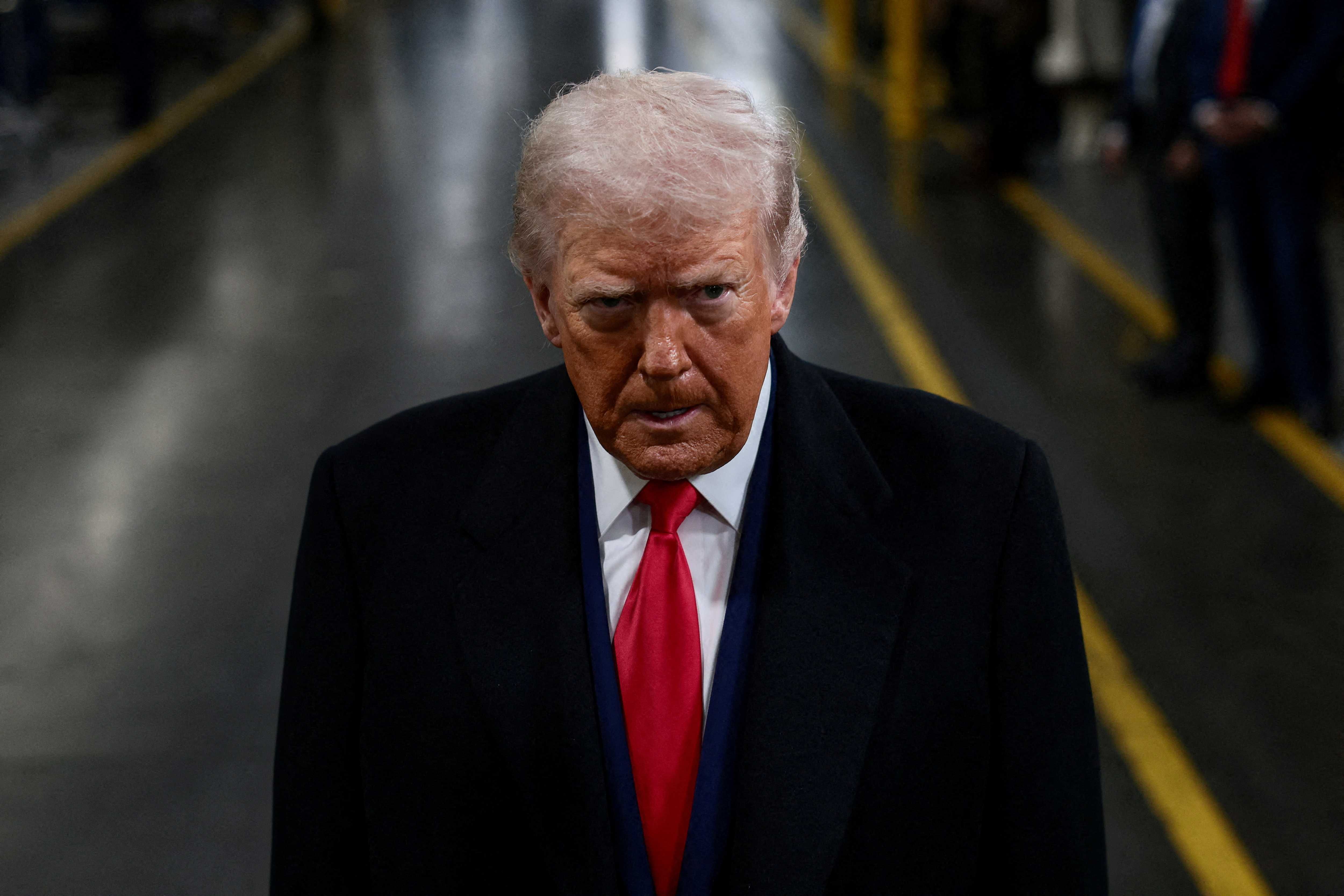
President Donald Trump in Dearborn, Michigan, January 13, 2026. REUTERS/Evelyn Hockstein
President Donald Trump appears to be suffering from a notable decline in his neurological condition, according to one clinical psychologist, who highlighted as evidence the "strange and unusual" tic that he cannot seem to control.
Dr. John Paul Garrison is a licensed clinical and forensic psychologist who specializes in body language. He is also a prolific content creator who provides professional insights into the things that public figures expose with their behaviors, including numerous videos breaking down Trump's many public appearances, coming to the general conclusion that his cognitive and physical decline has accelerated in the last year, likely made worse by his advanced age.
In his latest video, published this weekend, Garrison examined two recent press conferences Trump spoke at, arguing that he "continues to exhibit what appear to be concerning neurological symptoms." The first meeting he discussed included various tech company CEOs, and during the time when he was not speaking at the podium, the president appeared to suffer a minor spasm in his right arm, a symptom that Garrison has highlighted numerous times in the past. He noted that the issue would become more pronounced throughout the meeting, with Trump also giving off signs of increasing discomfort.
Breaking down what these recurring arm spasms might mean, Garrison
"So, as you can see, President Trump seems to have a distinct spasm on one side," he explained. "We're going to look at more examples in just a minute, but what this could mean is this could be neurodegenerative disease. We could be talking Alzheimer's, we could be talking Lewy body dementia, you could be talking something like Parkinson's disease. This could also come with post-stroke behavior. There can be damage to certain areas of the brain that can cause this, but we are seeing something distinct, and it appears to be involuntary."
Lewy body dementia is a form of the condition caused by protein buildups in the brain. According to the Mayo Clinic, this version of dementia can manifest with tremors, as well as difficulty sleeping and issues managing bowel and bladder control.
"Now, one thing we've seen very consistently from President Trump is that he is quite impatient when other people are speaking," Garrison added. "He feels agitated, and that's going to add to the likelihood we're going to see more of these spasms. Standing there, feeling irritated. Those types of feelings can increase the likelihood these will occur. If you were paying attention just now, you saw his right hand twitching a little bit. I do think that there's some awareness that this is going to happen again."
Trump exhibited similar issues during the second appearance that Garrison examined, in which he discussed various White House renovation projects with the press near the under-construction helipad in front of the building. During one of the president's digressions about flagpoles, Garrison zoomed in on his right hand as it once again appeared to suffer a spasm.
"So, as I pointed out a minute ago, what we're seeing is what appears to be distinctly involuntary spasms, particularly from the right side," he explained, later concluding, "Now, it did appear that there was a distinct right side spasm. It happened repeatedly over the course of the first meeting as well as the press conference outside. So whether this is related to damage to the brain that is post-stroke or it is related to something more like dementia, we're going to continue to explore this as more behaviors become apparent because there has been no shortage of them recently."