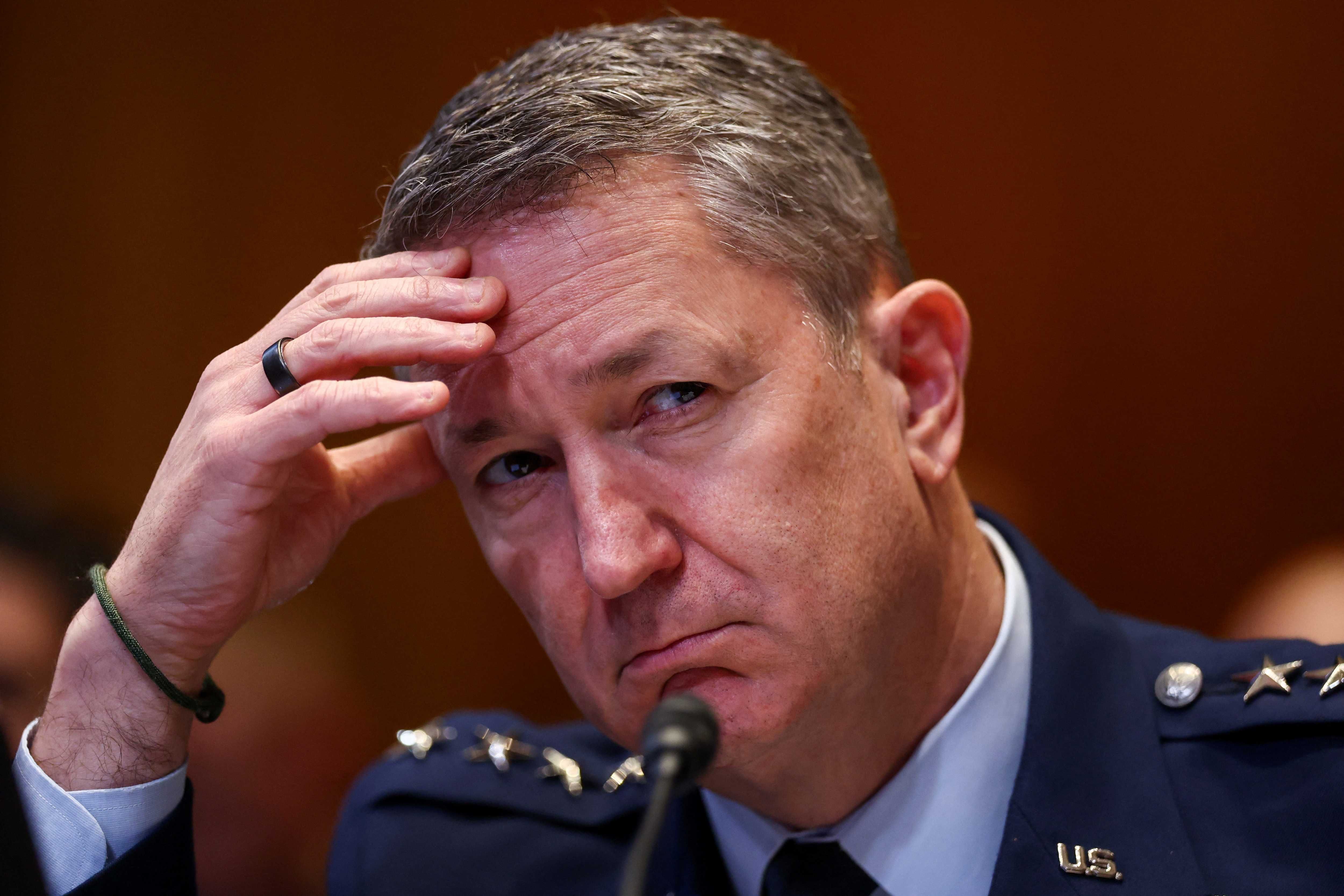
Chairman of the Joint Chiefs of Staff General Dan Caine on Capitol Hill in Washington, D.C., U.S., May 12, 2026. REUTERS/Kevin Lamarque
During a congressional hearing on Tuesday, U.S. Army Gen. Dan Caine — chairman of the Joint Chiefs of Staff — and Defense Secretary Pete Hegseth were grilled by lawmakers about President Donald Trump handling of the Iran war. According to the New York Times' Greg Jaffe, military experts are worried about Caine leaving determination of the war's "center of gravity" to Trump.
Jaffe notes that the term "center of gravity" is "rooted in U.S. military doctrine and the Prussian military theorist Carl von Clausewitz, who defined it as the enemy's primary source of strength."
"In the 1991 Persian Gulf War, as the United States sought to expel Iraqi forces from Kuwait, Gen. Colin Powell, the chairman of the Joint Chiefs of Staff, defined the center of gravity as Iraq's elite Republican Guard troops," Jaffe explains. "Twenty years later, as the Obama Administration was struggling to carry out a new strategy in Afghanistan, Adm. Mike Mullen, also the chairman, defined it as building an Afghan government that had the support of its citizens."
Caine, according to Jaffe, declined to "define" the "center of gravity in the Iran war" when questioned by Sen. Gary Peters (D-Michigan).
"Some of his reticence is a product of working for Mr. Trump, who has sought to preserve his negotiating flexibility by not locking his administration into binding war aims beyond ensuring that Iran never acquires a nuclear weapon," Jaffe reports. "Mr. Trump's mercurial nature — his willingness to change his mind on an almost daily basis — also puts military leaders in a difficult spot. To speak publicly about war strategy risks being countermanded by the commander in chief. Mr. Peters, a (U.S.) Navy veteran, offered his own diagnosis: The center of gravity, he said, was the Strait of Hormuz through which about 20 percent of the world's oil supply flows."
Jaffe points out that although a Joint Chief of Staffs chairman like Caine is "obliged to stay out of the political fray inflamed by the war in Iran," he "works for a president who demands absolute loyalty."
According to Jaffe, "some military analysts" interviewed by the Times "praised Gen. Caine's approach," while "others said he was ceding too much ground."
Retired U.S. Army Col. Heidi Urben told the Times, "When military leaders only talk about tactics, it reinforces this fallacy within the ranks that they don't need to worry about strategy, that other people will take care of that stuff."