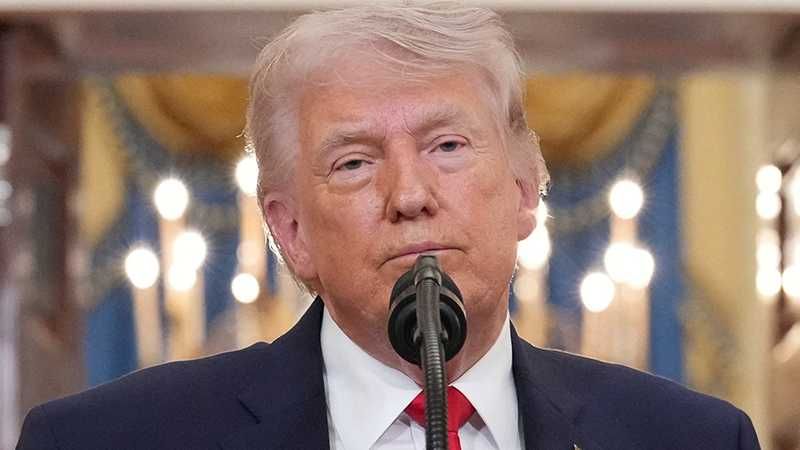
U.S. President Donald Trump delivers an address to the nation about the Iran war at the White House in Washington, D.C., U.S. April 1, 2026. Alex Brandon/Pool via REUTERS
President Donald Trump recently said that he does not care about Americans’ financial situation as his war against Iran continues raising prices on essential goods — and experts are saying this may cost him the 2026 midterm elections.
On Tuesday Trump was asked by The New York Times’ Erica Green if he will be motivated by Americans’ economic hardships as he tries to strike a deal that will end the Iran war. Because Iran closed the Strait of Hormuz after Trump invaded their country earlier this year, prices on gas, food and other necessary products have skyrocketed.
“Not even a little bit,” Trump told Green. “I don’t think about Americans’ financial situation. I don’t think about anybody. I think about one thing: We cannot let Iran have a nuclear weapon. That’s all.”
Gleuck argued that this response “flouted” conventional wisdom about how to win elections in a democracy.
“It was a response that flouted fundamental rules of American politics — that voters are motivated above all by economic concerns, that they want to support politicians who ‘care about people like me’ — and it was a risky one, given Trump’s dire political standing,” wrote The New York Times' political reporter Katie Glueck on Wednesday. “His disapproval rating is consistently hovering around 60 percent or worse; a new CNN poll found that 77 percent of Americans — including a majority of Republicans — thought his policies had increased the cost of living in their own community; inflation rose a startling 3.8 percent in April, the fastest rate since May 2023, sending a flashing warning about how the war in the Middle East is raising prices for Americans; [and] Republican pushback to the conflict is growing in Congress.”
Gleuck also interviewed veteran Republican pollster Whit Ayres, who elaborated on why Trump’s comments could be problematic for him.
“President Trump was re-elected for four reasons,” Ayres told Green. “To improve the economy, to bring down inflation, to control illegal immigration and to get away from woke culture. Anything that works against any of those four goals is not helpful.”
The only factor that could offset these problems for Trump is if Republican redistricting effectively gerrymanders the House of Representatives in such a way that the GOP retains their majority. In addition to Ayres’ observations, Trump could also get a boost from Democrats proving less competitive than expected in the Senate races or from voter purges, restrictions on mail-in balloting, voter ID laws and potential federal troops at polling places further complicating voting and/or intimidating voters.
Yet even with these factors in mind, Ayres pointed out that “there’s no question that there’s a strong relationship between the president’s job approval and his party’s performance in the House.”
Speaking to AlterNet in April, White House spokesman Kush Desai argued that the Iran war will ultimately be an economic positive for the American people.
“President Trump has been clear about short-term disruptions as a result of Operation Epic Fury, and the Administration went into this military engagement with a plan to mitigate these disruptions to America’s long-term economic resurgence," Desai told AlterNet. "As energy markets begin to stabilize, historic tax refund checks hit the mail, and the rest of the Trump administration’s pro-growth agenda continues taking effect, Americans can rest assured that the best is yet to come.”