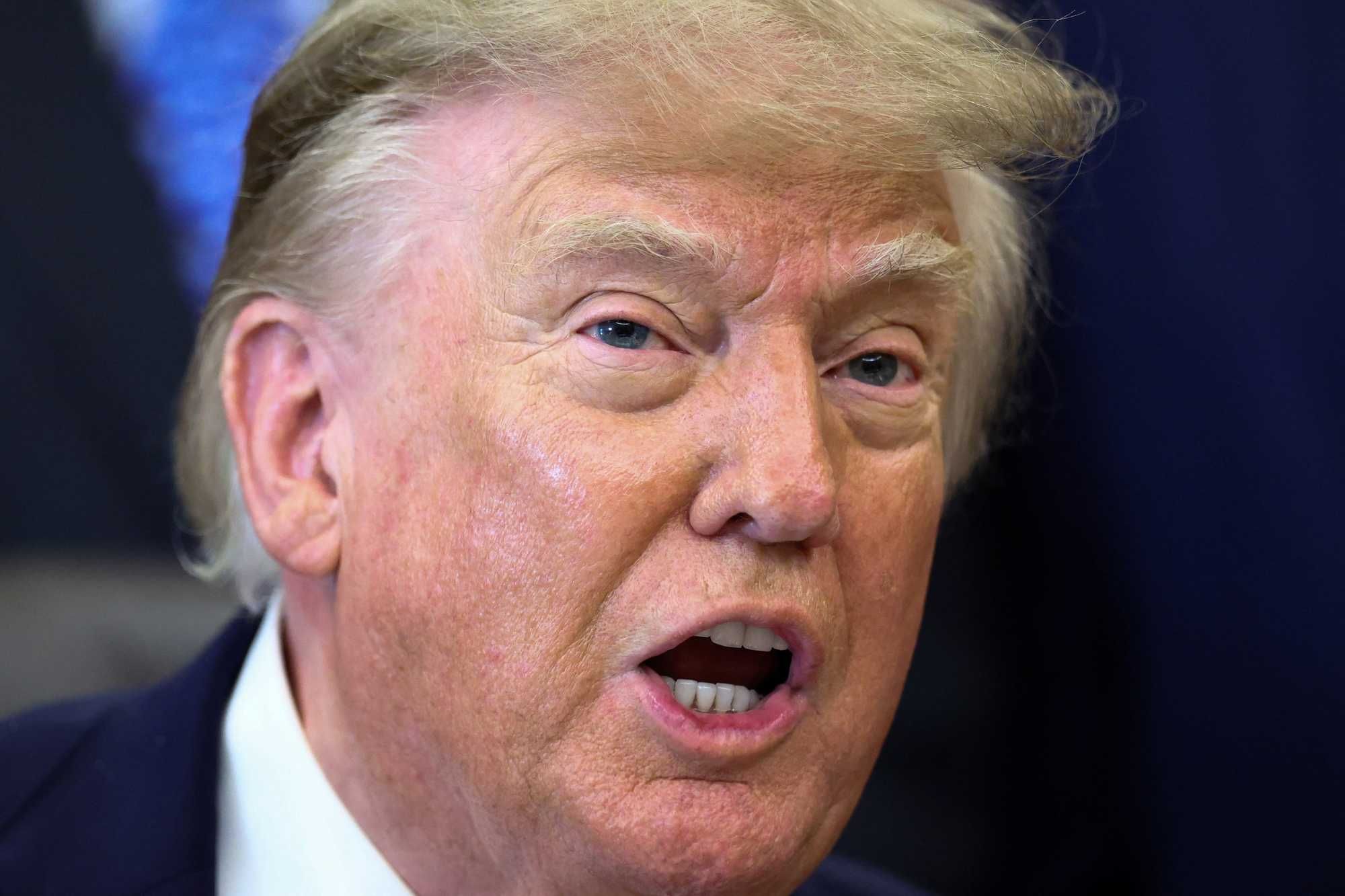
US President Donald Trump makes an announcement in the Oval Office at the White House in Washington, D.C., US, September 30, 2026.
Following the collapse of President Donald Trump’s White House press ban, a new analysis from legal experts at Slate concluded that one key thing tripped up what was ultimately deemed an "unconstitutional" attack on the First Amendment: his own “big mouth.” This was the assessment of Slate Senior Editor and attorney Dahlia Lithwick, who was joined on Wednesday by Director of the Columbia University Knight First Amendment Institute Jameel Jaffer to discuss how “the legal rubber met the authoritarian road last week with a full-frontal assault on the fundamental freedom of the press.”
“CNN, Politico, and MS NOW,” explained Lithwick, “were denied access to the White House after the president decreed in a post on Truth Social that they would lose their ability to enter the building because of his feelings about their biased coverage. Last Wednesday, Judge Timothy Kelly of the D.C. Circuit held an emergency hearing in a lawsuit filed by the news outlets, and at around midnight, Judge Kelly issued a temporary restraining order to stop the White House ban for 14 days.” He also signaled he was likely to side with the press in his final ruling, and the banned outlets were begrudgingly allowed back on White House grounds the following day.
According to Jaffer, what made the case so “unusual” was the fact that “there’s no dispute that the president has acted on the basis of viewpoint.” Normally in First Amendment cases, he elaborated, there is a factual dispute about the motivations of government action. These disputes often focus on the question of why a government took the action it did. In this case, why did it punish this news organization or punish this person? As Jaffer explained, “It’s quite unusual that the government says openly, ‘We’re doing this on the basis of viewpoint,’ but that’s what President Trump has said here. He said it multiple times. The whole plan here was to kick out these news organizations from the White House press corps, on the grounds that their reporting was not the kind of reporting the president likes. So the only real question in the case is, does the president have legal authority to expel news organizations from the White House because he doesn’t like their reporting?”
The matter came down to two First Amendment issues. “One has to do with a retaliation theory,” explained Jafeer. “The president has taken this action in retaliation for the reporting these news organizations have done in the past. The president himself has made that clear, so one theory is that this is unconstitutional retaliation.” The other issue involves the fact that the White House Press Corps acts as a type of public forum under the First Amendment. As Jaffer elaborated, “A public forum is a kind of fancy First Amendment way of saying it’s a space that the government has opened up for certain kinds of expression. And once the government opens up a space for expression to the public at large or to journalists at large, then if the space is a public forum, the government can’t then expel somebody from it on the basis of viewpoint.”
After the president banned the press outlets, noted Lithwick, he launched a “weird” state TV network called Trump TV, which may have backfired and damaged his case even further. As Jaffer explained, “It just underscores the higher-level goal here is to ensure that the American public is fed a steady stream of government propaganda, either through the White House’s own app or from a press pool that has been purged of independent journalists. That’s the broader goal that is revealed by all of these moves.”