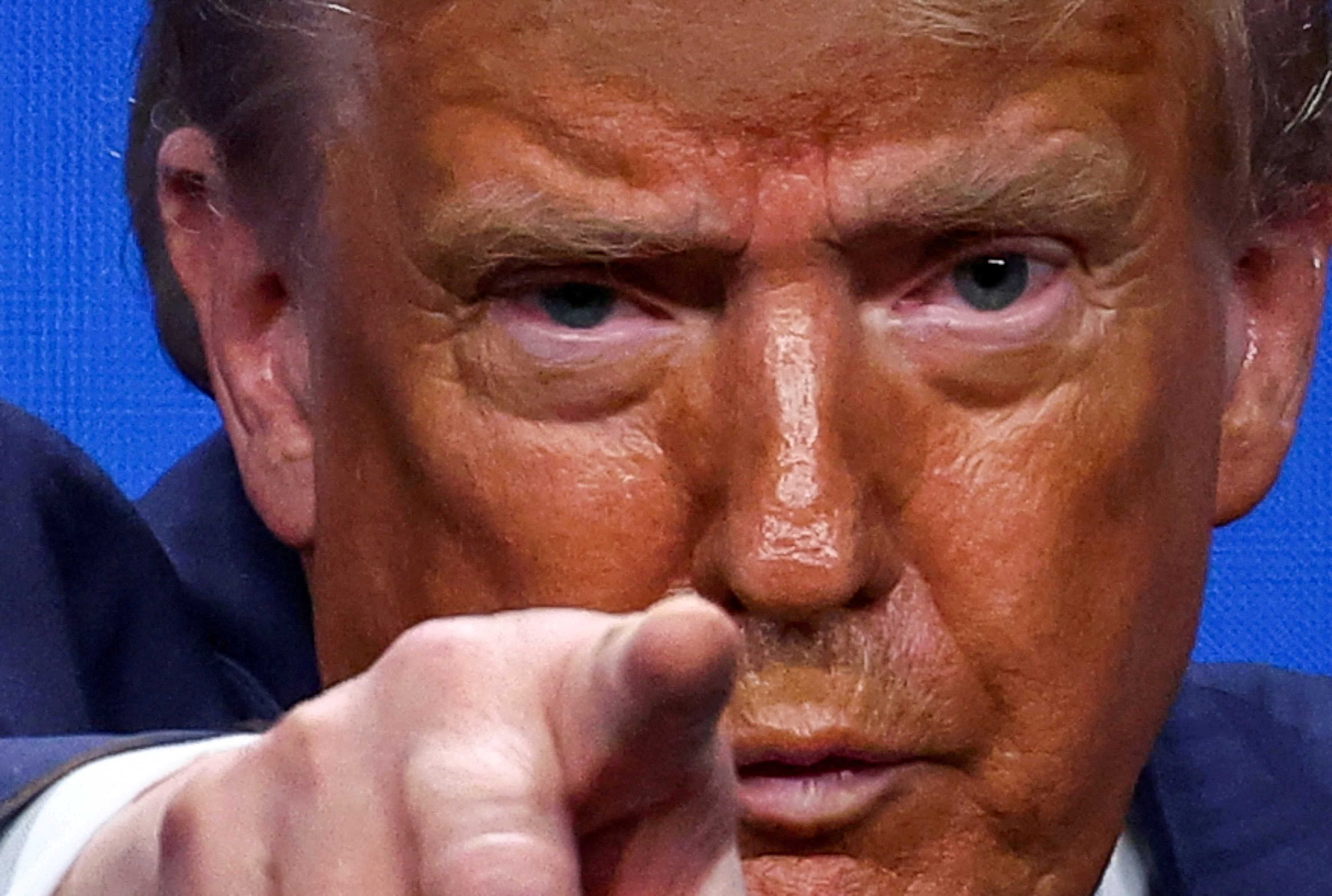
U.S. President Donald Trump gestures during a press conference at a NATO summit in The Hague, Netherlands June 25, 2025. REUTERS Yves Herman
American political scientist Daniel W. Drezner's Thursday Substack post argues that one of the defining sources of President Donald Trump's power has been his ability to instill fear in his opponents.
Infamously, Trump told then-The Washington Post journalists Bob Woodward and Robert Costa in 2016, "Real power is — I don’t even want to use the word — fear."
The quote ultimately became the title of their book about the president, his first campaign and the early days of his first term. But now Drezner thinks that Trump has lost that swagger.
In Machiavellian terms, Drezner says Trump long operated on the principle that it was better to be feared than loved.
"His ability to move fast and destroy things is truly unparalleled in modern American politics, which might be why so many techbros still like him," said Drezner. "His power to destroy also inculcated fear in broad swathes of the American body politic — which, in turn, made Trump seem even more powerful. Even those folks who opposed his moves believed that his threats and actions were consequential. Or, to put this in Machiavellian terms, Trump did not care if he was loved so long as he was feared."
That fear, however, is faltering, "if the polling is accurate," he noted. In fact, Drezner thinks that tech bros are the only ones left who like Trump.
He noted that it appears that, for the past few weeks, story after story has been about Trump "losing." But it also appears his heart isn't in it anymore, as his responses have become "empty and boring."
The perfect example is Trump walking away from his disaster in Iran. Over the past week, Trump's negotiators, Jared Kushner and Steve Witkoff, have focused more on the war between Russia and Ukraine. Meanwhile, a CBS News report revealed shocking photos of U.S. properties around the Middle East that have been completely demolished by Iran's attacks.
A separate report from the New York Timesclaimed that allies in the area are rethinking their alliance, "because U.S. bases no longer hold any deterrent value."
The New York Times’ Tony Romm reported Wednesday that Trump was furious when the Federal Reserve raised interest rates this week, as inflation doesn't appear to be improving and gas prices continue to climb.
"President Trump lashed out at the Federal Reserve on Wednesday over its decision to raise interest rates, as he reprised his earlier threats to cut off a broad swath of U.S. trade unless the central bank bows soon to his demands for lower borrowing costs," said the Times.
Drezner described it as "impotency in the face of political and policy challenges."
Meanwhile, before Trump jetted off to North Carolina, he told the press that if Canada joined in an alliance with the European Union over trade then he'd cut off all trade with both.
"To be clear, no one believes that Trump can or will cut off all trade with Europe," Drezner said. "It’s a nonsense threat — but it also highlights just how badly the Trump administration has played its geoeconomic hand."
And while Trump continues to lose in trade wars and military wars, Drezner said "China is reaping significant long-term benefits from Trump’s repeated own-goals."
The New Yorker’s Evan Osnos wrote: “In Beijing, a think tank at Renmin University recently published an assessment titled ‘Thank Trump,’ which wryly hailed his efforts to hasten the ‘twilight of an empire,’ by undermining America’s alliances, civil service, scientific institutions, and democratic credibility.”
It's clear, Drezner explained, Trump has lost his control-by-fear. It's something that Drezner said even Machiavelli said "should be avoided at all costs."