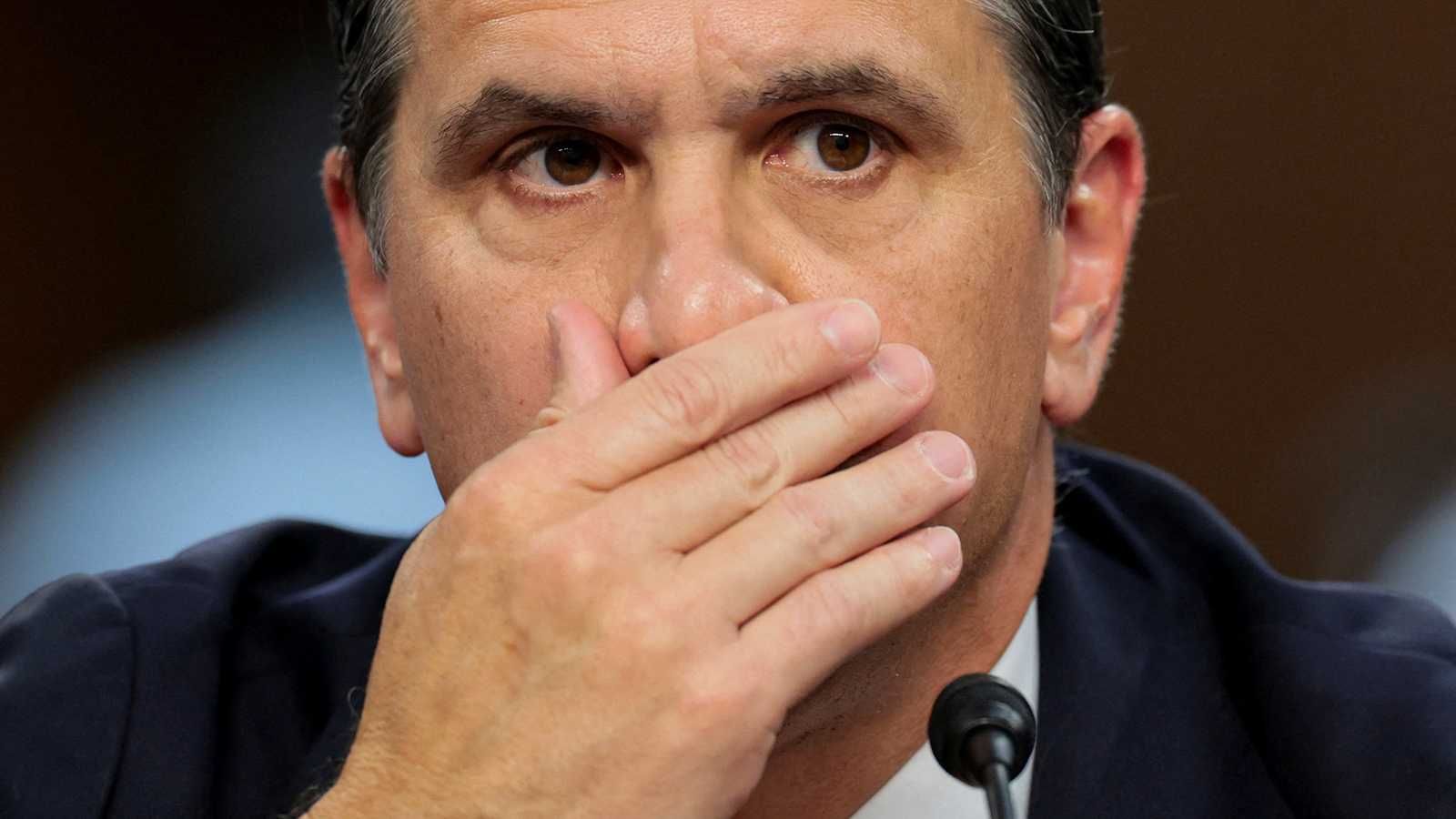
Attorney General Todd Blanche testifies before a Senate Judiciary Committee confirmation hearing on his nomination to be attorney general on Capitol Hill in Washington, D.C., July 15, 2026. REUTERS/Jonathan Ernst
When the Justice Department filed a civil lawsuit against California to block 20,000 voters from voting, the associate attorney general made a significant admission that made the co-hosts of the "Sisters-in-Law" podcast burst out laughing.
Kimberly Atkins Stohr, a senior opinion writer at the Boston Globe and MS NOW contributor, explained during the episode that this was part of the Department of Homeland Security's attempt to get states to purge their voter rolls of people that its database claimed weren't citizens. The problem is that the database has proven to be filled with errors. An alarming number of those they sought to remove were lawful voters. So, even Republican states refused the demand.
Stohr said that the DOJ claimed California had 190,000 non-citizens. That somehow shrank to 20,000. The DOJ said that they had 48 hours to purge the people from the voting rolls or face "repercussions." California said no. So, the DOJ filed a civil suit alleging that the names on the rolls were illegal.
"Now, California officials and other states have long decried the methods with which the federal government is allegedly cross-checking voter registrations in ways that election officials in blue states, in red states, everywhere," she explained. "They're saying you are picking up citizens. You're picking up naturalized citizens. You're picking up citizens who have the same name as somebody who's not a citizen. You are picking up this is a terribly inexact science, and we're not going to boot people off voter rolls in order for you not to do that."
It turns out California started reviewing the list and found a bunch of federal government citizens on it. By the time someone went through all of the people on the list from the feds, it went from 190,000 to 20,000 to just 28 people. The Los Angeles Times found that most of them didn't even know they had somehow registered to vote. Those folks could also have been automatically registered to vote when they got a state-issued ID, as happens with the "Motor Voter" program without choosing to.
What sent the women into hysterics, former federal prosecutor Joyce White Vance explained, was the press conference in which the Justice Department announced the lawsuit.
Paraphrasing, co-host and former U.S. Attorney Joyce Vance said that acting Deputy Attorney General Trent McCotter said, "Well, you know, we might be wrong about some of these people, right?"
Given the longstanding standards for evidence at the DOJ, the co-hosts were left astonished and laughing at such a telling admission about the strength of this case. She offered a prediction at what her fellow host and former U.S. Attorney Barbara McQuade made of that slip.
"I'm sure I mean, Barb, I'm going to use my crystal ball to predict your response to that," Vance said. "You thought, 'Holy goodness, DOJ's rules, the Justice Department's manual, it requires you to believe that you have evidence sufficient to obtain a conviction and make it stick on appeal before you bring charges.' And here's the Deputy Attorney General saying, 'I don't know. Some of our cases might not be so good.' I mean, my blood pressure went through the roof."
McQuade added later: "You know, the other thing that our listeners should be aware of is before you can be convicted of a crime, you have to do this knowingly. It's not enough that you made a mistake on the form or you were careless or reckless. You have to knowingly, you know, check a box that you were a citizen and entitled to vote. It's a crime of intent."