Marine veteran Mark Glesne explained to CNN that the war in Iran is justifiable in Christianity and that Secretary of Defense Pete Hegseth, a Christian Nationalist, is right to promote it as such as a U.S. official.
Speaking to CNN on Tuesday after President Donald Trump threatened to kill "a whole civilization," Glesne cited Romans 13. According to Glesne, it says, while Christians are called not to personal revenge, the state and governing authorities have been ordained by god and set up, as it says in Romans 13:3, to be a 'terror to bad conduct.'"
Traveling Minister Elijah Murrell challenged the often quoted clip, noting that those who use it to justify war are taking it out of context. He explained that Saint Paul wrote the passage to say that while God's ultimate authority reigns supreme, "Leaders can fail. Power can be abused. Laws can be unjust. But government exists (at its best) to restrain evil and protect the innocent. So yes—honor authority. But honoring authority doesn’t mean pretending leadership can’t be questioned."
The larger problem that Glesne has is that the U.S. government is run not by scripture, but by laws. It's what Retired Maj. Gen. Randy Manner pointed to when he talked about his ministry work as a chaplain for the military.
"I believe that we need to be able to talk to all the people of the United States, which, by the way, is not just Christian. It's also, of course, people who perhaps have no beliefs or they are Catholic or Muslim, or they are Jewish or whatever. Whatever religion they might follow," the chaplain said.
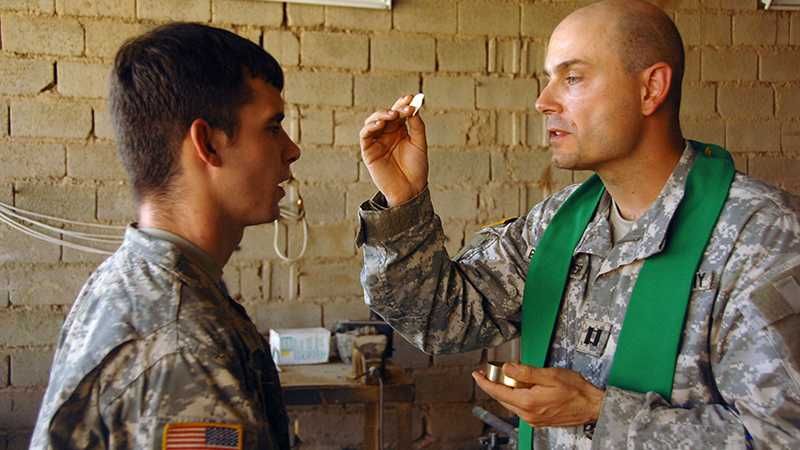
"Like chaplains in the military, the role of military chaplains are very different from those of a civilian religious leader," he explained to Glesne, who has only worked in civilian ministry.
"One: provide, obviously, unbiased support of our military members, both in wartime and peacetime. Ensure also — the second reason — provide specific religious support if a member requests it. For example, a Catholic priest or an Imam or a particular religious denomination. And thirdly, provide advice and counsel to the commander on the morale of the military members and their families. So I think we need to be able to separate this and ensure that our chaplains are not divisive, but are inclusive and providing hope and resilience to all our military members and their families," the former U.S. Army major general said.
Hegseth removed top Army chaplain, Maj. Gen. William Green Jr. last week. It is unclear why.
CNN host Pamela Brown asked Glesne about Trump's TruthSocial post threatening the civilians in Iran. Glesne explained that something like this is perfectly acceptable because the Earth is already a "fallen world." He then claimed that war is evoked all throughout the Bible.
"We see this nuanced understanding of violence in a fallen world in order to restrain evil. And again, that is what the state has been ordained by God to do, which is to be a terror to bad conduct," he said, implying that either Trump or the United States is somehow "ordained by God." It's a language typically reserved for a monarchy.
A piece for Christianity.com by theological scholar and missionary Vivian Bricker argued against the idea that kings throughout history were ordained by God. Citing 1 Samuel 8:1-22, the column said, "God never intended for there to be human kings; however, since the people rejected God as their king, God gave the people Saul to be their king."
"God did not ordain kings throughout history," Bricker said.
While Glesne claimed that "reasonable minds can disagree," Maj. Gen. Manner explained that the military chaplains have their own personal beliefs that may conflict with the leadership of the military. "They have to keep those to themselves."
The critical thing he wanted to voice is that the United States is a country of laws.
"The idea of eliminating a civilization, the idea of attacking civilian power plants, these are actually the words of potential war criminals. And we need to be able to understand that under both U.S. military law, U.S. law and international law," the major general explained. "Butattacking civilians, attackingcivilian bridges, attackingcivilian power plants, those are potential war crimes."
Glesne disagreed, saying that the military can use civilian targets too, like the military can use bridges and trains for war purposes.
Military law experts have argued that these could be considered civilian targets, regardless of what Trump thinks, a PBS News report said.
"Even if specific civilian infrastructure were to qualify as a military objective," said Stephane Dujarric, spokesman for U.N. Secretary-General Antonio Guterres. Such an attack would still be prohibited if it risks "excessive incidental civilian harm."
"What Trump is saying is, 'We don't care about precision, we don't care about impact on civilians, we're just going to take out all of Iran's power-generating capacity,'" explained Rachel VanLandingham, a Southwestern Law School professor who previously served as a judge advocate general in the U.S. Air Force.