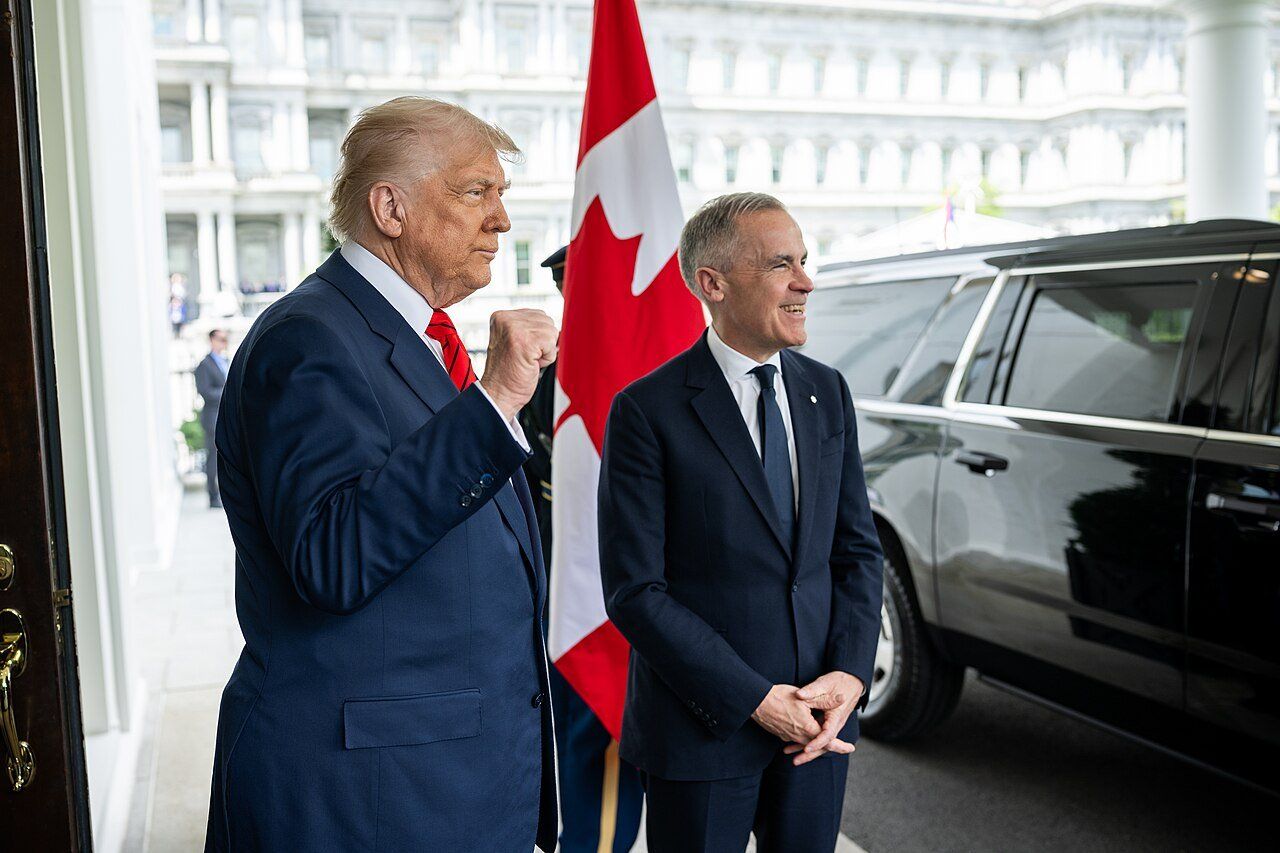
U.S. President Donald Trump with Canadian Prime Minister Mark Carney on May 6, 2025 (Official White House Photo by Daniel Torok/Flickr)
President Donald Trump is proving to Canadian Prime Minister Mark Carney — and to the world — why other leaders may want nothing to do with his controversial statements, a New York Times columnist argued Sunday.
Columnist Ezra Klein wrote that America’s president now looks less like a world leader and more like a sulking hegemon.
“Everything Trump has done over the last week has made him look tawdry, addled and small,” Klein said.
Trump recently disinvited Canada from his so‑called “Board of Peace,” which he claims will be responsible for rebuilding Gaza. The invitation was withdrawn after Carney publicly said he had no role in the group. Most of Europe has also rejected Trump’s offer to join the “board.”
Klein wrote that Carney’s knack for “assessing [Trump’s] transactionalism” is what landed him on the president’s list of adversaries.
Carney’s speech at the World Economic Forum in Davos last week accomplished several things, Klein argued. “First, Carney’s speech used the word ‘hegemon’ four times. He said the word ‘America’ only once, and then only to specify ‘American hegemony,’” Klein noted. “This is who we are now to our northern neighbors: not the America they once knew, or thought they knew, but ‘the hegemon.’”
In Davos, Carney said, “The system’s power comes not from its truth but from everyone’s willingness to perform as if it were true.” Klein cast Carney’s role as refusing to “perform” and giving others permission to stop performing as well. Trump and Carney, he wrote, understand each other “all too well.”
Ahead of Trump's term, Klein said he spoke to advisors about the foreign policy philosophy of the second term. All of them said some version of the same warning that the U.S. never uses its power as leverage, and under Trump, it will.
Carney called that out, alleging that great powers of the world are “using economic integration as weapons. Tariffs as leverage. Financial infrastructure as coercion. Supply chains as vulnerabilities to be exploited. You cannot ‘live within the lie’ of mutual benefit through integration when integration becomes the source of your subordination.”
Trump promptly responded in his speech that Canada only exists because of the United States. "Remember that, Mark, the next time you make your statements," said Trump.
Klein closed by calling the speech a "risk," as he rejected Trump's "nakedly transactional or thoroughly corrupt" worldview. Unlike Trump, Carney "intend[s] to do something more with his power than profit off it. It was a bracing speech, but more than that, it was a brave act. It was the kind of act that Trumpism suggests does not exist, the kind of act that rebuts Trumpism by simply existing."