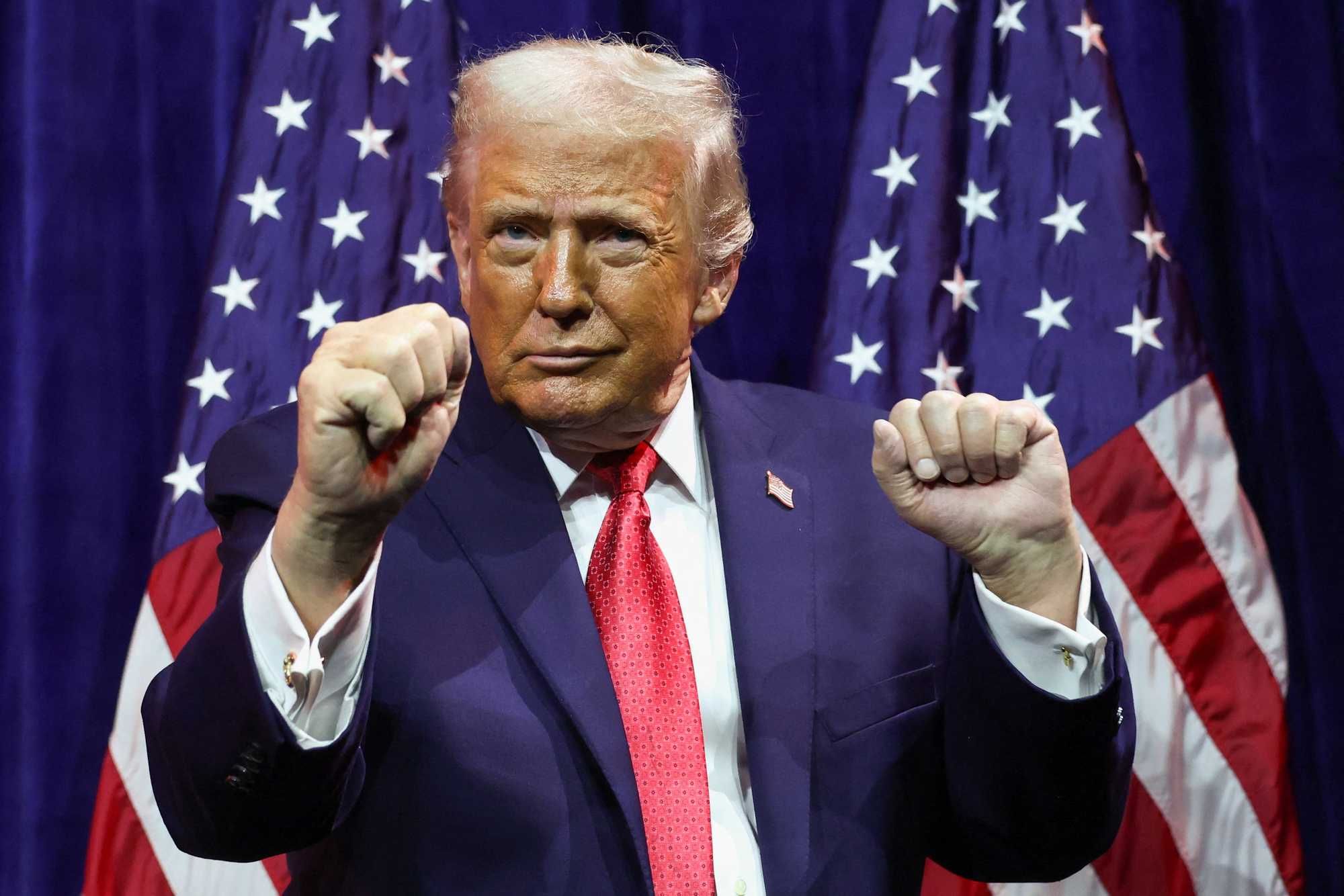
U.S. President Donald Trump gestures as he addresses House Republicans at their annual issues conference retreat, at the Kennedy Center (REUTERS)
When I spoke with one of the world's top aging experts about President Donald Trump, he immediately established that he will not allow politics to influence his judgment on this subject.
S. Jay Olshansky is a University of Illinois Chicago emeritus professor best known for developing the "biodemographic paradigm" of mortality. He focuses on how to slow aging and help humans reach the upper limits of their potential lifespans. For his pioneering work on these subjects he has won the Gerontological Society of America's Kent Award, a Senior Fulbright Award and the Irving S. Wright Award. When talking about a president who turned 80 this year, and is regularly slammed by critics for showing potential aging signs like seemingly sleeping on the job and behaving erratically in general, Olshansky is an excellent expert from whom to extract insights.
Some of his answers surprised me, and I pushed back. Yet I respect him for his willingness to admit when he has been wrong in the past, and to be absolutely candid about his point of view even when it isn't popular.
This interview has been lightly edited for clarity, context and length.
Is it ageist to criticize President Trump for being old?
ROZSA: You've argued for years that chronological age should not count against a candidate. In 2020, you said no one should be discounted from any position, even the presidency, based on age. What have you seen that makes you distinguish between President Donald Trump's age and President Donald Trump's brain?
OLSHANSKY: Well, I have no basis for making any assessment at all about cognitive functioning. And actually, nor does anyone else, perhaps except his doctors. So, honestly, I don't trust videos that I see. Those can be doctored and altered. I don't trust audio that I hear; those can be doctored and altered. I don't trust opinions of others based on video and audio, because those are often influenced by politics. Bottom line is I think very few people have any valid basis for drawing any conclusion about cognitive functioning about the president.
ROZSA: I appreciate you being so candid because it tells me that you're not partisan in your assessment. I would like to push back a little. I think that it is dangerous to outright diagnose him, but at the same time, when he does seemingly narcissistic things like trying to put his name on the Kennedy Center, plowing down the East Wing to build a ballroom, demanding that other institutions be named after himself, engaging in erratic foreign policymaking, like trying to annex Greenland or threatening to do so with Canada, these things do speak to an instability in his character that to some degree needs to be characterized in psychological terms. At least that's how I feel about it. What are your thoughts?
OLSHANSKY: Well, a lot of these are political issues that are above my pay grade, and I'm not into politics. I'm into aging science. And so I can't draw any conclusions about the president's cognitive functioning based on the decisions that he's making on a day-to-day basis, because I don't have all of the relevant information that's used to make those decisions.
What I can say is that I used to believe that presidents, presidential candidates should be protected from revealing their full medical records, where this kind of information would likely be located. I used to believe that presidents and presidential candidates should be allowed to withhold that information just like anyone else. It's private health information. I've changed my tune fairly recently. I've come to the conclusion that these kinds of issues should be addressed like with airline pilots, for example, where they do need to be tested and evaluated because the decisions that they make on a day-to-day basis can influence the health of other individuals, where their decisions can influence them directly or indirectly.
And I think presidents and presidential candidates also need to abide by the same rules. So I think they do need to be evaluated. I think that information does need to be made publicly available. And it's only there, where that information is made publicly available, will we know whether or not there are any cognitive or physical health challenges associated with a president or presidential candidate. And even then, I would be less concerned about physical functioning. I actually really couldn't care less about whether somebody's eye isn't working as well or their knee isn't working or hip isn't working. These are all age-related changes that occur to all of us at one level or another. But cognitive functioning is a different issue, and I think that's the point that you're raising. And the only person I would trust to provide any reliable assessment of cognitive functioning would be the individual's physician.
ROZSA: You've said concerns about Trump's health could be put to rest if he released more detailed medical records as other presidents have done. What specifically should be released — cognitive screening results, imaging, a full neurological exam — and who should evaluate them?
OLSHANSKY: Well, the answer to the first question is everything. Nothing should be redacted. Every single piece of information that exists in the medical record should be made public. Now, in terms of who should be evaluating them, to me, it should be professionals: physicians, geriatricians that are familiar with the kinds of things that go wrong with older individuals, individuals that study cognitive health. I don't know if there should be an identified group of individuals, but if it's publicly available, then people can make decisions on their own. In my own work, I gathered together a group of geriatricians to evaluate the medical records of both Biden and Trump, which was the most publicly available information we could find at the time. It was a good group of scientists who were capable of evaluating full medical records to draw conclusions.
So I can't identify specific individuals, but in general, the rule of thumb is that if all of the information is released, it will be evaluated by experts in the field.
ROZSA: In 2020, you said that both Biden and Trump appeared to be super agers, yet, you may recall, Biden's cognition became the defining issue of the 2024 campaign, at least until he dropped out. What did that episode teach you about the limits of longevity models for judging fitness for office, and should there be a standard cognitive assessment for presidents of any age?
OLSHANSKY: Well, I don't know about a standard cognitive assessment. That would be a decision made by experts in that field. The information that we had at the time came from the physicians of both individuals, and both of the physicians drew the conclusion that there were no significant cognitive issues among either candidate. And those were the people that we could rely on, hopefully, for reliable information. Now, we can't know with certainty whether or not we were given reliable information, but it was coming from the sources that we trust in general, which are the physicians that are seeing these individuals on a day-to-day basis, or however frequently they are seeing them. So I think our conclusions at the time were correct. I did watch the debate between Trump and Biden, and of course, you could not unsee what we saw.
It's unclear whether or not there were significant cognitive issues. I did see videotapes of interviews with the president shortly after that, and he seemed perfectly fine. So it could have been a consequence of extreme stress that he was under at the time. He does have a severe issue associated with stuttering. So it's difficult for the average person — it's even difficult for experts — to know with certainty whether or not what we saw was cognitively related or some other related health issue that he's had his entire life. So I'm not sure I would draw any different conclusions than the ones that we drew back then.
Can a public figure's mental fitness be diagnosed by someone who has not personally treated them?
ROZSA: I'd like to talk about another situation in which someone assessing a president's mental fitness wound up raising what subsequently proved to be a valid point. When I interviewed former Yale psychiatry faculty member Dr. Bandy X. Lee days before the 2020 presidential election, she told me that if Trump lost to Biden, the outcome would be, quote, "frightening." Her exact words were, "Just as one once settled for adulation in lieu of love, one may settle for fear when adulation no longer seems attainable. Rage attacks are common, for people are bound to fall short of expectation for such a needy personality, and eventually everyone falls into this category. But when there is an all-encompassing loss, such as the loss of an election, it can trigger a rampage of destruction and reign of terror in revenge against an entire nation that has failed him." I would argue that she effectively predicted his coup attempt and the January 6th riots.
Do you not see how, because of events like that, someone like me could argue that psychological paradigms are useful in judging presidents, be they Trump or Biden?
OLSHANSKY: You mean psychological paradigms developed by people that have not actually met the person that they're evaluating?
ROZSA: Yes.
OLSHANSKY: Look, these are experts in the field, and in general, I trust them more than I trust me, that's for sure. And I trust them more than I trust other people because of their expertise. But the general rule of thumb is that unless you've met and evaluated somebody in person, I'm not sure I would rely on any type of assessment by anyone on the outside.
I'm very cautious. Look, I'm a professor of public health. It's science and evidence that should be driving the conclusions that we come to. If we don't have the information that we need to draw these judgments, I think we should be extremely cautious about how we address any of these issues. Look, I see many of the things that other people talk about and see, but I'm not an expert on the psychology or the psychosis that we see in individuals. It's not my area of expertise. And I generally don't trust most of what I see from the media because it's heavily influenced by politics. So either we're talking science or we're not. If we're talking science, in general, the only people I trust would be those that have actually evaluated the individuals in person.
ROZSA: Now I want to quote Dr. Jerome Kroll, a professor of psychiatry emeritus at the University of Minnesota Twin Cities. I interviewed him in 2023 about the Goldwater Rule, which is the APA rule that essentially dictates what you're saying here: that one should not comment on a public figure's mental health unless you've personally evaluated them. Kroll said, "Those psychiatrists who think the Goldwater Rule is just incorrect and self-serving think that the APA leadership have no special expertise in ethical issues and no mandate to intrude upon Article One of the Bill of Rights [the First Amendment]." He then added that, quote, "Celebrity persons reveal much about themselves, whereas regular patients can and do often withhold important information for various reasons from their doctors." And he continued, "Doctors in emergency rooms frequently have to make rapid diagnoses and important decisions of persons they have never seen before, have little reliable information, no previous records, and no reliable way to evaluate the accuracy of the person they are assessing, yet they have to assign a working diagnosis and a treatment plan, such as involuntary admission to a psychiatric ward, on just a few salient features of the interviewed person. This is accepted in ethical practice for doing all this. There is no luxury of delay in the ER other than perhaps an overnight stay for observation. The APA leadership just ignores these realities of daily work of psychiatrists." What are your thoughts on his counter to your position?
OLSHANSKY: Actually, I don't think it's a counter to my position at all. What he's saying makes perfect sense: that in an emergency room setting, where decisions have to be made on an instant basis to ensure the health of the individual, all of that makes perfect sense. They have to make decisions very quickly. That's not what we're talking about here.
ROZSA: I must interject to remind you that he also said that celebrities can reveal a great deal about themselves without intending to in public settings, and that psychiatrists are often misled by their own patients even when they're personally evaluating them.
OLSHANSKY: Yes, I would imagine that that's entirely possible, but that information — you have to remember how you get that information. It has to come from the media. It has to come from videos and audiotapes that come from a source that I think in today's world we need to be very cautious about. It is so easy to create a video of somebody that is altered with AI where the average person cannot easily detect whether or not it's real or fake. I can't detect real or fake videos or audios. I think very few people are capable. And there's very strong political forces at work here that are trying to influence decision-making in the general public based in part on some false or fake information that is readily and easily produced by AI.
It's one of the disadvantages of AI. There's lots of advantages, but one of the disadvantages is deceit.
ROZSA: I certainly agree that AI can be used to spread misinformation, but the observations about Trump long predate the prevalence of AI. And even in the AI era, there are objective observations about him behaving in seemingly erratic ways, such as falling asleep during meetings, slurring his speech, having trouble paying attention, going on rambling digressions during his speeches. These are things that people who have seen him in person have verified.
OLSHANSKY: Yes. No, I'm not disputing any of that, although I will question whether or not he's sleeping. I don't know whether or not that's true. I've been to many meetings myself where I close my eyes to listen carefully. So somebody who's taking a picture or video of me might come to the conclusion that I'm sleeping when in fact I'm just listening carefully. So I would be cautious about that type of conclusion, but I think your other points are well taken. And that is that there are people that are with the president on a day-to-day basis and they have drawn conclusions, and I'm not there. I can't see any of that. I'm not an expert on the psychology behind many of these issues. So, yeah, I'm not gonna personally draw any conclusions based on this, other people that happen to be in the same room at the same time.
It doesn't mean that I'm not seeing many of the things that you're talking about. It's just that I'm not willing to draw any sort of scientifically based, definitive conclusions based on that because, aside from not trusting some of the information, I'm not an expert in many of these areas. My expertise is in aging and longevity. That's what I'm best talking about. So, honestly, a lot of the questions that you're asking me are outside of my area of expertise.
To what extent can psychology be used to study public figures?
ROZSA: I would say that they're very much within your area of expertise in the sense that I'm asking about connections between what people perceive in terms of his mental fitness and whether that is connected to his aging. I agree with you wholly that people should not connect his aging to his capacity to serve. Where I disagree with you is in the notion that we shouldn't have any psychological framework for explaining his behavior.
OLSHANSKY: Well, I didn't say that. I didn't say that there shouldn't be any psychological framework. I certainly understand how and why experts in psychology would be much more able and capable of drawing conclusions that I'm not able to, based on their area of expertise. I would tend to trust them more than I would trust me in evaluating any of these issues, because that's what they do for a living. But even those individuals, I think, are obviously cognizant of the fact that they're not meeting President Trump in person, unless some of them are. I mean, maybe some of them have met him in person, have done some sort of evaluation, but I'm very, very skeptical of anyone drawing conclusions that hasn't really either met with the doctor that does evaluate him on a yearly basis, or even the doctors that are with him on a day-to-day basis. In general, I would tend to trust them more than just about anyone else.
ROZSA: I then refer back to what Kroll said, that patients can often conceal things from their doctors and unintentionally reveal important information in public settings.
OLSHANSKY: Well, let me add to that, by the way. Not only can patients themselves hide things, but the doctors themselves can hide information. This [allegedly] happened during the second term of President Reagan. I'm pretty sure the information came out fairly clearly that he was diagnosed with early-onset Alzheimer's early on in his second term, and it was never revealed. I think there's probably a history of presidents or presidential candidates hiding information about their own health, either while they're in office or while they're running for office. I think the same held true for President Kennedy. I think either he or the doctors did not reveal some of the health issues. So it's not just the individual, it's the health professionals associated with them. And I would be more concerned about physicians hiding information that they know.
I mean, if, for example, a president's physician knew after their assessment that the individual that they've just assessed has cognitive issues and they don't reveal that to the public, I think that is a serious, serious concern. And that's the reason why I've changed my mind on this issue of making publicly available all information, unredacted, uninfluenced by any decisions by physicians or patients. It should just be all made public.
ROZSA: In my experience, most people don't change their mind. Most people would rather die being wrong than humble themselves in the name of being right. And I'm curious, do you believe that you could change your mind in terms of your belief in the Goldwater Rule, which is essentially what we've been discussing for much of this interview?
OLSHANSKY: Well, look, I'm a scientist. We are always open to changing our minds. When the evidence comes in front of us and it leads us to come to alternative conclusions, we should be changing our mind. It's a responsibility of a scientist to do exactly that based on new information. So absolutely, yes. Myself, others — I would imagine other scientists involved would be perfectly willing to change their minds based on new information. Absolutely.
ROZSA: You didn't answer the second half of my question, which was about the Goldwater Rule and about Kroll's observation that the Goldwater Rule does not take into account how public figures can reveal important information about themselves in public settings — or, for that matter, when I quoted Lee, who was able to accurately predict Trump's refusal to accept his loss to Biden days before it happened, based on her psychological profile of him. Do you see what I'm saying?
OLSHANSKY: Yeah. And that's impressive. I think that this is where the expertise of individuals comes into play. It offers some sort of predictive power, and I get it. And I would trust somebody with that level of expertise more than I would trust myself, because that's not what I do for a living, and that's not my area of expertise.
Have you discussed any instances where she made a prediction that was wrong? I mean, you're discussing a single instance where she made a prediction that was correct, and that's great. Has she made any predictions that are not correct?
ROZSA: I'm sure she has, but that doesn't invalidate the reasoning that she used in order to come to the correct one. It's not like she waved her hands over a crystal ball and guessed right. She accurately broke down his psychological features and logically deduced, based on that deconstruction, that this is how he would respond if he lost to Biden.
OLSHANSKY: And that's impressive. And I think that her expertise is clearly what led her to that type of conclusion. That is not the type of conclusion that I could come to, or the vast majority of the population, because we don't have that expertise. So in general, I would trust the expertise of individuals who are experts in that area. I think that's impressive. It does need to be taken into consideration with regard to other examples where she may have been wrong. You know, did she make other predictions that didn't come true? What if she made 10 predictions and that's the only one that was right, and that's the only one that you're telling me about? So, from a scientific perspective, you've got to be cautious about what you see and not selectively choose information. I don't know if you're selectively choosing information.
You may not even know if you're selectively choosing information, and she may very well have been right based on the information that was in front of her, and I think that's quite impressive. But that doesn't mean that you can rely on that type of information for drawing all conclusions about cognitive functioning.
ROZSA: Albert Einstein famously said that nuclear energy would never be attainable, and even though he was wrong about that, it doesn't discredit his other contributions to what we know about physics.
OLSHANSKY: Correct. Yeah. No, you're correct. And I'm not disagreeing with you. It was perhaps not an unexpected conclusion based on her area of expertise. In general, I would trust her more than I would trust me to draw any types of conclusions like that. That's not my training. If you ask me about predictions about longevity, I've been involved in making predictions about human aging and longevity for decades now. And in general, I think I would be more trustworthy when it comes to making predictions about aging and longevity based on my expertise. Am I right all the time? No. But in general, do we tend to be correct more often? Yes, because of our knowledge base, and that seems to be the case that you're describing. So, yeah, I mean, I see many of the things that you're talking about.
It's just that I'm very, very, very cautious about coming to certain conclusions based on information where I can't reliably assess the source of information. Again, I have seen so many videos and audios that have been altered by AI, and I can't detect whether or not they're fake. And so, in general, I just don't trust a lot of the information. Now, what you're describing, I think, is a little bit different at one level. These are people that have been in the same room with him. And I've talked to reporters that have been in the same room with the president and have said, "Yeah, this is what I saw." And I'm going, "All right. I get it. I can't comment on that because I wasn't there." And I haven't seen any of that. So I'm just reluctant to draw any conclusions.
And certainly, when it comes to the issue of age, and that is my area of expertise, I would not preclude somebody being president just based on the number of trips around the sun.