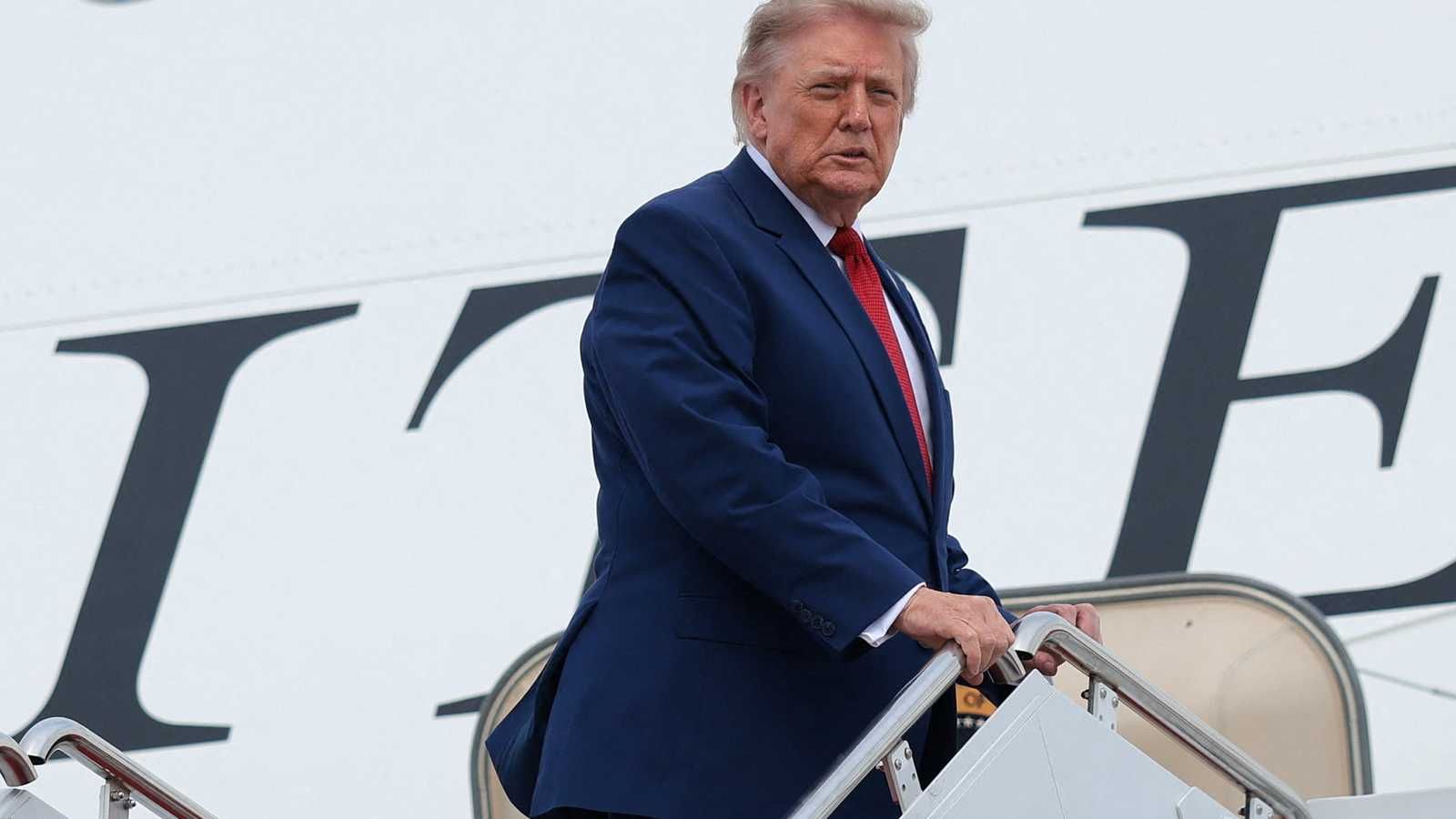
U.S. President Donald Trump looks on as he boards Air Force One, en route to Geneva, Ohio, at Joint Base Andrews, Maryland, U.S., August 11, 2026. REUTERS/Kylie Cooper
U.S. President Donald Trump looks on as he boards Air Force One, en route to Geneva, Ohio, at Joint Base Andrews, Maryland, U.S., August 11, 2026. REUTERS/Kylie Cooper
President Donald Trump is already desperately searching for someone else to blame if Republicans lose a significant number of seats in the 2026 midterms. However, the latest polling suggests voters are no more fond of him than they are of the GOP he leads.
CNN's Aaron Blake wrote on Monday that the president keeps trying to find a way to blame Congress for his policy failures, but the argument is "flat-out wrong."
When Trump appeared on Fox News with Trey Gowdy, Trump agreed that he would spend the rest of the election season promoting his policies and record.
“I’m going to go out, and I’m going to campaign like I did for myself,” he said.
His effort to blame Congress slipped a little with his next comment: “But some people like me more than they like the party. I mean, you can’t be insulted by it. There’s nothing you can do about it.”
It's reminiscent of Trump's claim in early August to Punchbowl News, “they're angry at Republicans, but they're not angry at me."
"But it’s also just wrong. Not only is there evidence that Trump is to blame for his party’s midterm woes, but it’s not true that there are a bunch of people who like Trump but not his party," said Blake.
Polls show something very different. It's Trump whose numbers are underwater far more than the GOP's. Last month, it showed that 52 percent viewed the GOP unfavorably. For Trump, that number is 66 percent unfavorable.
"Politicians these days are usually more popular than their parties and their broader congressional contingents because clear majorities generally dislike political parties. In fact, in CNN polling dating to 2006, at least 50 percent of Americans have disliked the GOP in 49 out of 67 polls," Blake explained.
He said there's very little reason to believe the problem is the broader GOP rather than Trump.
"When presidents’ approval ratings are as low as Trump’s (which is generally in the 30s), their party almost always suffers large losses in the midterms," Blake recalled of past races.
A July CNN poll found that 40 percent of voters said they intend to "send a message of opposition to Trump" with their November vote. Just 18 percent in that poll said they wanted to send a message of support. The last time numbers looked like this was in the 2006 election, with George W. Bush's low approval ratings that led to a GOP bloodbath up and down the ticket.
"If anything, congressional Republicans might be doing a little better than one might expect, given how bad Trump’s numbers are," said Blake, looking at the “generic ballot." That's where pollsters asked if you could vote for a Democrat or a Republican, which would you choose.
On Monday, new numbers were released showing that about 58 percent of 2024 Trump voters said they were “very confident” about their choice. That number is down from 74 percent in April 2025.
Blake closed by saying that, rightly or wrongly, the midterm elections end up being a referendum on the president. Trump's attempt to change the narrative can't be backed up by data.