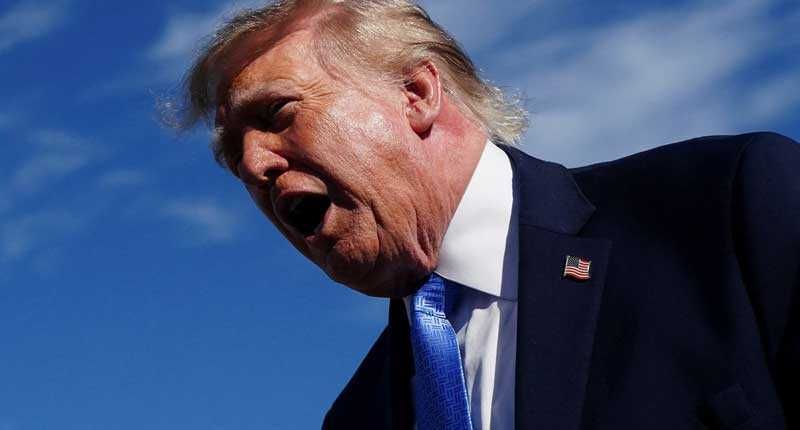
US President Donald Trump speaks to members of the media after exiting Air Force One at Chicago O’Hare International Airport, in Illinois, US, September 27, 2026.
President Donald Trump engaged in an extensive series of digital outbursts, utilizing Truth Social to launch a barrage of attacks against various media networks and public personalities. This escalation compounds an ongoing conflict between the administration and the press corps, which has seen previous attempts to revoke press credentials for major news organizations and the launch of a short-lived livestream network on the official White House YouTube channel.
The primary catalyst for Trump's latest online pushback was an Axios report detailing his administration's diplomatic posture toward Iran. Axios reporter Barak Ravid stated that Trump was open to granting Iran sanctions relief and unlocking frozen assets in exchange for concrete steps from Tehran regarding its nuclear program. The report cited anonymous U.S. officials and suggested a willingness to negotiate, following a tense week at the United Nations General Assembly where the president publicly weighed whether the U.S. should annihilate Iran. The Axios article arrived just three days after Trump had publicly rejected a peace proposal from Iran.
Trump flatly denied the report. In a late-night social media update, the president attacked Axios, calling the reporting a total fabrication and demanding that the publication immediately withdraw the story. He further claimed that the report was an outright hoax meant to satisfy what he described as "Trump Derangement Syndrome," writing that he offered Tehran nothing.
This denial was only one component of an all-day social media offensive, according to the Daily Beast. Prior to focusing on Axios, Trump targeted other mainstream media programs and personalities, posting separate rants criticizing MS NOW and late-night host Bill Maher. This multi-front media grievance coincides with systemic pushback against his administration's press policies. Trump previously attempted to ban journalists from CNN, MS NOW, and Politico from White House grounds, though a federal judge subsequently ordered the temporary restoration of those hard passes. Trump later floated ideas to dramatically alter the media presence at the White House, even suggesting transforming the James S. Brady Press Briefing Room into a swimming pool.
The tension between the executive branch and the press corps has prompted a unified response from major news organizations. In solidarity with the banned outlets, several major television networks—including NBC, ABC, CBS, and Fox News—suspended their White House pool duties, refusing to assign coverage crews to the president's standard press pool. Media commentators have noted that Trump's efforts to restrict critical coverage are largely backfiring. While he can regulate access to White House grounds, he cannot prevent journalists from covering him at international public forums like the United Nations. Furthermore, the network boycott has meant that his formal statements are increasingly ignored by major networks, a significant development for an administration historically fixated on television ratings.