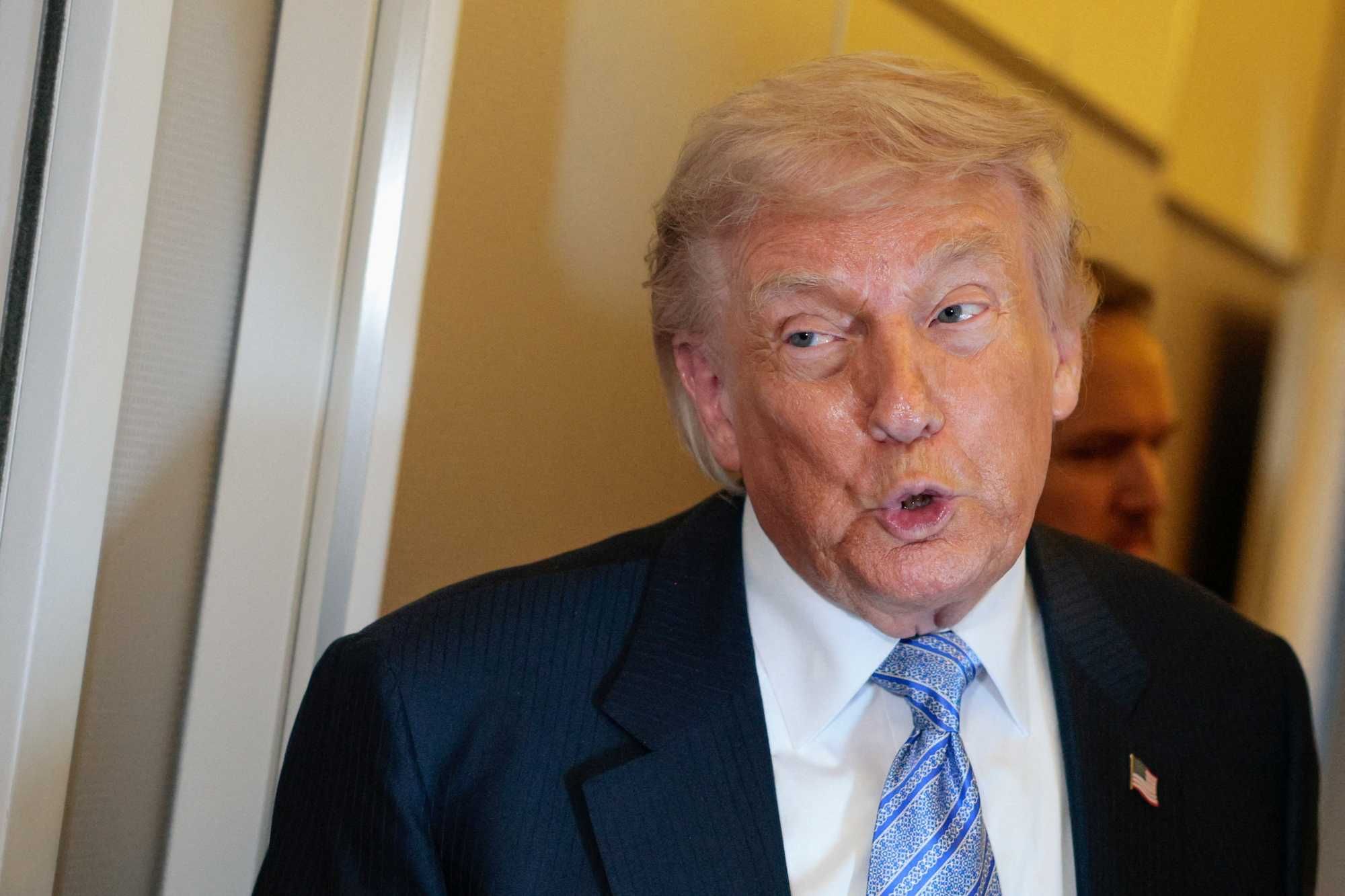
U.S. President Donald Trump speaks to the press aboard Air Force One enroute to the U.S. following his official visit with President Xi Jinping in China, May 15, 2026.
President Donald Trump and his administration are so corrupt, it overwhelms ordinary Americans while robbing them blind, at least according to one prominent economist. It goes beyond simply providing special treatment in his tariff policies to people who are close to him, or him earning $2 billion through businesses like cryptocurrency investments since beginning his second term. The problem is the totality of these behaviors, this economist argued — and ordinary Americans are noticing this.
"Donald Trump is robbing Americans blind, and even Republicans are starting to notice," wrote The Bulwark's Catherine Rampell on Friday. "You may recall that back in March, there were some suspiciously timed, uncannily lucrative oil and stock trades. About fifteen minutes before Trump abruptly announced he was retracting some threats against Iran, billions of dollars’ worth of contracts were placed on bets that oil prices would fall and the S&P 500 would jump. And those lucky bastards turned out to be right!"
Rampell proceeded to review cases of seeming insider trading, Trump trying to capitalize on Truth Social, his cryptocurrency ventures and the controversies over who donates to the White House ballroom. Then she pointed out polls reveal Americans are noticing this and upset by it.
"While the wording of those polls doesn’t specify who is engaging in perceived corruption, we now have other evidence that even Republicans believe their party leader is governing on behalf of his own pocketbook," Rampell wrote. "In new AP-NORC polling released this week, three-quarters of Americans said Trump has prioritized his personal financial interests and the interests of people close to him since taking office again in 2025."
She added, "A majority of Republicans agreed [55 percent]."
Rampell also wrote that in order to do these things, Trump and his supporters are literally redistributing wealth from the poor to the wealthy.
"Hiring has flatlined, real wages are falling, and food insecurity is rising," Rampell pointed out. "Polls show that Americans are increasingly anxious about their finances, especially when it comes to food costs."
She continued, "In fact, one in five Americans says they got food from a food bank or food pantry in the past year, according to new data from the Pew Research Center3: SNAP enrollment has declined for two interconnected reasons, both created by Republicans’ One Big Beautiful Bill. First, the law imposed tighter work requirements, creating massive new paperwork demands for both beneficiaries and states (which administer the program). Second, it incentivized states to err on the side of just purging people from the rolls whenever this swelling paperwork burden threatens to overwhelm them. (You can read more about how this works in an edition of Receipts from June.)"
Earlier in October, former President Bill Clinton's Labor Secretary Robert Reich elaborated on how Trump's seeming corruption hurts ordinary Americans.
"Trump’s tariffs offer another example of higher prices connected to corruption," Reich wrote. "The tariffs are import taxes that have increased annual household costs by an estimated $1,100, according to The Budget Lab at Yale."
He continued, "Again, though, the price increases tell only half the story. Trump’s tariffs have enabled Trump to give out tariff waivers and carve-outs to industries and companies that do him favors."
Similarly in August, former President Bill Clinton's Undersecretary of Commerce and top economic adviser Dr. Robert J. Shapiro claimed that Trump's deficit spending is effectively robbing future generations by putting the burden of paying off a massive national debt on their shoulders.
"[Former President George W.] Bush undid what Clinton did," Shapiro told AlterNet. "[Former President Barack] Obama undid only about a quarter of what Bush had done. And so the deficit, as a share of GDP, begins moving up.You can see it in the data — it's about 3.3 percent of GDP on average during the 2010s, through 2019, since I don't count recession years."
He continued, "Then you get [former President Joe] Biden. Biden doesn't undo any of what Trump did; he leaves it all in place. He runs very large deficits at first because of post-pandemic spending, to maintain demand. And he makes no effort to address certain underlying features — mainly the aging of the boomers, which is completed during the Biden years as the last cohort moves into retirement. So Medicare spending, in particular, goes up. He has some additional spending, but nothing of great magnitude. He essentially ignores the deficit.
Shapiro concluded, "Then Trump comes in and doubles down. What Biden had done would have led to a gradually shrinking deficit over the next ten years, because the economy is growing. What Trump does instead is say, 'No — we're going to have huge deficits as far as the eye can see,' meaning deficits equal to six or seven percent of GDP, which is unprecedented in the postwar era. It's a real outlier. And that's driven entirely by his tax changes, which carry enormous budgetary costs, plus a wholesale, large-scale increase in defense spending. So how much of this is Trump? A majority of it — not all of it, but a majority."