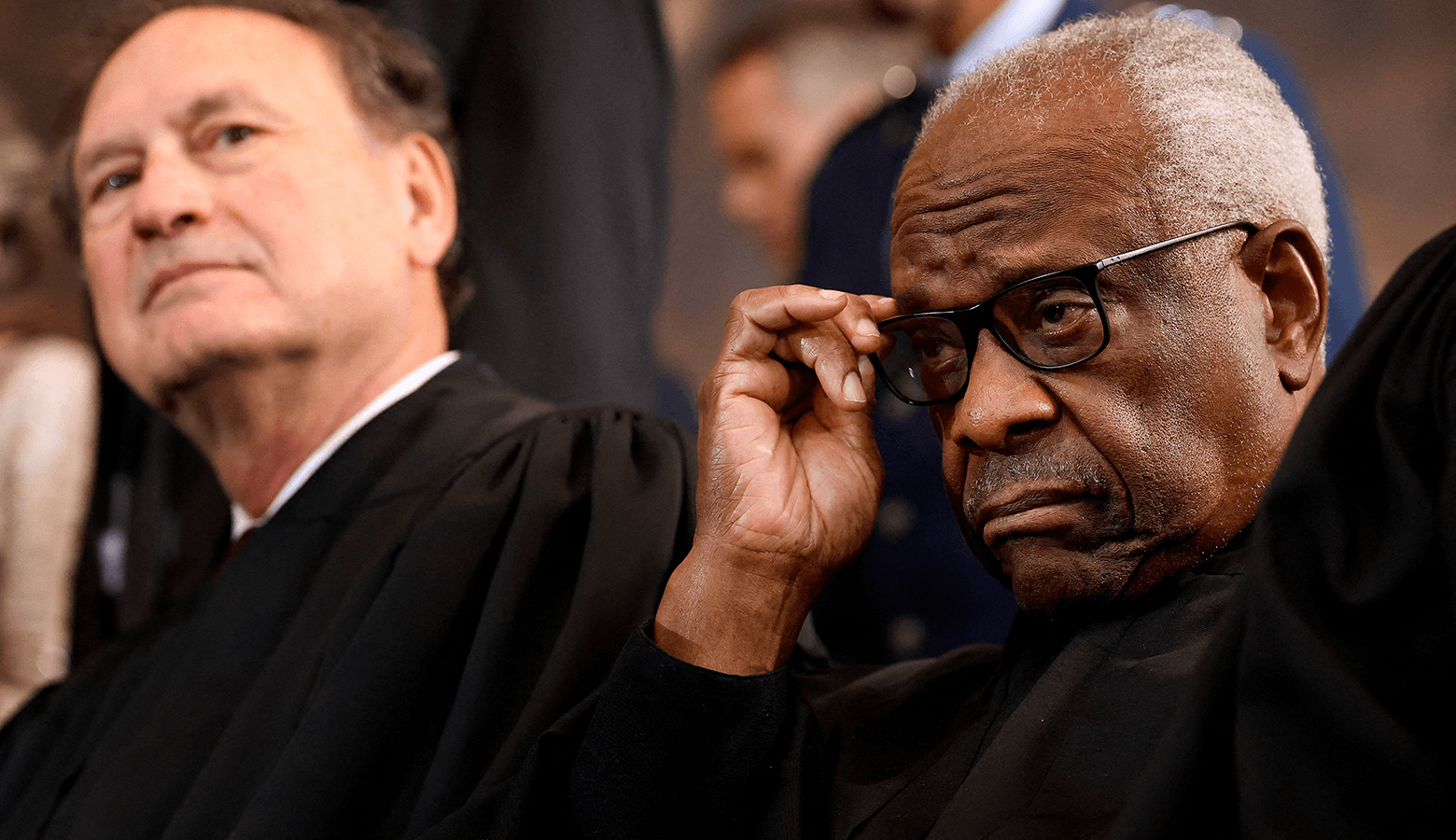
In late April, the Supreme Court handed down a decision that many say “eviscerated” the Voting Rights Act by allowing states to gerrymander voting district maps in any way they see fit, as long as the intention isn’t blatantly stated as discriminatory. With this, writes legal scholar Austin Sarat in the Guardian, “the Supreme Court’s takedown of American democracy is complete.”
According to Sarat, this “takedown” is part of a concerted effort on the part of conservative justices that has been underway for nearly 20 years.
“In 2010,” writes Sarat, “the court took a truly significant step in that direction when it handed down its ruling in Citizens United v Federal Election Commission. That case arose, as the Brennan Center for Justice notes, ‘when a conservative nonprofit organization challenged campaign finance rules that stopped it from promoting and airing a film criticizing then presidential candidate Hillary Clinton.’ The court used the case to deliver the death knell to almost all campaign finance restrictions.”
It did so by essentially declaring corporations “people” and their money “speech,” thereby allowing them to spend that speech as freely as they wanted to. “As the Brennan Center observes: ‘The justices who decided Citizens United held that independent spending could not pose a substantial risk of corruption … [and] that existing transparency rules would require all the new spending they were permitting to be fully transparent.’ Both assumptions, it adds, ‘have proven to be incorrect,’ with Super Pacs playing key roles in recent presidential campaigns and even leading voter outreach operations.”
Then in 2013, “the court took the next step in its campaign against democracy, declaring two key provisions of the Voting Rights Act unconstitutional… The result was a rash of new efforts to make voting burdensome for the very groups whose voting rights had been protected.”
Six years later, the court took things further by declaring “that states were free to engage in partisan gerrymandering and to draw legislative districts with the express purpose of giving electoral advantages to the party in power… The court, as the attorney Emmet Bonderant argues, disregarded ‘thirty years of [its own] precedent’ and reached a result that allows politicians to pick their voters and limits the ability of voters to pick those whom they prefer to represent them. It also allowed state legislatures to engage in racial gerrymandering if they claim it is motivated by partisan, not racial, considerations.”
This was taken even further with the court’s latest attack on the Voting Rights Act, as it “made it almost impossible for anyone to prove that race plays a role in redistricting decisions. The court found that the only way to do so is to provide convincing evidence that the legislatures intended to discriminate when they made those decisions — and it disregarded a clear congressional statement to the contrary.”
Here Sarat is referring to a 1982 congressional act that asserted “a plaintiff could establish a violation of the section if the evidence established that … [a] standard, practice, or procedure being challenged had the result of denying a racial or language minority an equal opportunity to participate in the political process.” In other words, if a party could reasonably prove disenfranchisement, they had a case. But now, in justice Samuel Alito’s words, minority groups are only projected from “intentional racial discrimination regarding voting,” which essentially means the discrimination must be expressly stated.
In discussing this unfolding of events, Sarat referenced the 1943 words of historian Henry Steele Commager: “The court, he said, had never been a friend to US democracy, and it never would be. For anyone committed to the advancement of majority rule, he added, judicial review ‘is wrong in theory and dangerous in practice.’” Because of this, Commager asserted that “the only reliable way to preserve and improve US democracy is to act democratically by winning at the ballot box and prevailing in the legislative process.”
Sarat concludes that “Commager would not have been surprised by what has unfolded since 2010, but he would have warned Americans against despair. He would want us to get busy trying to save what is left of our democracy by using our votes and our voices.”