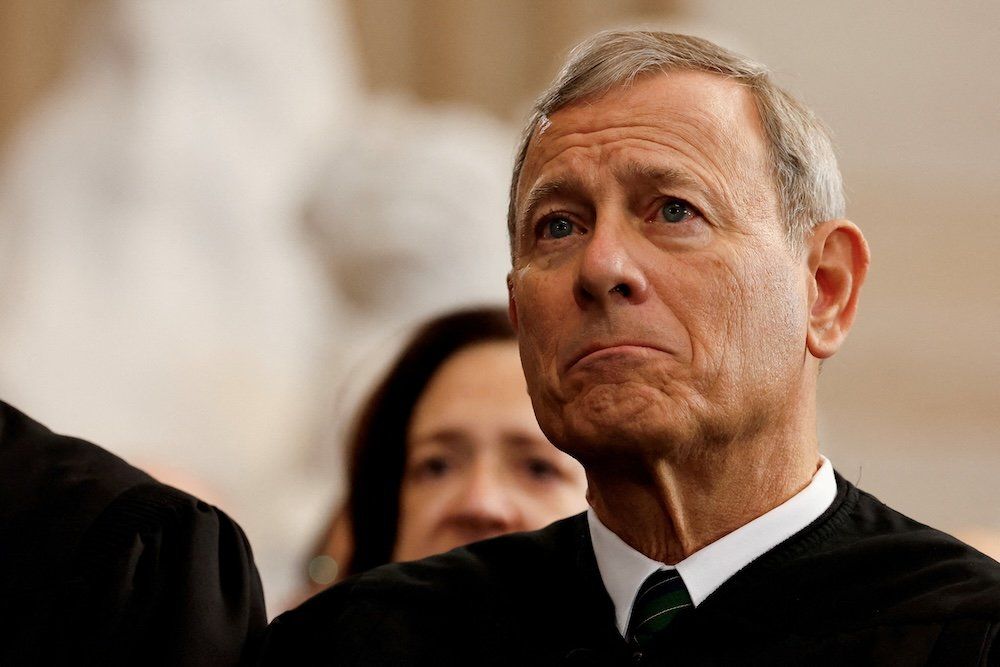
U.S. Supreme Court Chief Justice John Roberts U.S. Capitol on January 20, 2025 in Washington, DC. Donald Trump takes office for his second term as the 47th president of the United States. Chip Somodevilla/Pool via REUTERS
Last week, internal memos from an obscure 2016 Supreme Court decision were leaked by The New York Times, showing shocking revelations about Chief Justice John Roberts, who frequently plays a public role as a non-partisan justice, but behind the scenes, he's being exposed for his right-leaning slant.
In an analysis about it on Tuesday, Slate's Dahlia Lithwick and Mark Joseph Stern explained that this ruling is what began the "shadow docket."
AlterNet highlighted a piece by Georgetown University Law School Professor Steve Vladeck last week, calling out the legal flubs. Vladeck, who wrote the book on the "shadow docket," discussed the 2016 ruling, which had zero oversight and made significant changes to the U.S. legal system, all over a power grab in opposition to President Barack Obama's administration.
For years, conservatives have complained about the "shadow docket," calling it judicial secrecy and implying it was "bad motives to a benign emergency procedure that operates according to neutral legal principles," the Slate report said. The newly released memos "reveal exactly why the Republican-appointed justices don’t want to shine public or academic light on this practice: If this leak is any indication, the public would be aghast to see the brazenly political, spin-soaked flimflam that goes into deciding these critical cases."
When the high court stepped in to block the "Clean Power Plan" in 2016 with nothing more than a paragraph, while Justice Elena Kagan blasted it as "unprecedented." But it's the Supreme Court, so this set the new precedent, and what has followed is a decade of anti-green technology. Red states jumped in with a "Hail Mary" to stop the new EPA rules from going into effect and the conservatives on the court agreed.
"At the time, SCOTUS had never before frozen an executive branch policy while an appeals court was still reviewing it (and had already refused to grant a stay)," the legal analysts explained. That was what happened in this case. The D.C. Circuit Court hasn't even heard arguments over the case yet. Meanwhile, because the requirements didn't take effect until 2018, states had years to address them in court. Fossil fuel companies were given six years to prepare.
But the conservative justices still claimed there was a huge sense of urgency, and they needed to step in to stop everything from moving forward.
The leaked memos from Roberts and Justice Stephen Breyer, exchanged with their colleagues, show how they came to the conclusion that it was an "emergency" and that the shadow docket needed to step in.
"Perhaps most shockingly, this correspondence reveals that it was the chief justice who pressed hardest for a swift and sweeping decision, and that his reasoning had far more to do with presidential politics and personal grievance than any majestic legal logic," wrote Stern and Lithwick.
"More than anything, the new reporting puts the lie to the hollow claims of the chief justice sitting astride a mythical 3–3–3 court where his measured centrism guides the nation through partisan times. It is now manifestly clear that Roberts is himself a top partisan operator, especially under the cover of secrecy and internal norms of collegiality and confidentiality," they added.
While Vladeck detailed the legal mistakes in the ruling, Lithwick and Stern bashed Roberts for his catty snit, claiming that Obama shouldn't be able to "transform a substantial swath of the nation’s economy" without it being "tested by this Court before it is presented as a fait accompli. But it seems that the EPA is sufficiently confident of this rule’s immediate implications that not even the combined efforts of Congress and the President could reverse its effects.”
The Slate writers called Roberts' "glib" reaction particularly rich, given he has spent the past decade voting "to let the Trump administration implement a policy with immense, irreversible national consequences before his court has approved it on the merits."
The only way that they can read the comments from Roberts (and supported by Justice Samuel Alito) is that they were somehow offended, Lithwick and Stern said. "That the Obama administration, by way of comments, was somehow disrespecting the high court."
In Alito's memo, he claimed that the regulations would make a “nullity” of the court’s power and “institutional legitimacy," the piece said. Roberts went so far as to attack the EPA administrator, saying that if they didn't stop the rule immediately, then everything would be "functionally irreversible."
It wasn't a personal attack; it was an attack on the court as an institution. "Obama’s EPA was allegedly short-circuiting the court’s much-prized supremacy, and needed to be put in its place," the legal analysts explained.
The result has been the Supreme Court's "profoundly flawed analysis" of how to define an "emergency" so that they can "rubber-stamp policies and practices that seem dubiously meritorious, with adverse effects on millions of people waved away," the analysis closed.