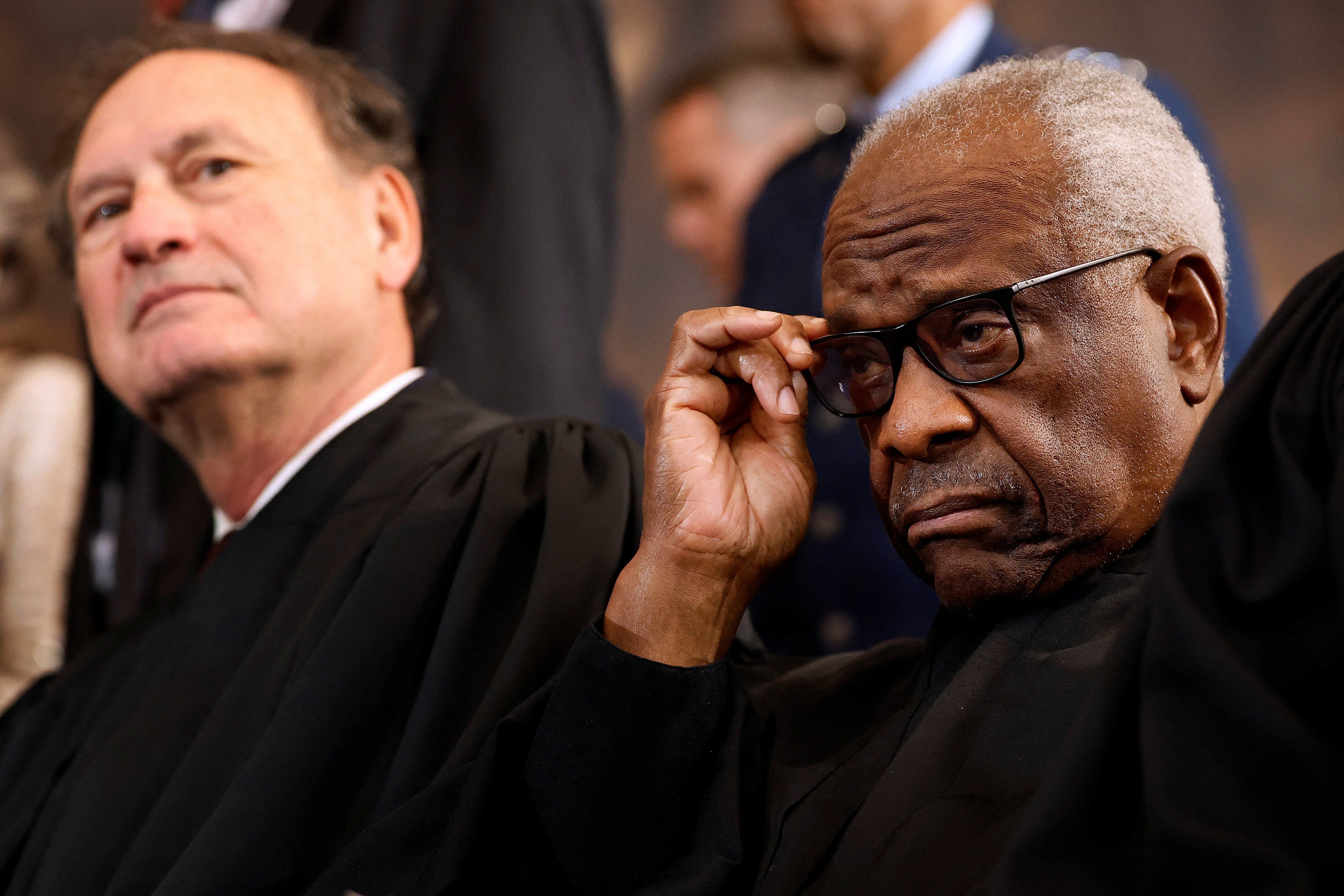
U.S. Supreme Court Associate Justices Samuel Alito (L) and Clarence Thomas wait for their opportunity to leave the stage at the conclusion of the inauguration ceremonies in the Rotunda of the U.S. Capitol on January 20, 2025 in Washington, DC.
The Supreme Court is currently hearing a case challenging state laws that allow mail-in ballots to be counted after election day, and it appears the conservative justices are sympathetic to suggestions that the practice should be illegal. This, according to New York Times columnist Jamelle Bouie, is a sign that these justices have “pickled their brains in MAGA slop.”
Questions surrounding mail-in ballots were first raised by President Donald Trump, who blamed them for his loss in 2020, even though, and Bouie points out, “he insisted that he didn’t lose the election." Now Republican justices on the court seem compelled by his argument that absentee ballots are “somehow suspicious in some way.”
This is despite the fact that studies have firmly proven that voter fraud is “basically nonexistent,” and that, ironically, in recent elections, it appears the GOP actually benefited from mail-in ballots, as these are often relied on by rural and older voters. As Bouie also notes, had mail-in ballots been banned in 2020, it still wouldn’t have impacted the outcome as the 6 key states Trump lost don’t have provisions for them in the first place.
“The extent to which Republican members of the Supreme Court seem to take serious claims of fraud when it comes to mail-in balloting is to me one of those signs that these people are as brain-curdled as any kind of Fox News grandpa,” says Bouie. “In fact, they are literally Fox News grandpas in the case of Alito and Thomas in particular. Their minds have pickled in MAGA slop as much as any pardoned January 6er.”
The ideas they’re supporting come “directly from the mind of Trump” and are circulated through conservative media, and have “no basis in fact.”
“They’re pure conservative conspiracism meant to sow distrust in elections,” says Bouie, “and the fact that Supreme Court justices are repeating them back during oral arguments is one of many troubling signs of the media environment in which these people operate.”
Bouie points out that while Trump thinks any ballots that come in late “change the result” of the election, they don’t — the election isn’t over until all the ballots are counted. The idea that an election process that takes more than a day is somehow new and wrong is completely ahistorical. It’s actually much more akin to early U.S. elections, when there was no election day; it was more like election month or “election season,” and results would trickle out gradually over time.
“If you’re looking at this from a historical basis,” says Bouie, “the level of flexibility we have in voting today, the amount of time we set aside to allow people to vote — that is much more in keeping with the American tradition of voting than this highly restrictive, very narrow idea that election day is the only day you get to vote, and if you can’t get to it, too bad.”
According to Bouie, justices should “start from the position that voting is a right that has to be protected, and that the court’s role is to ensure democratic participation — not to find ways to allow others to restrict it.”
While in the past the Supreme Court has enjoyed a fairly consistent level of public esteem, confidence in the Court has plunged since 2000, and in recent years has been at an all-time low.