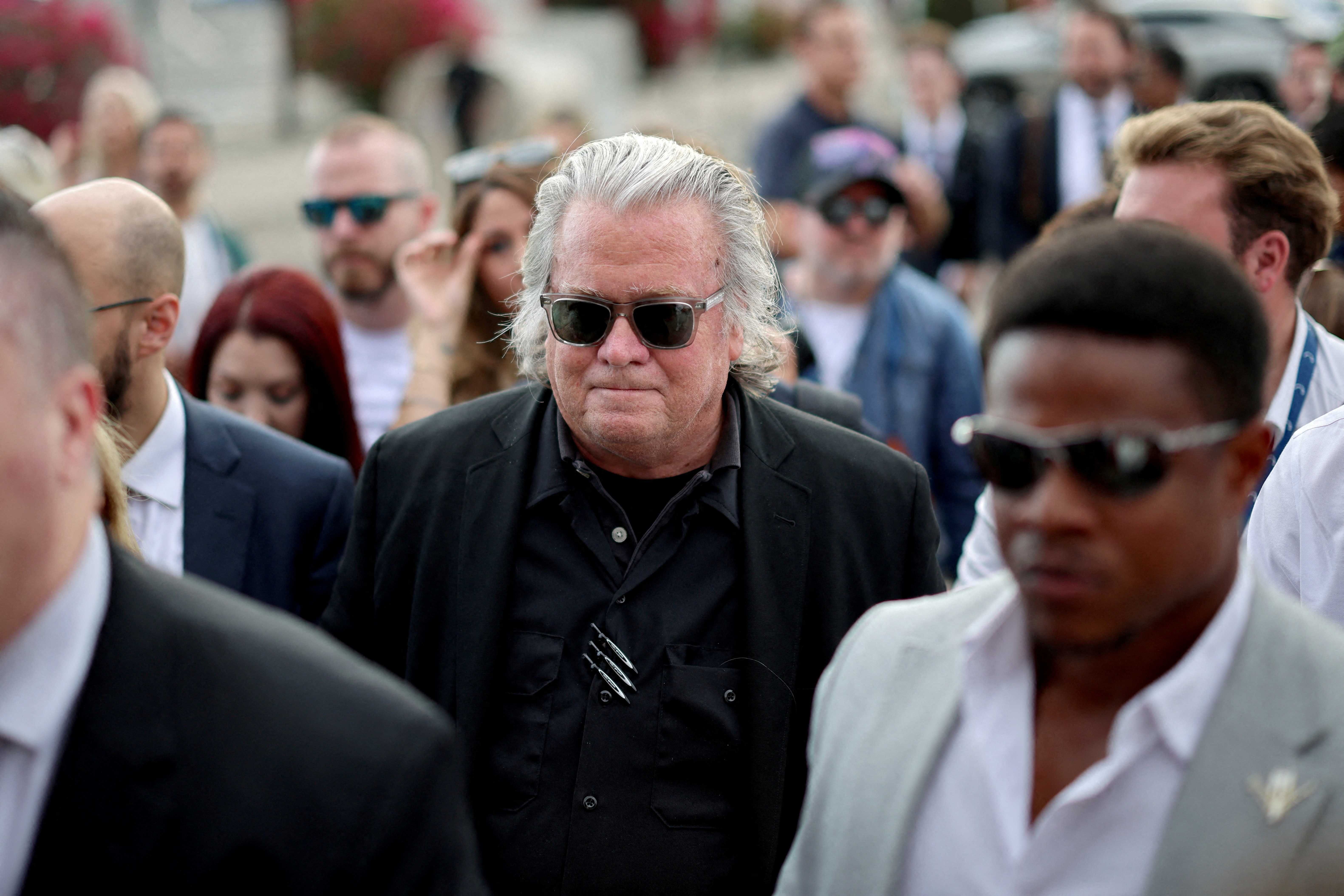
Steve Bannon arrives for a memorial service for slain conservative commentator Charlie Kirk at State Farm Stadium, in Glendale, Arizona, U.S., September 21, 2025. REUTERS/Carlos Barria
One of the rare experts on Donald Trump is far-right host Steve Bannon, and he knows exactly how to get the president to stop his reckless antics and return to navigating economic woes.
Speaking to The Atlantic's Ashley Parker, Bannon explained, “He’s driving deep. Remember, our strategy — I say it every day — is maximalist, a maximalist strategy. You have to take it however deep you can take it and, quite frankly, until you meet resistance. And we haven’t met any resistance.”
One year into Trump's second administration, “We haven’t met any resistance," Parker repeated.
"It is astonishing just how far Trump has pushed the country over the past year," without much response from lawmakers on the federal level, she said,
Parker listed off the growing number of actions Trump has taken that "in some cases, especially his base," would have been "outraged" over.
The growing list of actions that haven't inspired much response from the GOP-led Congress: "Already, many Americans have grown accustomed to bands of National Guard troops patrolling their cities; the United States bombing other countries without congressional approval (or even notification); white-nationalist rhetoric filling government social-media feeds; federal funding disappearing from elite universities that are viewed as too 'woke' and hostile to Trump’s movement; hundreds of thousands of immigrants being arrested and deported, often with extreme force; the once-independent Justice Department taking orders from the White House; conservative influencers masquerading as journalists; government data losing their reliability; museums quietly whitewashing history; and the White House being physically and symbolically demolished and rebuilt in Trump’s image."
Behind the scenes, leaders told Parker that they think Trump's election wasn't the standout, but that President Joe Biden's was. "Trump's reelection is not a fever dream but rather a reflection of the country at this moment."
State and world leaders, she pointed out, appear to be operating under the assumption that if they simply flatter Trump with attention and gifts, he might leave them alone. Those willing to stand up to Trump are quickly "labeled domestic terrorists, accused of left-wing 'street violence,' and threatened with 'the power of law enforcement.'"
As a "lame duck," Trump appears "impervious" to his sinking poll numbers, Parker wrote.
"It remains unclear just how far the president is willing to go, and what his endgame is," she cautioned.
While the first Trump term had the president backing off from unpopular policies when the public and lawmakers reacted collectively, this time, things are different.
"I have been struck by just how little meaningful resistance he’s faced, from citizens and even from lawmakers who claim to find his actions appalling or terrifying," said Parker.
She posited that Trump Derangement Syndrome has, instead, "been replaced by Trump Exhaustion Syndrome."
Bannon explained that the list of policies that Americans find objectionable is slowly shifting those ideas toward policy.
“You move it, and you do it, and no one complains — or MSNBC and The Atlantic complain and nobody gives a f— —and then you do it again, and push it again," said Bannon.
Parker closed by characterizing the U.S. as "settling" for Trump's behavior with "the illusory safety of the fetal crouch."