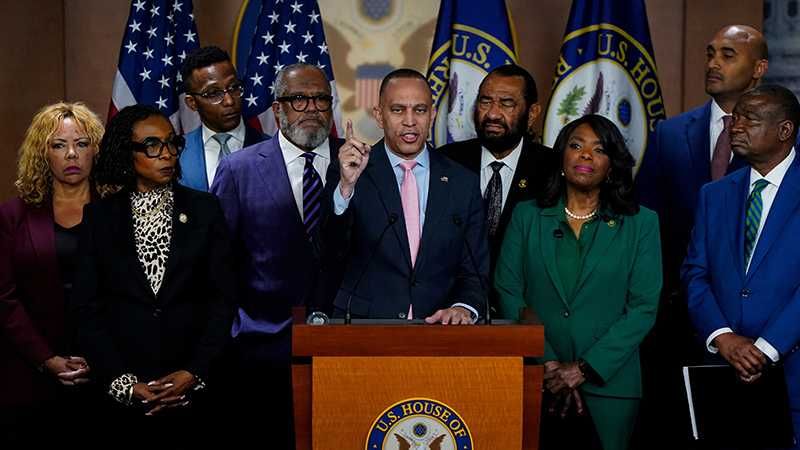
U.S. House Minority Leader Hakeem Jeffries (D-NY) speaks during a Congressional Black Caucus on Capitol Hill in Washington, D.C., U.S., April 29, 2026. REUTERS/Elizabeth Frantz
U.S. House Minority Leader Hakeem Jeffries (D-NY) speaks during a Congressional Black Caucus on Capitol Hill in Washington, D.C., U.S., April 29, 2026. REUTERS/Elizabeth Frantz
Donald Trump is openly tying his power grab to the 2026 midterms, in a desperate effort to stop investigations into corruption in his administration that are likely if Democrats win back the House and Senate.
The New Republic's Greg Sargent welcomed Mother Jones columnist Ari Berman on the morning podcast to discuss Trump's recent move, blurting out his midterm rigging strategy while Republicans cheered it on.
With his approval ratings in freefall and polls turning brutal, the president is openly pushing aggressive gerrymandering, voting crackdowns, and power grabs to lock in GOP control of Congress. Democrats and election watchdogs are sounding the alarm: this isn't just hardball politics, it's a blatant attempt to steal the 2026 midterms before voters can boot his party out.
Last week, the Virginia Supreme Court stepped in, saying that the constitutional amendment approved by the voters would be nullified because there wasn't a 90-day waiting period between the legislature passing the bill and the vote itself.
It comes amid Gov. Ron DeSantis (R-Fla.) "openly said that Florida’s prohibition on partisan and racial gerrymandering was unconstitutional," said Berman. "He basically is now daring the courts to strike down what is enshrined in Florida’s constitution. That is far more blatantly unconstitutional than whatever minor technical errors may have occurred in Virginia—and there’s obviously debate about whether there were even any technical errors that occurred in Virginia."
He mentioned Louisiana as well. The GOP-run state suspended its election after 42,000 people had already voted. But they wanted to pause the election so that they could quickly eliminate the majority-Black districts in the staet.
"So, the process has been completely different in all of these red states. They have not only not been approved by voters, but they have broken so many different norms in terms of how they’ve gone about this process," Berman said.
"I mean, look at the backdrop between Virginia and Tennessee this last week. In a matter of basically three days, Tennessee Republicans dismantled a majority-Black district that had existed for decades," Berman continued. "In fact, Memphis had had its own congressional district since 1923. So it had existed for basically 100 years. They split it into three—no opportunity for anyone to weigh in," he added.
The difference is that Virginia took months, giving voters a lot of opportunity to weigh in and, in the end, approved the redistricting survey.
"And to me, the vote by the voters in Virginia should have been the end of the discussion, right? The Supreme Court should have said, even if we have some minor qualms with the process, voters approved it and we are going to defer to the voters," said Berman.
Ultimately, he characterized it by agreeing to allow the GOP to do whatever it takes to rig the system. Whereas the Democratic Party "has a hand tied behind its back in the effort to try to counteract it. And I just don’t think that’s fair."
"Winning elections aren't enough if elections themselves aren’t fair," Berman closed. He wants to see the playing field leveled enough so that each side is playing by the same set of rules.