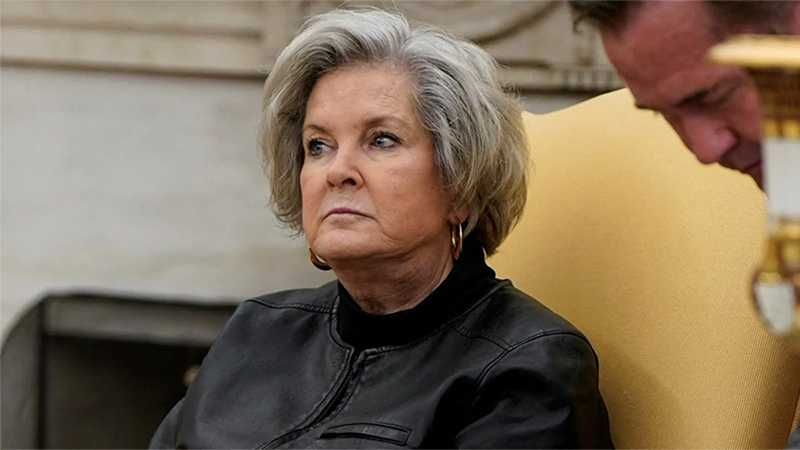
U.S. President Donald Trump's Chief of Staff Susie Wiles looks on, at the White House, in Washington, U.S. February 3, 2025.
Rather than talk about war, we argue over leaks of reports that show dissent. Instead of straight talk about divisions about the direction and values this country should take, we linger over the labels.
This Trump government would rather unearth leakers, mock or hector journalists and silence critics than deal with the substance of what amounts to questions about our national clarity and strategies.
Prime among examples this week were disclosures that top generals and admirals stationed around the world in our defense are calling out the ill effects of continued, extended commitments to a war with Iran that lacks focus or, apparently, achievable goals.
Reporting by The Washington Post disclosed that military leaders have advised War/Defense Secretary Pete Hegseth that prolonging large-scale operations against Iran is unsustainable and risks weakening their ability to confront threats elsewhere, including the U.S. itself.
Contents of an internal Pentagon document known as the Secretary of Defense Orders Book (SDOB) – a classified compilation – were made available anonymously. It outlines worldwide availability of U.S. weapons and personnel amid presidential priorities and includes frank insights from military leaders.
While it is not uncommon for military leaders on the line to offer statements called “non-concur” – criticism in any other language – the timing and breadth of these assessments seems unusually important as Donald Trump and Secretary Pete Hegseth talk of more extended deployments in the Middle East. “Non-concur” may mean disagreement, but that the brass is carrying out the orders anyway.
Of course, the disclosures drew immediate Hegseth statements of denial and inaccuracy, along with right-wing suggestions of “treason.”
What’s Embarrassing Here?
It’s no secret that the open-ended commitments to keep the Strait of Hormuz open are drawing warships and resources from other parts of the world. And it seems likely that military leaders tasked with protective operations in those parts of the world would raise their hand to remind their superiors that there are issues on the ground.
Among civilians and voters, one might think that these reflect reasoned and gamed strategic debates that are meant to consider all the negative possibilities before we commit our troops to an international fight.
But what comes through most clearly is that this administration will not brook dissent of any sort. It turns out that the tough talk at the White House and the testosterone-fueled lethality from Hegseth is so thin-skinned as to make them brittle under criticism – even if it comes in the form of fact-gathering.
That’s why we see Homeland Security refusing to acknowledge fissures over tactics of border patrol agents who refuse even to wear identifying clothing as they engage sometimes violently with migrants and civilians alike. It’s why Health Secretary Robert F. Kennedy Jr. can’t answer a straight question about vaccine hesitancy before Senate committees. We can’t even talk about who’s supposed to authorize a name change at the Kennedy Center for the Performing Arts without a public demolishment threat.
This week, Trump himself called on the Federal Communications Commission to “rebuke” or punish NBC “Meet the Press” host Kristen Welker for touching off some kind of Trump internal madness over saying that the president’s political endorsements have not proved universally successful in various primaries around the country. Who cares what Welker said, and what was wrong about it, anyway? We’ll see in November how the vaunted Trump popularity carries in an election based on voter anger.
Since the start of Trump 2.0, the Pentagon has thrown out reporters, sought to block or prosecute them, and supported inquiries into networks that broadcast material they find unsupportive of the war effort, of dismissal of generals or candidates disproportionately minority, of decisions that have allowed deterioration of weapons supplies. At the White House, Trump rails against those reporters, often women, who ask questions that he feels put him on the defensive.
The facts are that after a month of no military engagement, the U.S. and Iran are exchanging fire again, this time seemingly sparked by Iranian moves to lay more sea mines and a U.S. commitment to bottle up Iranian shipping. The facts are that despite announcement of a U.S. vow to sanction anyone doing business with Iran, it’s hard to see the literal results of that promise – even if that were to prove effective as a strategy with a resistant Iran. The president and the Pentagon already are extending deployments into the new year, stretching supply lines and prompting pushback from military families who want to know when the end will be.
Is the issue really whether logical, reasoned advice from some generals and admirals reflects what the rest of us are thinking?
Terry H. Schwadron retired as a senior editor at The New York Times, Deputy Managing Editor at The Los Angeles Times and leadership jobs at The Providence (RI) Journal-Bulletin. He was part of a Pulitzer Gold Medal team in Los Angeles, and his team part of several Pulitzers in New York.