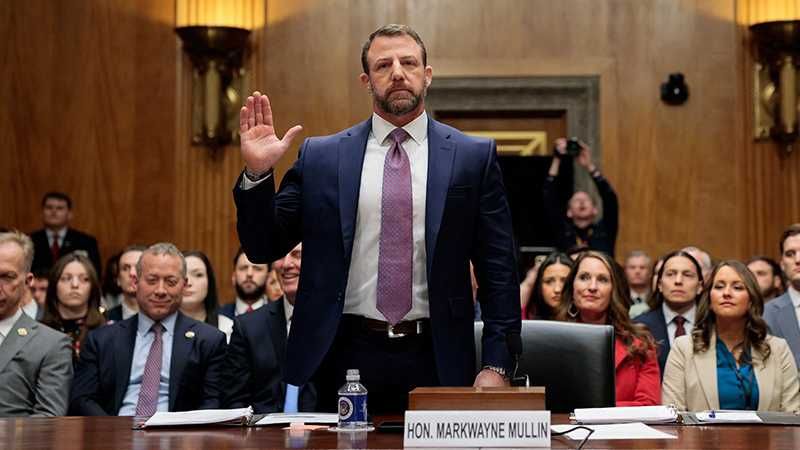
In a bombshell moment at the end of the confirmation hearing for Sen. Markwayne Mullin (R-Okla.), it appeared he was caught in some potential resume padding that Democratic Sen. Gary Peters (D-Mich.) said he wanted to find out about.
Appearing before the Senate Homeland Security and Governmental Affairs Committee, Mullin promoted work that he had done, claiming it was "classified" in conjunction with the Defense Department under a missionary program in Afghanistan.
"You stated your special assignments occurred intermittently between 2006 and 2011," Peters said. "My letter did not exclude official travel and it also give you explicit instructions for providing classified information, how we could do that, and do it in a way that protects the classified information. You did not provide any of that. Today is the first time I'm hearing about your classified activities from 2015 to 2016. Quite frankly, as we have these conversations, you have not been forthcoming with me and the committee."
"The story always seems to kind of change," Peters continued. "As you know, candor, honesty, transparency are absolutely critical to try to build trust as the secretary of Homeland Security. We have to clear this up. We feel pretty strongly we have to understand exactly what this is."
Peters then noted, "We've checked, and the SCIF is available," referring to a secure facility where officials can discuss and read classified information. "We would love to have you come into the SCIF and tell us exactly what you are talking about. That will put my colleagues' minds at peace. Would you be willing to tell us the classified activities you are talking about?" Peters asked.
Mullin refused.
"Sir, I think this committee made it clear with the paperwork they give me that I do not have to disclose my official travel. That was part of the documents," said Mullin. "It went over two or three times. I complied exactly with what the committee said. There is no area for mission work and mentorship that was a volunteer basis [that] I did on my own time. It was specific, over and over again, that you do not have to claim official travel."
In earlier comments, Mullin was asked about one of the trips to Afghanistan: "That was an official trip that is classified."
There appeared to be a discrepancy about what was missionary and what was "official."
"We want to know what this supposed classified work was. I have real questions about it. I asked the FBI yesterday and said, 'If someone had appeared in any classified document, any document, would that be in this report?' And they said, 'Yes.' And I said, 'I do not see anything for Sen. Mullin, why is that?' They said, 'Nothing showed up.' We queried the Department of State, the Department of Defense, and other intel folks. So, you are in no classified document the federal government has, according to the FBI. And yet you are telling us you did all this classified work."
"Sir, I didn't say 'all,'" Mullin argued. He claimed that he complied with everything the document said, insisting it was "official travel" and a "classified trip."
Paul chimed in, saying that he too asked the FBI about any "classified work" and the FBI told Paul Mullin would have a "separate folder."
"So, it's confusing to us because there may have been some papers that said your official trips were excluded," Paul said.
"I can cancel the vote tomorrow," Paul continued." I'm willing to have the vote, get this done and get it over with. Just to make clear — it does not sound like it is a secret you are too concerned about divulging."
"If you would spend one hour or 30 minutes and just tell the ranking member and the others, it would be private. It would get this over with," Paul suggested.
Mullin then said he had no problems as long as the senators could get "cleared."
"That would be on you. We're not going to try and figure out who the four people are and whether we can have access to it," Paul said as Mullin tried to speak over him. Paul ultimately concluded that it was something they should be able to discuss.
Mullin said he didn't have any authority to release the information. Mullin wouldn't even say who assigned him the program in the Senate because it too was classified.