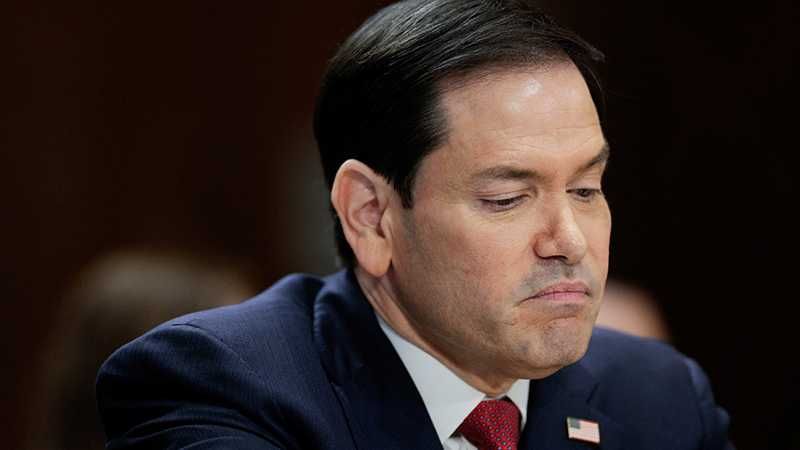
Secretary of State Marco Rubio faced off against lawmakers on the Senate Foreign Relations Committee as he begged for a hefty budget increase for his department in 2027.
While there were some questions about the ongoing battle to reinstate USAID and the boat strikes in the Caribbean, the larger focus was on the Iran war.
Sen. Tim Kaine (D-Va.) noted that when the administration began bombing alleged drug boats, "the administration presented a legal opinion from the DOJ that we [lawmakers] could review." That hasn't been the case for the Iran war.
The Justice Department's Office of Legal Counsel (OLC) issued a legal memo justifying President Donald Trump's unilateral decision to bomb Iran without congressional approval. Only Congress can constitutionally declare war. However, the OLC decided that it isn't a "war in the constitutional sense." It then immediately classified the memo and published it with heavy redactions.
Kaine is among those on the Senate Intelligence Committee, and he told Rubio that he hasn't seen the memo without redactions despite having the proper clearance level.
"You are here asking for a budget, and in the armed services committee, they are asking for $1.5 trillion, an increase of over 40 percent of last year's budget, but won't let us see the legal opinion," Kaine said. "Mr. Secretary, you know what kind of thinking we do. If you showed us the legal rationale for two wars and you won't show it to us for the third, is there something in the rationale they don't want us to see?"
He further asked whether there is a dissenting opinion saying that it isn't legal or if there were conditions about civilian strikes like schools and bridges.
"Are there factual assertions like the war will be over in two days or Iran will never close the Strait of Hormuz?" he continued. "By not sharing the legal opinionwith the Article I oversightbranch, you give us the opinionthat there is something in thereyou don't want us to see."
He asked whether Rubio would use his influence to get the administration to share the memo with lawmakers.
Rubio tried to dodge the question, raising his hands in a defensive posture and saying the State Department had nothing to do with the memo. He then tried to change the question that Kaine asked.
"So, I think what you're asking is why hasn't the Office of Legal Counsel provided it," Rubio said.
Kaine explained that it wasn't his question. His question was whether Rubio could "use his influence" as Secretary of State and the national security advisor to have the memo handed over to those in Congress with the proper classification.
Rubio dodged again. "Here's what I will do: I can certainly inquire as to why it has not been available. I'm not aware, in fact, my understanding is they have provided documentation to the committee," he said.
Kaine corrected him again, saying that the DOJ has never provided the OLC memo to the members.
"And you would not accept that," Kaine said to Rubio, who previously sat on the very committee he was speaking with.
The back-and-forth continued as the two talked over each other.