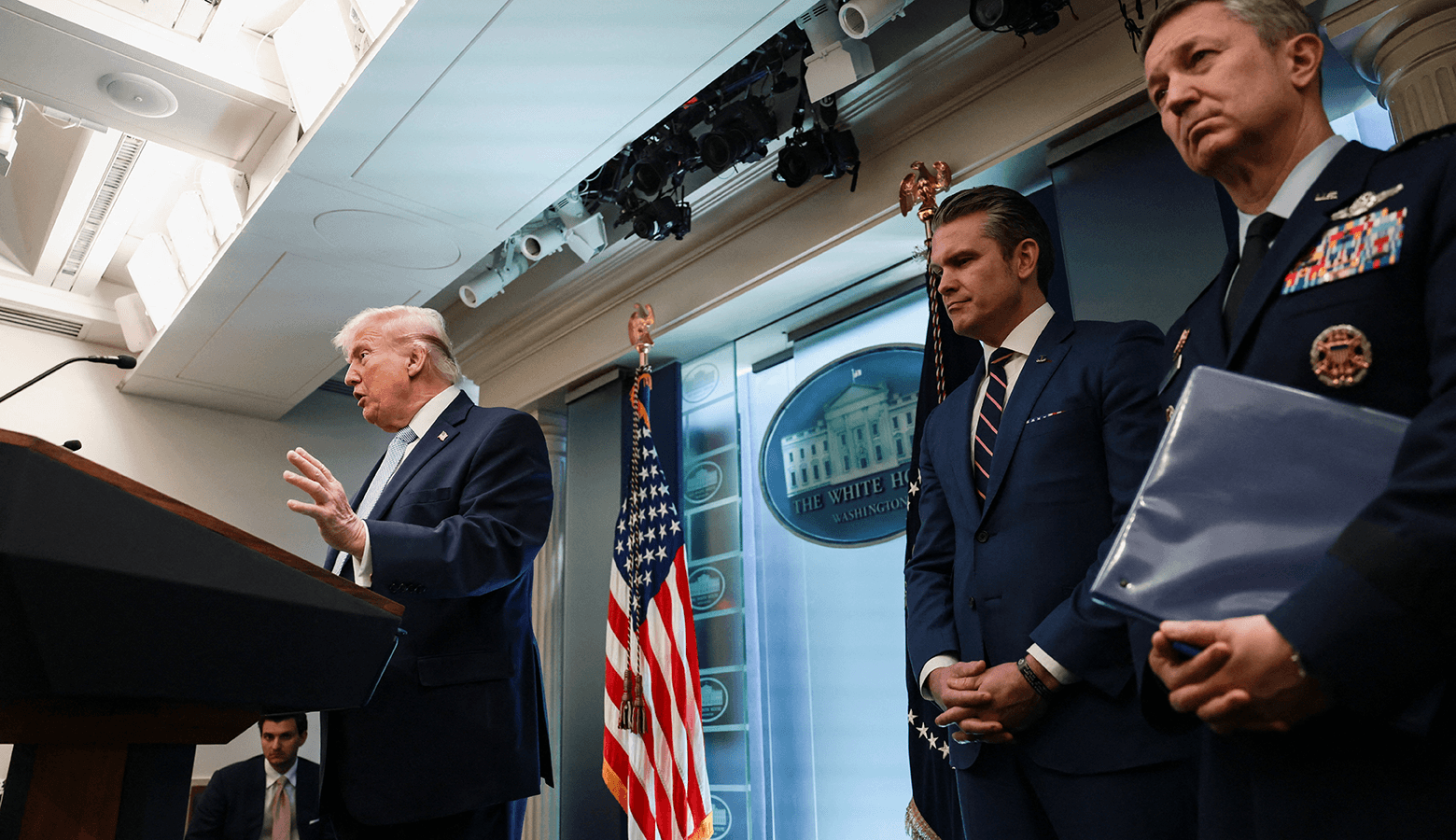
With President Donald Trump’s war against Iran suspended under a tenuous ceasefire, the world has a moment to take a breath and assess the conflict’s consequences and motivations. In regard to the latter, while the administration’s stated goals have been notoriously unclear, according to some experts, Defense Secretary Pete Hegseth is being driven by something that has nothing to do with regime change or nuclear weapons. Instead, Hegseth is propelled by a divine militancy.
His body covered with tattoos referencing the Crusades and white Christian nationalism, Hegseth has made religious proclamation a key aspect of his messaging over the course of the second Trump administration, particularly since the start of the war. Repeatedly invoking “God’s almighty providence” to express his confidence that God is fighting on America’s side, the Fox host-turned-Pentagon chief often rails about how much he hates the “stupid rules of engagement,” promising “no quarter” to the “barbaric savages,” then in the next breath suggests the U.S. will win “in the name of Jesus Christ.”
An adherent to a little-known, aggressively Calvinist branch of evangelical Christianity, for Hegseth, the violence of war isn’t just a fact of life, but is willed by God — particularly in relation to Hegseth's enemies.
“You could not get a better embodiment of that ideology, that particularly militaristic conception of Christianity and ends-justifies-the-means mentality that baptizes violence and cruelty in the name of righteousness,” says Calvin University history professor Kristin Kobes Du Mez. According to Kobes Du Mez, the self-proclaimed “Secretary of War” believes, “Any enemies of America — foreign or domestic — and any enemies of their particular agenda are also enemies of God. What we’re living through now is seeing what happens when this ideology becomes national policy.”
Hegseth has made no secret of his view that religion and policy are inseparable, injecting militant Christian rhetoric into most of his public appearances.
Months before the war, for example, Hegseth invited his personal pastor, Brooks Potteiger, to the Pentagon to deliver a sermon in which he suggested that one should rely on God to “issue the commands and do the aiming and the shooting."
“If our Lord is sovereign even over the sparrow’s fallings,” said Brooks, citing a Biblical passage, “you can be assured that he is sovereign over everything else that falls in this world, including Tomahawk and Minuteman missiles … Jesus has the final say over all of it.”
“They believe that nothing happens that isn’t in God’s will,” says Julie Ingersoll, professor of religious studies at the University of North Florida. “They believe that God directs everything that happens.”
Nine months later, an American Tomahawk missile struck an elementary school in Iran, killing as many as 175 people, mostly schoolgirls between ages 7-12. So if Hegseth and his associates believe that God directs everything, wondered the Guardian, does that include “a bomb falling on an elementary school full of children?”
“If God would order a genocide in Deuteronomy 20,” says Ingersoll, referencing a Bible passage in which God tells the Israelites to “destroy every living thing” in certain cities, “what makes you think he wouldn’t cause a girl’s school to be attacked?”