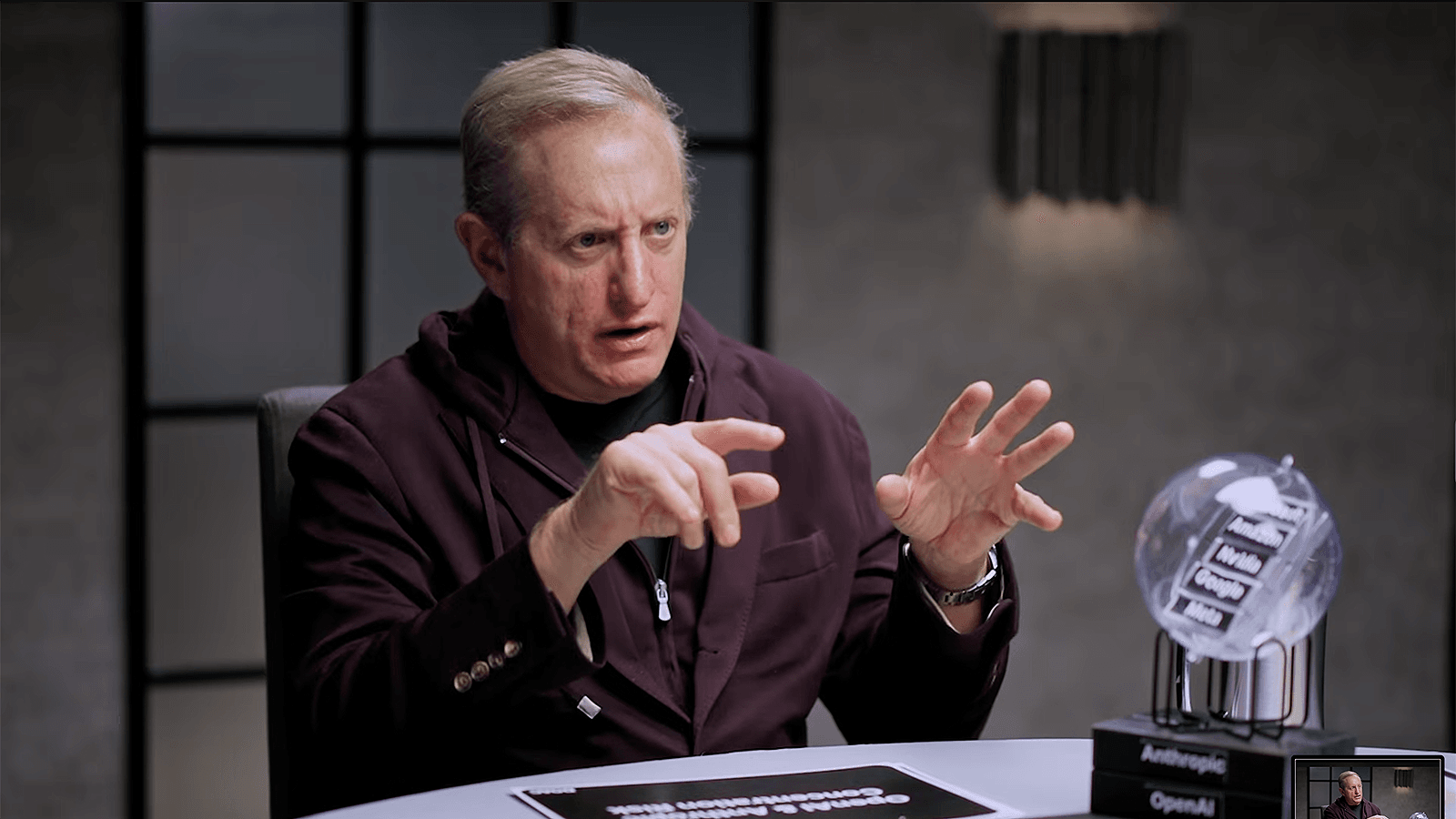
Investor Steve Eisman (Photo: Screen capture)
Legendary investor Steve Eisman, who is well known for predicting the 2008 subprime mortgage collapse, spoke with "The Diary of a CEO," hosted by Steven Bartlett, and is now predicting the next financial collapse.
In the subprime mortgage crisis, Eisman said that "Wall Street created an entire industry where they were all incentivized on volume, not on quality. So, they were going to originate loans until planet Earth literally burned, which is exactly what they did." Eisman said he made about $1 billion betting against it.
But he thinks the lessons from the dot-com bubble of the 1990s really apply to the artificial intelligence (AI) movement. He recalled a colleague who told him that "dynastic levels of wealth" would be made as a result of the internet. AI is doing the same thing.
"But what happened was there was overinvestment because it was a mania just like over here," he said, gesturing to the 1843 railroad mania. "And you know, most of the companies were very, very new. They had almost no revenue, and they cracked, and most of them went bankrupt. It was only the second generation of internet companies like Google that went public .... that went on to glory. And they were able to use all the infrastructure that was created during the dot-com bubble. They didn't have to spend the money on it because it had already been spent. There's something about that that's very similar to what's going on right now.'
The dot-com bubble didn't impact normal people. The consumer was fine; it was the investors and technology companies who took the hit. Bartlett said that the dot-com bubble seemed more like people were selling an idea, whereas he sees AI companies that are solely focused on AI as another matter.
He explained it as "token maxing." When AI first came out anyone could have a membership and use it however much they want. Then it became a matter of having tokens that were necessary to use the AI.
"Token maxing was basically you're a software engineer in some company and your CEO literally calls you on the phone and says, 'Dude, I want you to use AI all day and all night. I don't care what the costs are. Just use it, use it, use it, use it, use it,'" described Eisman. "So, of course, well, if your CEO tells you to use AI day and night, you're going to use it day and night. Well, what started to happen is that the costs went insane."
He noted Uber ran through its full AI budget in three months. So, some companies blew through $500 million by using AI before they fully realized it.
"So sometime this summer token maxing stopped and then the Chinese models have really come in to take market share. If you look at Anthropic's S1, which has just come out, it's the IPO prospectus. The numbers look great in the first quarter and second quarter," said Eisman. But the third quarter saw a slowing. "And I have my doubts about these two companies," Open AI and Anthropic. The reason, he said, is that "there are no motes" around it.
He brought up concentration risk, which is when a company is operating with only one customer; it's a high risk.
"So at the top of the food chain is Nvidia," said Eisman. "So Nvidia is the largest market cap company in the world and in the most recent quarter it grew revenue by over 100 percent. ... If you say the largest company on planet Earth grew revenue over 100%. I'd say that's unbelievable. So that tells you the power of what's happening. Whether it lasts is another story."
In Nvidia's case, 70 percent of its revenue comes from five customers, which he called "very concentrated." Many of those companies are the big ones like Google, Amazon and Microsoft, with a little bit for Oracle and Meta, and those companies all have diversified business models.
So, "70 percent of AI revenue that Microsoft, Amazon and Google are currently generating is just from these two guys," said Eisman. So, Anthropic and OpenAI are paying them.
"So, the entire chain in a way is dependent upon these two because these guys are ordering chips and equipment and stuff to build AI data centers because they have commitments that are largely from these two" companies, Eisman continued. "If either one of these two were to die, the entire chain would stop. We'd go into a recession immediately."
So a company that didn't exist two years ago has now over $800 billion in commitments to Microsoft and Google.
"And the crazy thing, I mean, we could talk about it, is the entire market is basically an AI trade right now," Eisman said. "And you know what else is so is the US economy. So, if this thing fails, if this whole AI story fails."
He cautioned that "we could have a situation where one of these two guys fails. Everybody stops ordering all the chips. We go into a recession. Eventually, we work our way out and then we grow at a better pace. That could happen. I think that's the more likely event."
Eisman said that he was thinking of betting on the outcome that there would be a burst bubble. What changed that is the 2026 midterm elections. Currently, the S&P is made up of 40 percent tech companies. Adding in communications companies like Google, Meta and Amazon, it's 50 percent. Then add in utilities like power companies that is 3 percent. Investment banks that are funding these operations, industrial companies that provide the power, that equals 65 percent of the S&P market that is linked to AI operations. The only sectors that aren't in AI are healthcare and consumer staples. It means the U.S. economy is closely tied to the big two companies, Open AI and Anthropic.