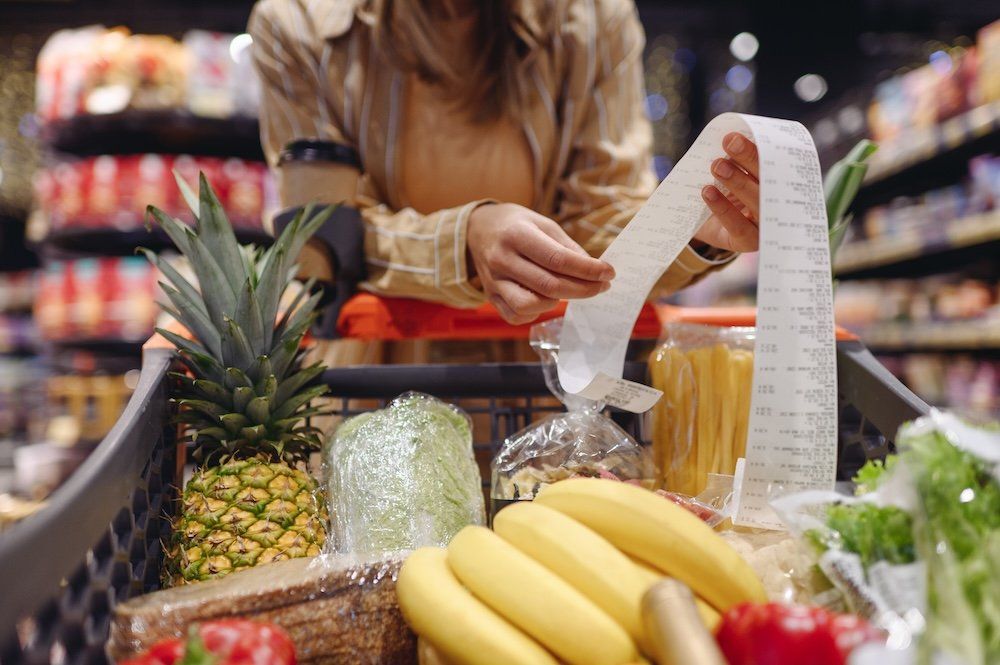
A woman grocery shopping Image: Shutterstock
There is a looming financial crisis that Washington politicians are not only ignoring, but they're also making it worse by ignoring it.
The New Republic's Grace Segers wrote Monday that food prices are continuing to rise as fuel prices drive up transportation costs. Wages, which continue to remain stagnant amid inflation, mean that many Americans are struggling to pay for everyday things like gas and groceries. So, they're turning to high-interest-rate credit cards or other forms of borrowing that put them in an even greater financial bind.
So-called payday loans or pay later loans give families an early boost, but at a high cost. On a credit card with a 25 percent interest rate, an individual pays $125 for $100 of groceries. Other pay-later lenders charge interest rates of 300 percent or more, even 600 percent in some states, explained one credit union.
The report recalled the high egg prices ahead of the 2024 election, in part due to the avian flu outbreak, but now high beef or bread prices have taken over.
“The war is just exacerbating all the angst around,” said Mark Zandi, the chief economist at Moody’s Analytics. “It’s a real problem financially, but also it’s being supercharged in the minds of people because people are really focused on the cost of food and groceries.”
Zandi explained that, unlike in 2024, with a few high-ticket items, the concern is that so many of the items are now higher-priced. “Almost everyone has a food item that they’re focused on [that] they buy regularly ... [and] use as a benchmark for the cost of living and their financial situation.”
At this point, even if President Donald Trump were to end the Iran war this week, the economic impact will be felt for the next several years. He asserted he's "already solved inflation."
“There’s no going back on energy costs, at least not in the next couple, three, four years,” Zandi said. “I think we’re all going to be paying a lot more for energy, and that will translate into higher costs for everything, obviously including groceries and food more broadly.”
Beyond the financial impact on the country as a whole, Segers frames it as part of a troubling trend and as a sign of deeper economic stress for most Americans, particularly lower-income families, who are more likely to use pay-later lenders.
The ultimate result is that rising costs for essential items put people on a kind of endless hamster wheel that they can't break. It's a problem that Congress could fix by investing in safety-net programs and expanding access to credit counseling. The problem is that Republicans made astronomical cuts to such programs in the so-called "Big, Beautiful Bill" passed in 2025.