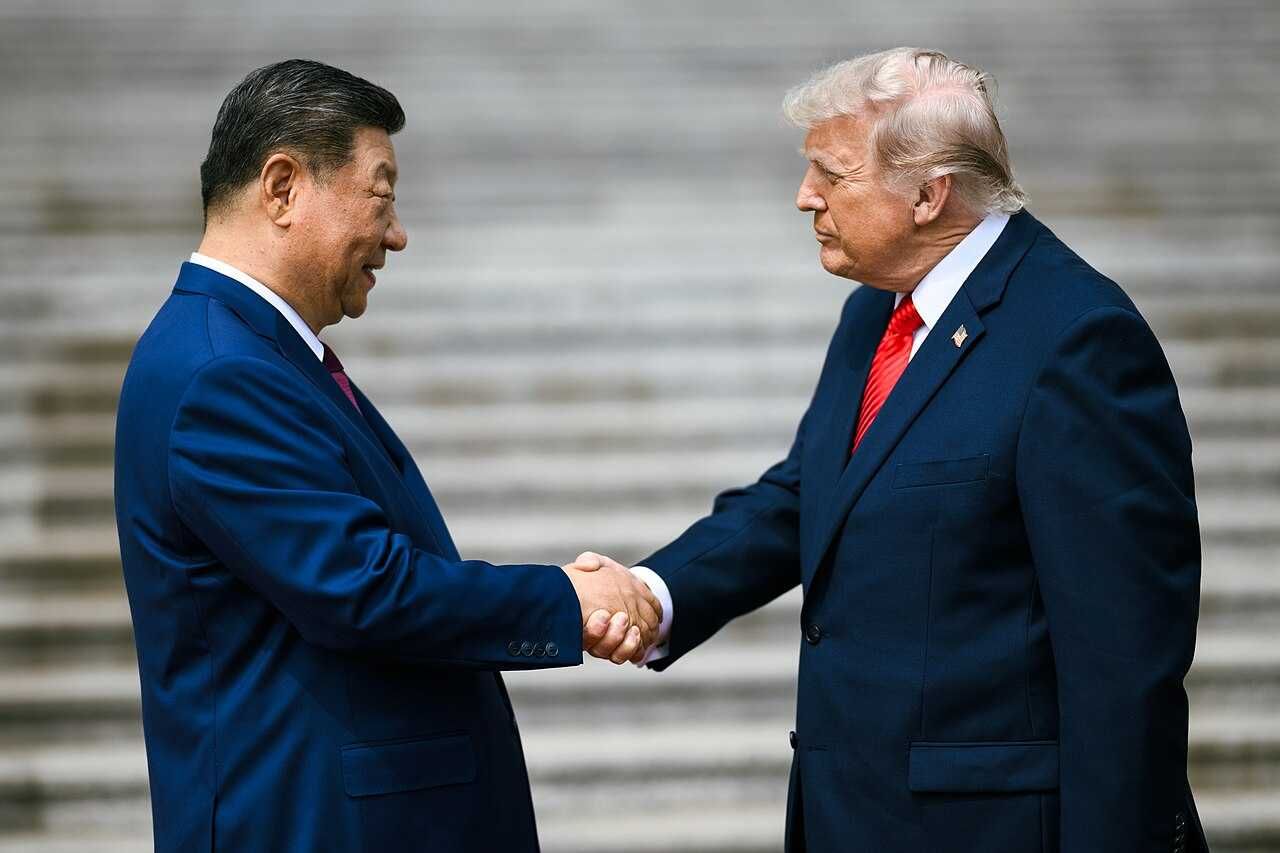
U.S. President Donald J. Trump with Chinese President Xi Jinping on May 14, 2026 in Beijing, China. (Official White House Photo by Daniel Torok/Flickr)
At a time of instability around the world — from U.S. President Donald Trump's war against Iran to the Russia/Ukraine war — geopolitics experts are worried that another major crisis will occur if Mainland China invades Taiwan. Conservative Washington Post columnist George Will examines that possibility in his Friday column, warning that the fallout would be enormous if such an invasion occurs.
"Deterrence employs military, diplomatic, economic, technological and political measures to prevent wars," Will explains in his Post column. "The number of times deterrence has failed approximately equals the number of wars history has seen. Deterrence failed to protect Ukraine against aggression, the consequences of which are slight compared with those that would follow a failure to deter Chinese President Xi Jinping from invading Taiwan, or attempting to coerce its surrender by measures (intended to be) just short of war. Xi has ordered his military to be able to seize Taiwan in 2027."
Will adds, "Deterring this involves influencing one person: Xi. But the myriad variables involved are staggering."
The Never Trump conservative makes his points by quoting geopolitics expert Eyck Freymann's 2026 book "Defending Taiwan: A Strategy to Prevent War with China."
Freymann, a Hoover Institution fellow at Stanford University in California, believes that an invasion of Taiwan by the People's Republic of China would not only be terrible for Taiwan, but for many other countries as well.
"He believes that U.S. abandonment of Taiwan 'isn’t an option,'" Will notes. "The 'disastrous, cascading consequences' of Taiwan's forced submission to Beijing would include the collapse of U.S. credibility, Beijing's domination of its Indo-Pacific neighbors, including their involvement in the global economy, and an incentive for Japan and South Korea to acquire nuclear weapons."
The conservative columnist adds, "Taiwan, a vibrant democracy of 23 million, is the world's most important supplier of the high-end chips that power economic modernity, including 90 percent of the most advanced chips powering artificial intelligence … Xi's constant 'gray zone' operations — economic, legal, cyber and sociocultural — include military violations of Taiwan's territorial waters and airspace. Xi might hope that these, perhaps supplemented by a quarantine (Beijing's control, justified as 'customs enforcement,' of Taiwan's international trade), will, Freymann writes, 'incrementally establish the norm that Taiwan no longer has full practical control over' its global economic interactions."
According to Freymann, deterring a Mainland China invasion of Taiwan means showing Xi that the United States could "decisively" defeat China in an "all-out air-naval war" near China.
"Freymann says — startlingly, without elaboration — that by seizing Taiwan, Xi could make himself 'untouchable by rivals in his old age,'" Will observes. "It is relevant, and unsettling, that Xi, who visits here next week, has thrived in such a high-risk, high-stakes, uncivilized political milieu."