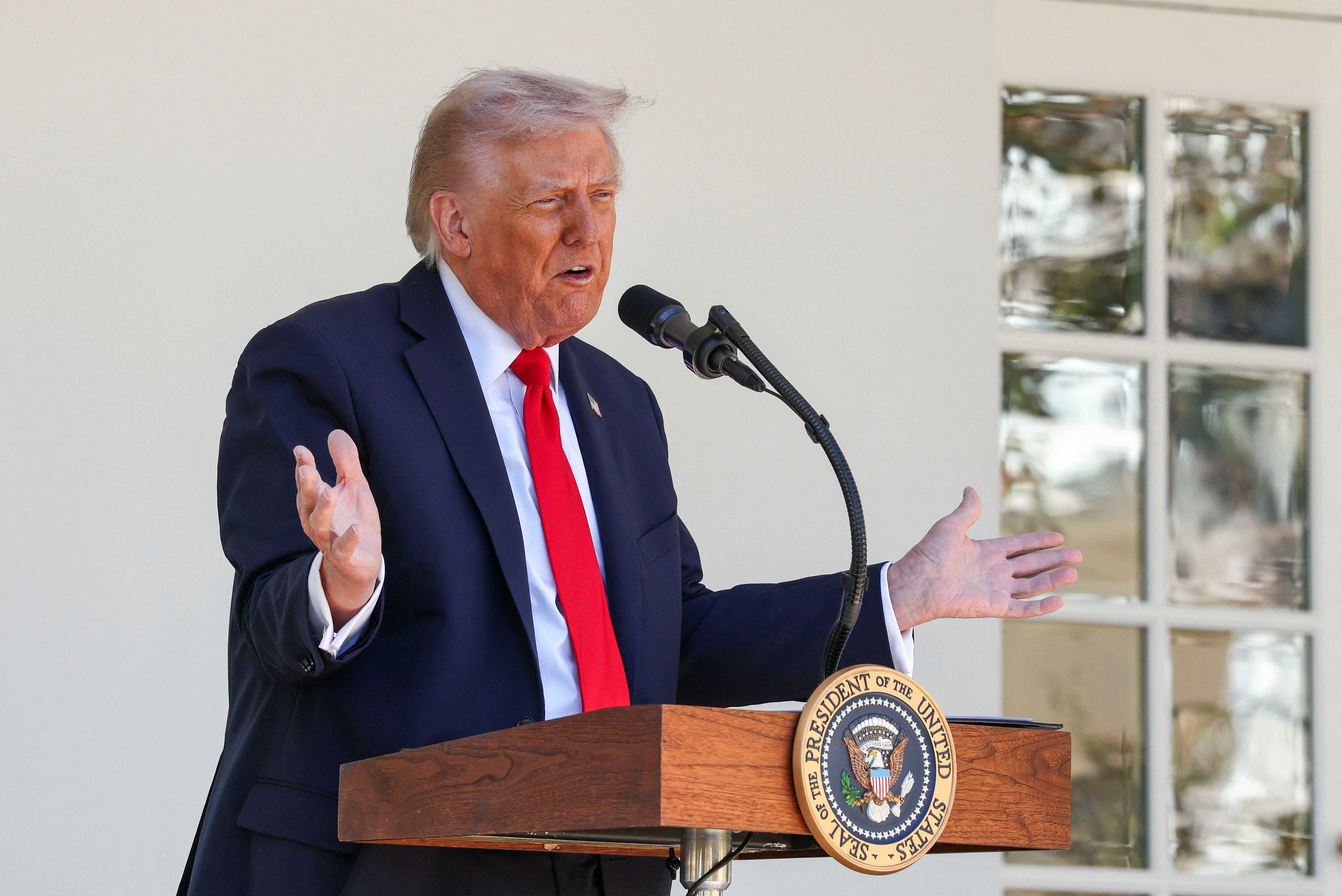
President Donald Trump hosts a Rose Garden Club lunch at the White House in Washington, D.C., October 21, 2025. REUTERS/Kevin Lamarque
President Donald Trump's reaction to losing to the 2026 midterm elections has been, for the most part, an uncharacteristic silence. According to a new report, that distinctly unusual quiet about recent political developments has even expanded to issues hurting Republicans post-election, such as the recent nationwide grounding of commercial flights.
"For a man who tells Americans that their country has now entered a new 'Golden Age', President Donald Trump did literally nothing this weekend to shore up rapidly sinking public confidence about the safety of air travel in the United States," reported The i Paper's Simon Marks on Sunday. "From the moment his government’s Federal Aviation Administration ordered only the third complete ground stop at all American airports in US history, paralysing the travel industry and causing untold disruption to millions of passengers, Trump absented himself from the public conversation."
Marks added, "On Friday night, as the crisis escalated, the usually garrulous U.S. leader made no effort to call any of the U.S. television news networks to calm the public and assure them he had the problem in hand. He did not call any of his favoured reporters to urge the nation to remain patient. He failed to use his Truth Social account to offer any words of sympathy to affected families, many of them stranded at airports where they were receiving only paltry and disjointed information."
From there, Marks went on to describe how Trump reacted to the crisis in lieu of the standard approaches involving sophisticated public relations.
"Instead, at 5:52 p.m. on Friday, right in the middle of the crisis, his social media account published an incongruous diatribe about the urgent need to 'MAKE OUR ENTERTAINMENT INDUSTRY GREAT AGAIN!' – an effort to entice the film industry back to the United States after it 'largely moved to Canada, the United Kingdom, Australia and other countries,'" Marks wrote. "Trump insisted 'the actors, producers and all others involved want to come back home!'"
Marks added, "That absolutely nobody was, at the time, able to come back home only served as the icing on the cake, but then irony has never been this president’s strong suit."
In general, Trump has been perceived as responding in a lackluster way to politics in general after his shocking setback on Election Day 2026.
"In the days since his defeat, he has sounded like a man in denial," The New York Times' Peter Baker reported earlier this month. "With his party still picking through the wreckage of a political earthquake, a seemingly oblivious President Trump signed a steel beam for his new White House ballroom and flew to Florida to give a speech on the space program. He seems flat these days, maybe a little dazed."
Throughout the months leading up to Election Day, Trump repeatedly intimated that he would nationalize or otherwise attempt to tamper with the results if they did not favor Republicans. Yet as one expert told AlterNet shortly after the election, the Democrats' victories were so widespread and overwhelming that the election became too big to rig.
"One of the things that I would point to as to why these worst-case scenarios didn’t materialize is that, unlike the 2020 election, which was a presidential election, in a midterm year each state is responsible not only for managing its election procedures, which it does in any election, but for choosing its representatives and senators and sending them to Congress," Beauregard Patterson, Election and Voting Rights Counsel, Democracy Defenders Fund, told AlterNet at the time. "And so one of the challenges here is that, in order to actually overturn this election, the Trump administration would have had to successfully overturn the results in several states simultaneously."
Patterson added, "And look at the past year and a half of litigation efforts to challenge election procedures and to federalize elections, particularly, if you’ll recall, the attempt to use USPS as a federal mechanism for whether ballots are rejected or accepted. Because of the failure of all those dozens of legal challenges and attempts at subversion by the Trump administration, they were left with few tools at this point to meaningfully try to take over and overturn the election results."