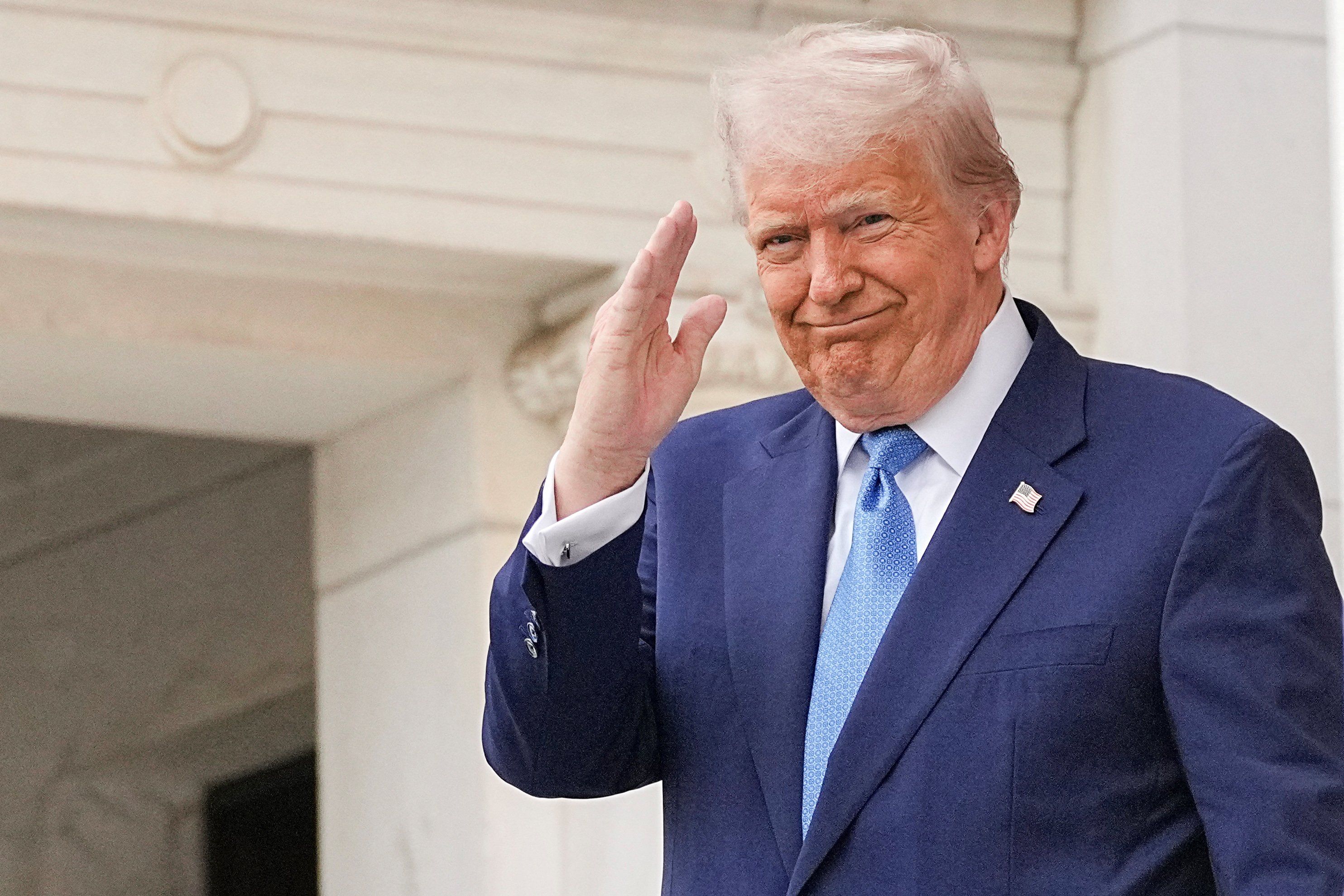
President Donald Trump salutes during the annual National Memorial Day Observance in the Memorial Amphitheater at Arlington National Cemetery in Arlington, Virginia, May 26, 2025. REUTERS/Ken Cedeno
President Donald Trump was reportedly surprised when Army Secretary Dan Driscoll tendered his resignation last week, but he should not have been. Under the reign of Defense Secretary Pete Hegseth, America's military has undergone a purge, with the man who never rose above the rank of major either firing or blocking promotions for more than 80 high-ranking officials. Many of those targeted were either women or African American, leading to allegations of discrimination, but a Republican columnist argued there is an even bigger problem — Hegseth also targets competence, and therefore is putting American lives at risk.
"To maintain the stalemate against Iran, the United States is drawing resources from other, more dangerous theaters of potential conflict," New York Times columnist David French wrote on Sunday in a column titled "Pete Hegseth Is a Wrecking Ball." "There are now no active carrier battle groups in the Pacific region, for example, exactly when China has ramped up its military activities around Taiwan."
He added, "The lack of interceptors is escalating the crisis in Ukraine. Russia is able to pound Kyiv and other Ukrainian cities with ballistic missiles virtually at will, creating a critical vulnerability for the Ukrainian war effort. Last week, for example, Kyiv endured the longest sustained bombing campaign on the Ukrainian capital since the opening days of the war."
After noting how The Economist reported Putin plans on escalating his attacks in Ukraine and on NATO, French went on to say that "as long as Iran — a longstanding ally of Russia that’s closely linked to its neighbor through the Caspian Sea — remains in the fight, it can continue to deplete our interceptors to the point where it might take years to bring our stocks back to acceptable levels, even if we ramp up production at immense cost."
Along with undermining America's ability to meet its global responsibilities, French continued that "the long-term threat is to the character and competence of the armed forces. They are becoming politicized, and the politicization of a military can both destroy its combat effectiveness and turn it into an instrument of domestic oppression. If you are under the delusion that Hegseth’s purges are about competence more than loyalty — a welcome corrective to the excesses of D.E.I. programs — well then, as we say in the South, bless your heart."
In August, NYU law professor Ryan Goodman calculated that Hegseth's removal of 25 senior military officers alone cost the military "over 900 years of military experience." Elaborating on this point, fellow NYU law professor Eric Schmitt wrote that "since January 2025, the Defense Department has removed, replaced, or forced the early retirement of a remarkable concentration of operationally experienced senior officers. Among them are the chairman of the Joint Chiefs, the chief of naval operations, the chief of staff of the Army, and the commander of U.S. Cyber Command, who concurrently serves as director of the National Security Agency.”
He concluded, “Most recently, Gen. Christopher Donahue, one of the most decorated and combat-experienced officers of his generation, has been forced out as commander of U.S. Army Europe and Africa and, in his NATO (North Atlantic Treaty Organization) role, as commander of Allied Land Command. Public explanations have been sparse and, to the extent they have been offered, largely general."
Speaking with AlterNet in April, Dr. Robert Shapiro, a former top economic adviser to President Bill Clinton, identified how Trump's war against Iran (which Hegseth encouraged) is also inflicting long-term damage to the United States in a different way — economically.
“Even if hostilities do not restart, the price of oil will not return to pre-Trump levels because there’s a new risk premium that they could restart at any time, increasing tanker insurance costs for example, and because oil infrastructure has been degraded, reducing supply for some time,” Shapiro told AlterNet at the time. “An Iran-controlled toll to use the Strait will produce big bucks for Iran, but its impact on world prices for oil, natural gas, helium, etc. should be minimal. Another source of economic friction will be the now-intense uncertainty about what the Trump administration will do next—in the Mideast and in scores of policies at home; and uncertainty dampens investment.”
He went on to say, “As it is, the economy was weakening before this crisis began, and these and other factors will exacerbate those downward pressures. A resolution over the next two weeks will not stop the deterioration in economic conditions.”