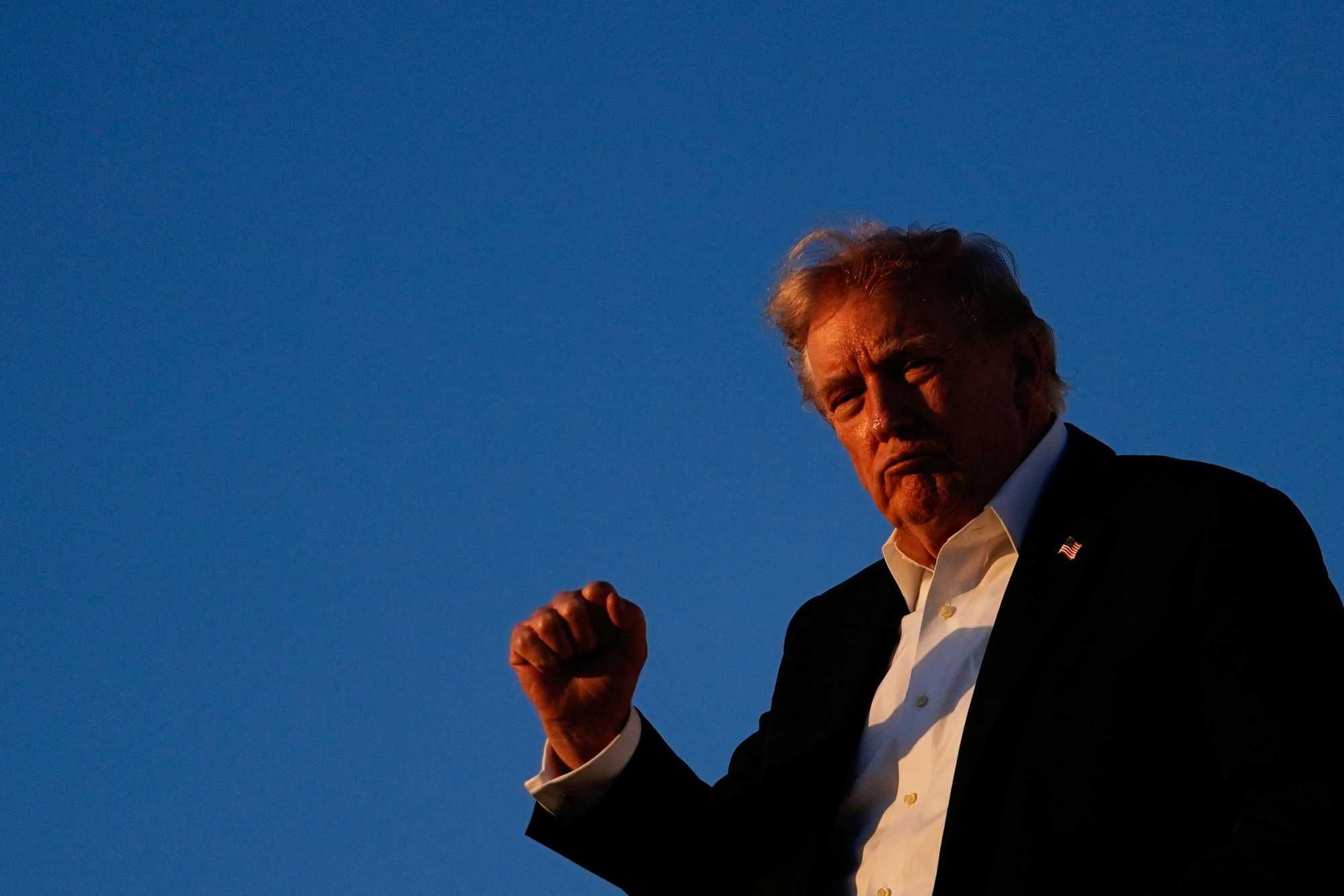
President Donald Trump at Joint Base Andrews, May 3, 2026. REUTERS/Nathan Howard
President Donald Trump has, at best, a "fuzzy" respect and understanding of international borders, two experts warned in a new piece from the New York Times, and the results of that are dragging the world into a new world order that looks a lot like the old one, and it is one that will be paid for "in blood."
Stephen E. Hanson and Jeffrey S. Kopstein are political science professors at William and Mary College and the University of California Irvine, respectively, and together, they also co-wrote the book, "The Assault on the State: How the Global Attack on Modern Government Endangers Our Future." On Wednesday morning, they published an op-ed for the Times highlighting a recent comment from Trump and the vast implications it speaks to.
When pressed about whether or not the map of Iran would look the same after his war came to an end, Trump said, “That I can’t tell you. Probably not.”
"In an administration that frequently confuses swagger with strategy, this remark was nonetheless extraordinary," Hanson and Kopstein wrote. "Iran is one of the largest countries in the world. Redrawing its borders might unleash political, ethnic and religious conflict that could destabilize the entire region. This is only one example of a much larger pattern: Mr. Trump’s notion of international borders is, in a word, fuzzy."
This sort of disregard for borders and the global system they underpin can also be seen in Trump's blatantly imperialistic desire to annex countries as territories for the U.S. As Hanson and Kopstein highlighted, since returning to office, Trump has threatened to "take back" the Panama Canal, insisted that the U.S. should control Greenland and nearly obliterated relations with Canada after repeatedly insisting that it should become the 51st state.
"Where is all this going? The president has embraced an openly imperial approach to foreign policy, one that regards treaties as provisional, allies as obstacles and military power as a personal instrument of rule," the pair continued. "While commentators have noted the 'neo-royalist' cast of Mr. Trump’s worldview, his patrimonial understanding of geopolitics threatens something even more basic: the clearly defined international boundaries that are the very foundation of state sovereignty in the modern world. For someone who talks endlessly about borders, Mr. Trump has a porous idea of what they are. The result of this thinking will be a world of fuzzy borders, leading to a cacophony of territorial claims by rival states across the globe."
Borders, they explained, can "feel natural, even inevitable" to a modern person, but that kind of "stability is a historical anomaly," a shift from prior to the 20th Century, when they were "vague, shifting and endlessly contested." "Fuzzy border" and territorial disputes were at the heart of both World Wars, and in their bloody wakes, the world has put in considerable work to keep them steady, well-defined and respected. Now, Trump threatens to undo a lot of that progress.
"A system of fuzzy borders, in which powerful states treat territory as negotiable and sovereignty as conditional, is not a viable alternative to the liberal world order," Hanson and Kopstein concluded. "It would mean the re-emergence of a much older political logic in which power, not law, determines the boundaries of political community. The great powers of the 21st century — the United States, China and Russia — may each be tempted by this patrimonial vision of international affairs. But the price of returning to that world would not be paid in prestige or rhetoric, but in blood."