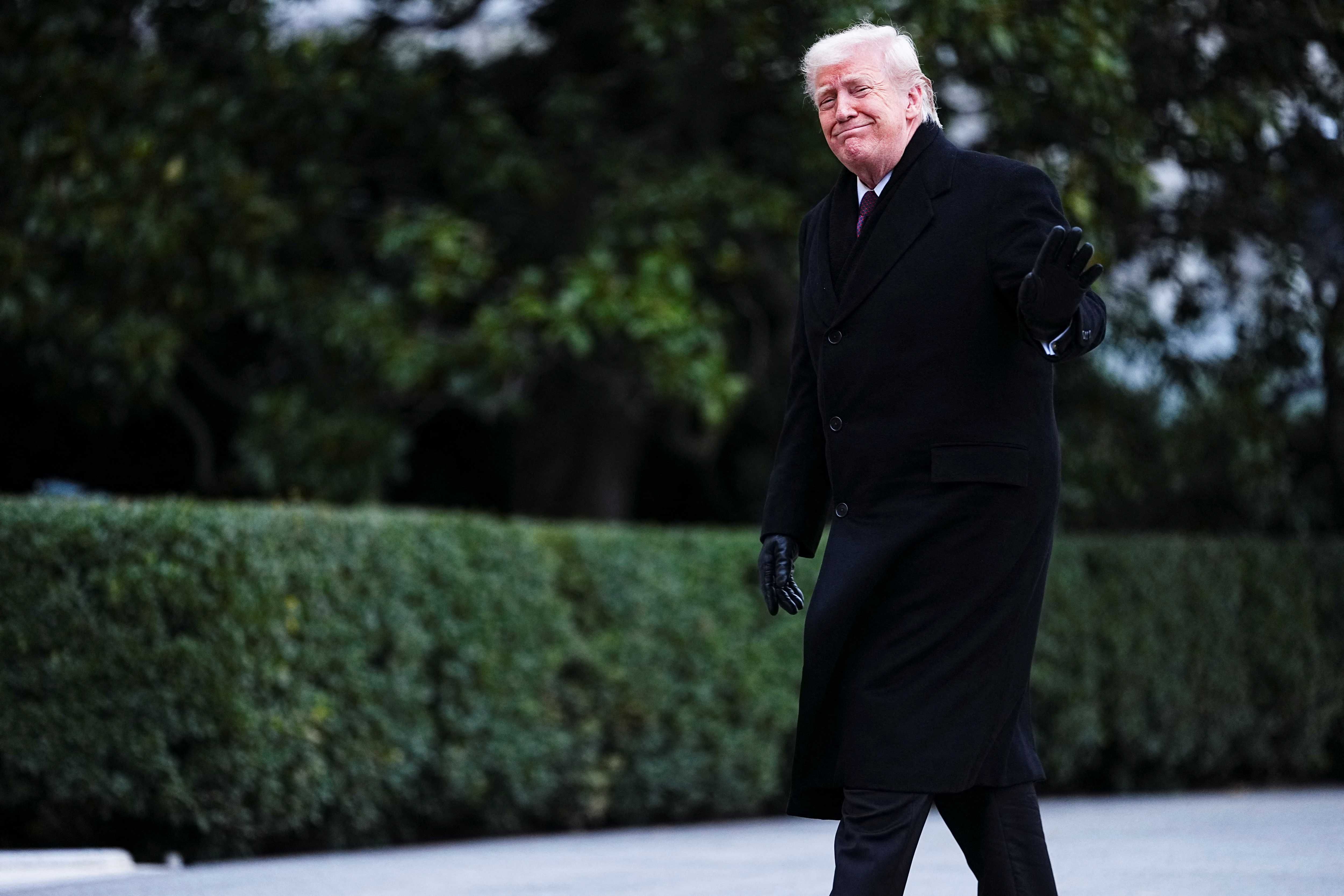
U.S. President Donald Trump waves as he returns to the White House from Dover Air Force Base, in Washington, D.C., December 17, 2025. REUTERS/Aaron Schwartz
U.S. President Donald Trump waves as he returns to the White House from Dover Air Force Base, in Washington, D.C., December 17, 2025. REUTERS/Aaron Schwartz
When U.S. President Donald Trump is drawing criticism for one of his policies, his response is typically to double down.
Trump's response to accusations of "gunboat diplomacy" is to praise the capture of Venezuelan President Nicolás Maduro as a foreign policy triumph and reiterate his push for the United States to annex Greenland. And his response to the outcry that followed the fatal shooting of unarmed 37-year-old Minneapolis motorist Renee Nicole Good by a U.S. Immigration and Customs Enforcement (ICE) agent is to send even more ICE agents to Minnesota's largest city.
In an article published on Monday night, January 12, The Atlantic's Jonathan Lemire (formerly of the Associated Press and Politico) looks back on the previous week — which, he stresses, showed Trump becoming even more intense in 2026.
"Even for Trump, it's been quite the week," Lemire writes. "But this is more than just a series of dizzying news cycles. The White House, after months of struggle, believes that it has found its footing again. Trump, though never restrained, is now pure id, acting on impulse and goaded on by advisers who see an opportunity to further expand executive power."
Lemire adds, "His poll numbers are still low, and the aura of invincibility that he held for the first half of last year is gone. The MAGA base has been fractured, and some Republicans have objected to his plans, while many more quietly worry that the president is ignoring the economic issues that will likely decide this year's midterm elections. But Trump simply doesn't care."
Trump's pattern during a "dizzying" week, according to Lemire, was to double down.
"Back home, an ICE agent in Minneapolis fired three bullets into the car of a 37-year-old mother who had been protesting deportation operations," Lemire observes. "Trump, instead of calling for national unity at a time of tragedy, blamed the victim, and his administration sent more armed officers to the city. And his retribution campaign — faltering to this point, to be sure — targeted the chairman of the Federal Reserve, who is now the subject of a Justice Department investigation."
Lemire continues, "The normally soft-spoken Jerome Powell called it payback for a disagreement on interest rates and warned that Trump had jeopardized the Fed's independence, perceived by many as the bedrock of American financial stability. Oh, and for good measure, the White House launched a website on January 6 that thoroughly twisted the facts of the 2021 insurrection, as Trump, once more, suggested that U.S. elections, including the upcoming midterms, could be rigged."
But some Republicans, according to Lemire, fear that the "sugar high" he's getting from "outrageous statements and acts" won't help their party in the 2026 midterms.
"Sen. Thom Tillis of North Carolina, in a floor speech last week, said that he was 'sick of stupid' and urged Trump to focus on his domestic legacy," Lemire observes. "Indeed, Republican lawmakers have sent word to the White House that affordability, not military interventionism, remains top of mind for their constituents, and that voters don't much care about what's going in distant lands such as Venezuela and Iran — and can find Greenland on the map only because it's drawn disproportionately large."
Read Jonathan Lemire's full article for The Atlantic at this link (subscription required).